Minimum Wage hike: These 5 US states to raise pay in 2027 by up to 60%, with rates hitting $17.73 an hour
Workers in five US states are set to receive higher minimum wages from 1 January 2027, further widening the gap between state-level pay floors and the federal minimum wage of $7.25 an hour.
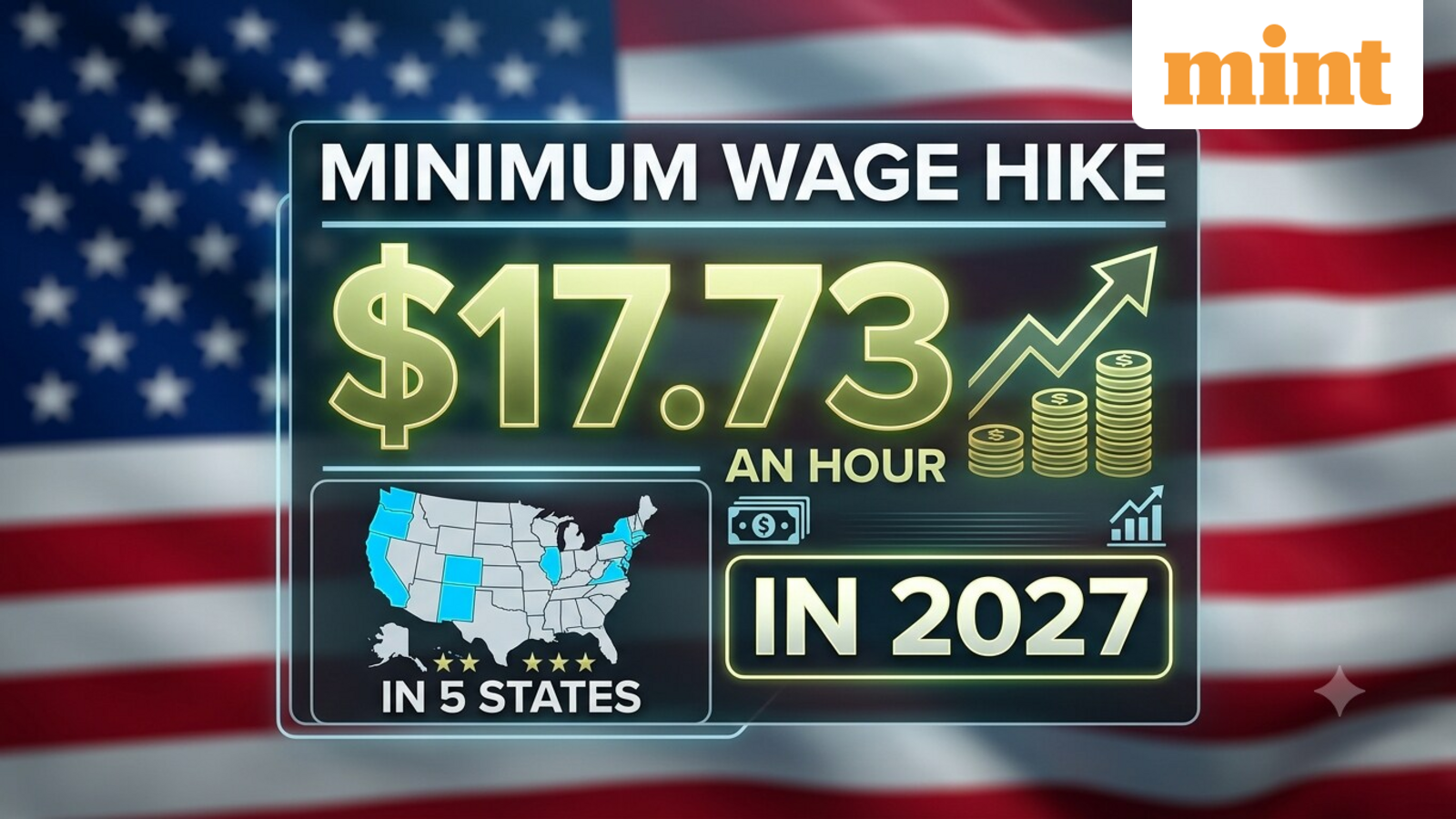
Washington, California, Connecticut, New Jersey and Michigan are among the states increasing their minimum wages, with Washington set to have the highest statewide rate at $17.73 an hour.
The changes highlight the growing divergence between state and federal wage rules, with several states having minimum wages more than twice the federal floor.
US minimum wage 2027: Washington leads with $17.73 an hour
Washington’s minimum wage will rise by 60 cents from its current $17.13 to $17.73 an hour. Connecticut will increase its rate from $16.94 to $17.48, while California’s wage floor will rise from $16.90 to $17.40.
New Jersey will raise its minimum wage by 56 cents to $16.48 an hour for most workers. Michigan is set for one of the biggest increases, with its minimum wage climbing from $13.73 to $15 an hour.
The federal minimum wage, meanwhile, remains at $7.25 an hour.
Minimum wage gap widens across US states
The wage increases are not limited to Democratic-led states. Several Republican-led states have also set minimum wages well above the federal rate, although they remain below the highest-paying states.
Florida’s minimum wage reached $15 an hour on 30 September and will remain at that level through the end of 2027. Missouri also has a $15 minimum wage, while Nebraska will increase its rate from $15 to $15.26 an hour on 1 January.
The differences become even sharper at the city level.
Seattle minimum wage to hit $22.14 in 2027
Seattle is set to raise its minimum wage to $22.14 an hour in 2027, almost $4.50 above Washington’s statewide rate.
The city’s wage rules have become part of a wider debate about rising labour costs for businesses. Since 2025, all Seattle employers, including small businesses, have been subject to the same inflation-adjusted minimum wage. Some restaurant owners who subsequently closed their businesses cited higher
labour costs among the pressures they faced.
Why Washington’s minimum wage rises every year
Washington’s minimum wage is linked to inflation, meaning the rate is recalculated annually rather than requiring lawmakers to approve each increase.
Voters approved a 1998 measure that raised the minimum wage and linked future increases to inflation from 2001. Another measure approved in 2016 established wage increases through 2020. Since 2021, the minimum wage has again increased annually based on inflation.
Each September, Washington’s Department of Labor & Industries calculates the following year’s rate using changes in the Consumer Price Index for Urban Wage Earners and Clerical Workers (CPI-W). The new rate is announced on 30 September and takes effect on 1 January.
Washington jobs market faces pressure
The latest wage increase comes as Washington’s labour market shows signs of weakness. The state’s unemployment rate reached 4.9% in August, compared with 4.1% nationally and 4.6% a year earlier, according to the Washington Employment Security Department.
The state also lost an estimated 900 jobs during the month, including 2,300 information-sector positions. Employment in professional and business services was down 13,100 jobs from a year earlier.
The combination of higher wage floors and a softer labour market is likely to keep the debate over minimum pay and business costs firmly in focus as states prepare for 2027.