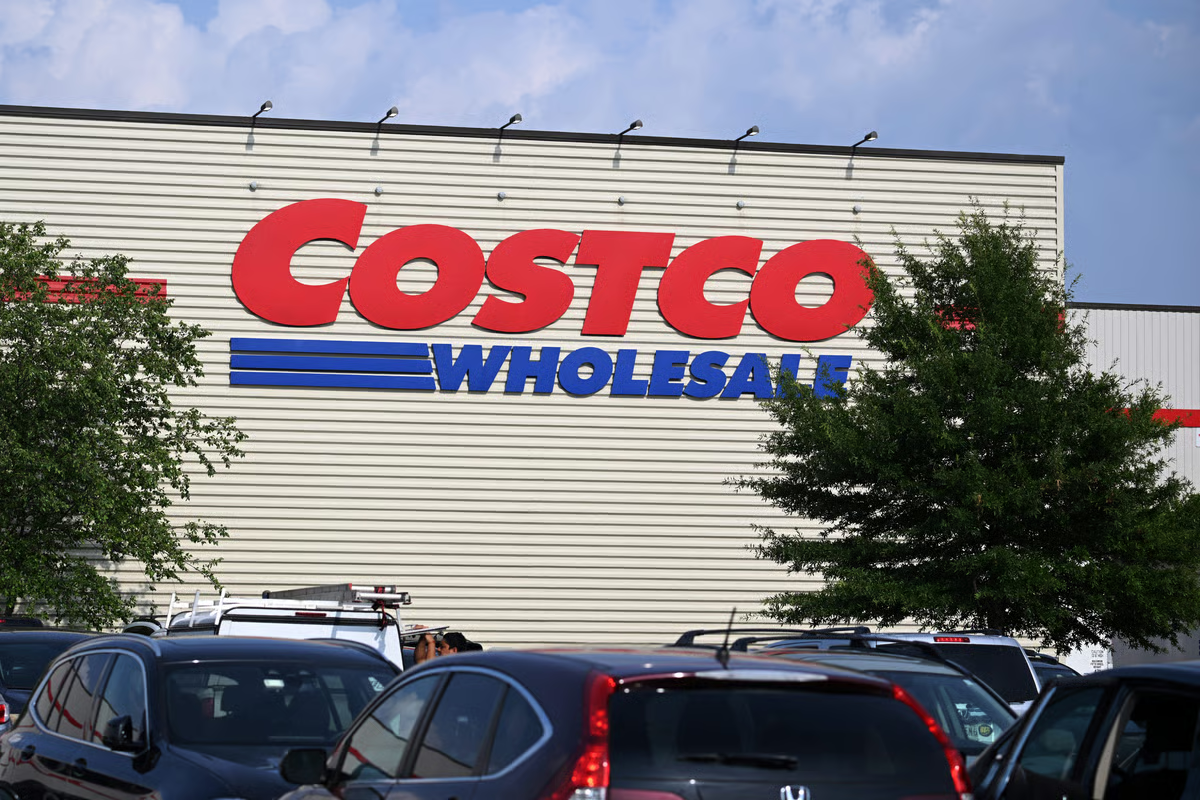
Costco Is Down 10% in 6 Months While the S&P 500 Is Up 17%. Is Costco Too Cheap to Pass Up Under $900 a Share?
Among retail stocks, Costco Wholesale (COST +0.31%) reigns supreme. Over the last decade, it has crushed the S&P 500 on a total return basis, 624% to 324%. Even successful rival Walmart (WMT +0.78%) has only grown by 415% during that time.
But this year, Costco’s stock has hit the skids. Over the last six months, its shares are down 9.3%, trailing the S&P 500’s 17.3% gain. Yet revenue and net income continue to rise, and Costco’s stores seem more popular than ever.
At this price, are Costco’s shares too cheap to pass up? Or is this a sign of bad things to come? Here’s why this “bargain” may not be all that it seems.
Image source: Getty Images.
Numbers can be deceiving
Those numbers don’t tell the whole story.
Yes, Costco’s share price is cheaper than it was six months ago. Yes, its revenue, profits, and free cash flow have all increased over that time frame, meaning its valuation using trailing-12-month (TTM) metrics like the price-to-sales (P/S) ratio, price-to-earnings (P/E) ratio, and price-to-free-cash-flow (P/FCF) ratio are all cheaper now than they were in March. But “cheaper” doesn’t necessarily mean “cheap.”
In fact, Costco’s shares still trade at a sharp premium to its retail peers’, whether that’s in the general merchandise sector, the grocery sector, or even the electronics/appliances sector (all of which are served by Costco):
| Retailer | P/S Ratio (TTM) | P/E Ratio (TTM) | P/FCF Ratio (TTM) |
|---|---|---|---|
| Costco | 1.35 | 44.3 | 43.6 |
| Walmart | 1.13 | 37.8 | 61.7 |
| Target | 0.66 | 16.2 | 16.0 |
| Best Buy | 0.44 | 14.6 | 10.5 |
| Kroger | 0.25 | 32.0 | 16.0 |
Data source: YCharts.
Only Walmart is valued higher than Costco by any of these metrics, and then only on price-to-FCF.
In other words, even at its current share price, Costco stock is trading at a premium.

Image source: Getty Images.
A tricky retail environment
The current economic situation hasn’t been kind to retailers.
Recent tariff increases on imports from China, Mexico, and Canada have forced companies to decide whether to pass the entire tariff amount on to consumers or cut their margins on those products. Some of those price increases have resulted in lost sales, which leaves the retailers stuck between a rock and a hard place.
Meanwhile, record diesel fuel prices have increased the costs of shipping both imported and domestically produced goods, which also increases retailers’ costs. Again, this puts them in a no-win situation of deciding between increasing prices or lowering their margins.
But Costco, which offers rock-bottom prices to its members, reported a 92.3% membership renewal rate for the U.S. and Canada in the most recent quarter, and overall paid membership growth of 3.8%, which is partly why its shares still trade at a premium, even in an unfriendly retail environment.

Today’s Change
(0.31%) $2.87
Current Price
$923.52
Key Data Points
Market Cap
Day’s Range
$914.75 – $925.34
52wk Range
$844.06 – $1096.50
Volume
1.2K
Avg Vol
2.1M
Gross Margin
13.41%
Dividend Yield
0.60%
Is Costco still a buy?
Over the long term, Costco has excellent prospects for continued slow and steady growth. That said, given its elevated valuation, investors looking for faster growth may continue to exit the stock in the coming months.
Costco is still a valid pick for buy-and-hold investors, but even with its shares down by 11% over the last six months, it’s still not cheap. There are more compelling growth opportunities in other sectors right now.