8th Pay Commission: How fitment factor could change Level 6, 7 and 8 basic pay
The 8th Pay Commission is set to begin its next round of discussions and consultations in Bengaluru, Karnataka, from tomorrow, 7 October. The meeting will conclude on 8 October, after which the commission will travel to Mumbai for another round of meetings scheduled for 22 and 23 October.
While the 8th Pay Commission has not announced a specific agenda for the Bengaluru meetings, prominent employee unions and pensioner organisations have raised various demands and grievances related to pay, pensions, the fitment factor, employee morale and other service-related issues during similar consultations held by the panel across states and Union territories.
The 8th Pay Commission is also seeking employee-related data from ministries and departments as part of its consultation and report-preparation process. After analysing the views and grievances raised by employee unions, pensioner organisations, and other stakeholders, along with data collected from ministries and departments, the panel headed by Justice Ranjana Prakash Desai will issue its recommendations on the revised pay structure, including the fitment factor.
The final report is tentatively expected to be tabled by May-June 2027. This will be about 18 months since the central government constituted the 8th Pay Commission on 3 November 2025.
The fitment factor is particularly important because it is a multiplier applied to an employee’s existing basic pay to calculate the revised basic pay. Under the 6th and 7th Pay Commissions, the fitment factors were 1.86 and 2.57, respectively. However, the 8th Pay Commission has not officially announced a fitment factor yet.
What could Level 6, 7 and 8 basic pay look like?
It is important to keep in mind that under the 7th Pay Commission, the minimum basic pay for Levels 6, 7, and 8 is ₹35,400, ₹44,900, and ₹47,600, respectively.
As no official fitment factor has been announced yet, and the 8th Pay Commission continues its consultations, only once official data is declared will it be possible to perform calculations related to the fitment factor and the 8th Pay Commission minimum basic pay. Keeping this aspect in mind, let us look at several illustrative cases of fitment factors and how the revised basic pay will shape up if adopted.
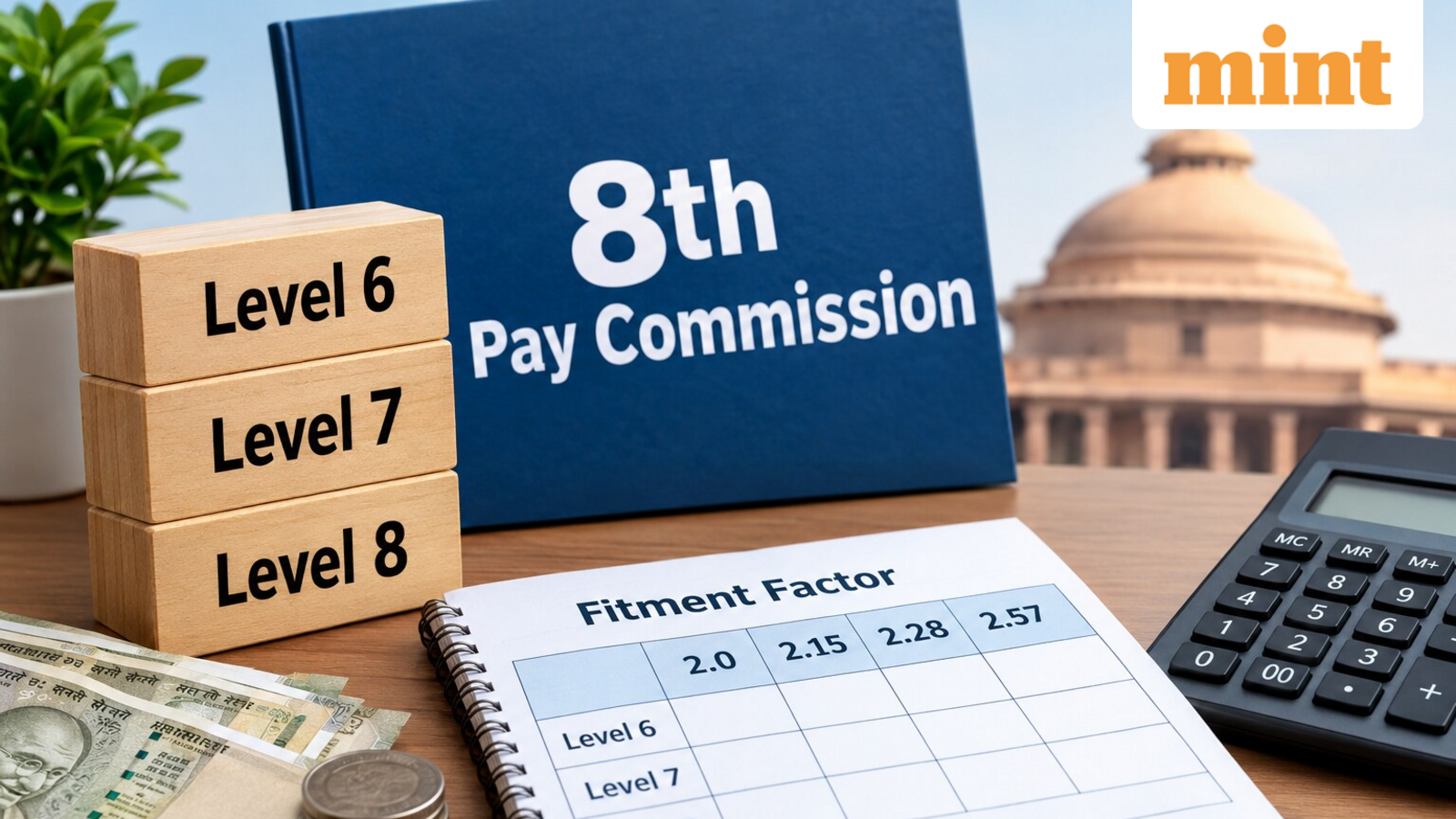
| Pay level | Current basic |
At 2.0x |
At 2.15x |
At 2.28x |
At 2.57x |
|---|---|---|---|---|---|
| Level 6 | ₹35,400 | ₹70,800 | ₹76,110 | ₹80,712 | ₹90,978 |
| Level 7 | ₹44,900 | ₹89,800 | ₹96,535 | ₹1,02,372 | ₹1,15,393 |
| Level 8 | ₹47,600 | ₹95,200 | ₹1,02,340 | ₹1,08,528 | ₹1,22,332 |
Note: The calculations above are illustrative only. No official fitment factor has been decided by the 8th Pay Commission panel and the central government yet.
For example, at a 2.57 fitment factor, a Level 8 employee with a current basic pay of ₹47,600 would receive an illustrative revised basic pay of ₹1,22,332.
Why the fitment factor matters
Prominent employee organisations and unions have meaningfully proposed higher fitment factors, with primary consideration given to rising inflation and lifestyle expenses. The National Council of Joint Consultative Machinery (NC-JCM), for example, has sought a 3.833 factor, which would raise the minimum basic pay for a Level 1 employee from ₹18,000 under the 7th pay Commission to approximately ₹69,000.
On similar lines, Bharatiya Pratiraksha Mazdoor Sangh (BPMS), another major employees’ federation, has requested a fitment factor of 4, which would boost the minimum basic pay of a Level 1 employee to ₹72,000 from the current ₹18,000 under the 7th Pay Commission, if the proposals are adopted by the 8th Pay Commission panel.
However, it is also vital to note that these are demands, not government-approved recommendations. The final fitment factor will be known only after the 8th Pay Commission submits its recommendations and the government takes a decision.
The calculations discussed above are based only on basic pay. Actual salary revisions will depend on several factors, including allowances, deductions, the revised pay matrix and other rules notified by the government. Employees should therefore not treat these estimates as confirmed 8th Pay Commission salaries.