Lifetime gifting can be an effective way to reduce the value of your estate and lower an inheritance tax (IHT) bill.
Larger gifts that fall outside other allowances, such as the £3,000 per year annual exemption and the £250 small gift allowance, are known as potentially exempt transfers (PETs).
How much inheritance tax is owed will depend on when the PETs were made.
Try 6 free issues of MoneyWeek today
Get unparalleled financial insight, analysis and expert opinion you can profit from.
Start your trial
Sign up for MoneyWeek’s free twice-daily newsletter.
Join more than 165,000 subscribers and keep yourself informed with latest financial news, insights and expert analysis to help you understand what really matters when it comes to your finances.
Join more than 165,000 subscribers and keep yourself informed with latest financial news, insights and expert analysis to help you understand what really matters when it comes to your finances.
Under the seven-year rule, if gifts were given at least seven years before death, they won’t be subject to inheritance tax.
Latest Videos FromMoneyWeek
If you die between three and seven years after giving a gift, a taper rate of IHT could apply on it.
But the way the seven-year rule is applied is misunderstood, according to Sean McCann, chartered financial planner at insurance firm NFU Mutual.
He said there is a “widely held misconception that if you make a gift and survive at least three but less than seven years, the inheritance tax due on the gift reduces on a sliding scale”, but the reality is different from this.
How does the seven-year rule work?
Gifts given between three and seven years before death may be taxed on a sliding scale, known as taper relief. These rates range from 32% to 8%.
Taper relief only applies if the total value of the gifts given during the seven year period before death exceeds the standard inheritance tax threshold, known as the nil-rate band.
The nil-rate band is an amount you can pass on to your beneficiaries tax-free and it’s currently £325,000.
Gifts made up to three years before your death face the standard 40% rate. No IHT is owed on gifts made more than seven years before your death.
The misconception is that the sliding scale always applies. In reality, the gift ‘eats’ your £325,000 nil-rate band first, with the taper relief applying to any part above that amount.
For example, a gift of £100,000 would leave someone with a nil-rate band of £225,000, if no other gifts were made within seven years of someone’s death. This would mean no tax would be owed on the gift.
If a gift of £425,000 was made within that period, there would be no nil-rate band left and the remaining £100,000 be subject to IHT. What rate it would need to be paid at would depend on when the gift was made.
The rest of the estate would then be subject to IHT at a rate of 40%. For example, if the remaining estate was valued at £100,000, £40,000 in IHT would be owed on that amount, in addition to the tax on the £425,000 gift.
If you leave your home to a child or grandchild, you get an extra £175,000 residence nil-rate band, taking your tax-free allowance to £500,000, provided your estate is worth less than £2 million.
However, this boosted allowance only applies to your remaining estate and not to lifetime gifts.
Chris Black, director of wealth management at RBC Brewin Dolphin, said: “For gifts made within seven years of death, the amount of IHT will be determined with reference only to the standard nil-rate band of £325,000 even if the deceased qualifies for the additional £175,000 residence nil-rate band.”
Swipe to scroll horizontally
How taper relief applies on PETs
Years between gift and death
Rate of IHT on the gift
3 to 4 years
32%
4 to 5 years
24%
5 to 6 years
16%
6 to 7 years
8%
7 or more
0%
Source: Gov.uk
How does the seven-year rule work in practice?
Lifetime gifts use up your £325,000 nil-rate band if you die within seven years of giving them.
This means gifting sooner rather than later can be tax-effective, but it’s worth exploring this with a financial adviser to make sure you don’t run out of money.
Below are two scenarios of how it would work in practice.
Scenario A: Someone without children or a partner gives £500,000 to a nephew and survives more than seven years. Their remaining estate is worth £1 million.
The gift would fall outside the person’s estate for IHT purposes. IHT would be owed on £675,000 (the remaining £1 million minus the £325,000 nil-rate band) at a rate of 40%, meaning an IHT bill of £270,000.
Scenario B: Someone without children or a partner who gives £500,000 to a nephew and survives for three and a half years. The rest of their estate is worth £1 million.
The gift would fall inside the person’s estate for IHT purposes.
£325,000 of the gift would eat into the tax-free nil-rate band. The remaining £175,000 of the gift would get taper relief of 32%. This means the IHT charge on the gift would be £56,000. The remaining £1 million of the estate would be taxed at 40%, costing £400,000 in IHT. This means the total IHT bill would be £456,000.
The above calculations are based on no earlier gifts being made within seven years of death.
IHT is calculated on gifts in chronological order, so one that was made earlier will eat into your nil-rate band first.
Scenario C: Someone without children or a partner gives nothing in their lifetime and their estate is worth £1.5 million. The total IHT bill would be £470,000.
Brokeree Solutions redesigned the interface for PAMM, its money management system for brokers, the company said today (Monday). PAMM is the third of its investment products to move onto one shared design system. Brokeree counts nearly 15% of roughly 1,000 brokers worldwide as offering managed account services, a figure it publishes itself and the one…
Is the UK too centralised and will devolution help? Devolution has long created separate administrations for Scotland, Wales and Northern Ireland, rather creating the illusion that the British state must be a quasi-federal one. But the whole of England – 85% of the UK’s population – remains governed by Whitehall. Westminster decides everything, says The…
Tritax Big Box has completed a 1m sq ft logistics facility at Symmetry Park, Kettering, with the pre-let to Amazon now commenced. CRE Herald Market analysis, deal insights, and sector research trusted by fund managers, asset managers, and senior executives. Subscribe Now Login To Unlock The Content!
…
Fintech GoodLeap launched the GoodLeap Home Visa Signature Card, a home equity line of credit that pays 6% cash back on home improvement projects initiated through the company’s app. This is a reward rate the company says is the highest available for home improvement spending from any major card. Processing Content Credit lines run up…
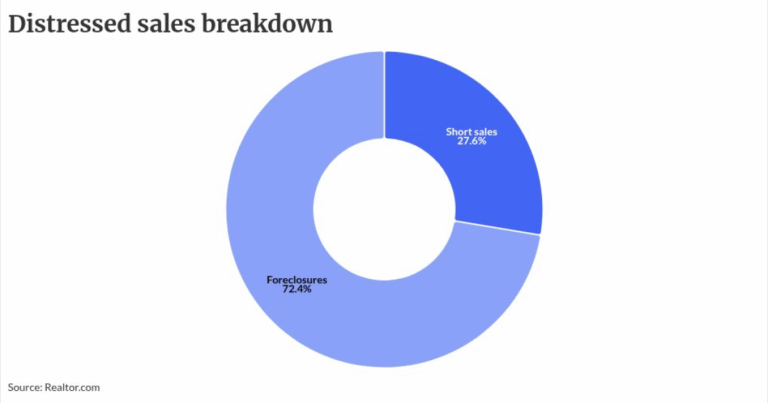
Short sales sold at a smaller discount than foreclosures starting in January, the first time that’s happened since Realtor.com began tracking these valuations in 2018. Distressed homes earned about 9% more of their estimated value as a short sale than as a foreclosure. Processing Content Foreclosed homes have sold in a fairly steady range, 25%-30%…