IPO mutual funds: How do fund managers buy and sell shares at pre- and post-listing stages? Experts explain
Mutual funds allow you to invest in a basket of stocks, but IPO-focused mutual funds offer a way to participate in the IPO segment. As this category is still at a nascent stage, how exactly do these funds work?
Examples include Edelweiss Recently Listed IPO Fund and Mirae Asset BSE Select IPO ETF FoF. While one is an active fund that gives the fund manager flexibility to select stocks, the other is a passive fund that tracks an index.
But how do fund managers actually buy and sell IPO stocks, and what should investors look at when evaluating these funds?
How do IPO mutual funds work?
Uttam Agarwal, Chief Business Officer at Bajaj Capital, mentioned that “for a fund manager, the real work starts much before the listing. Fund managers study the offer documents, meet the management and look at the business, financials, promoter track record and, importantly, whether the valuation makes sense”.
Once they decide to invest, position sizing becomes important. With a newly listed company, there is limited market history, so a manager may start with a measured allocation and increase it as the business delivers and the investment case gets stronger.
The same thinking applies to exits. A stock going up isn’t automatically a reason to sell. If the business continues to perform and the valuation remains reasonable, there may be merit in staying invested. If the fundamentals or valuation change, the manager can reassess, he explained.
When do these funds typically buy IPO shares?
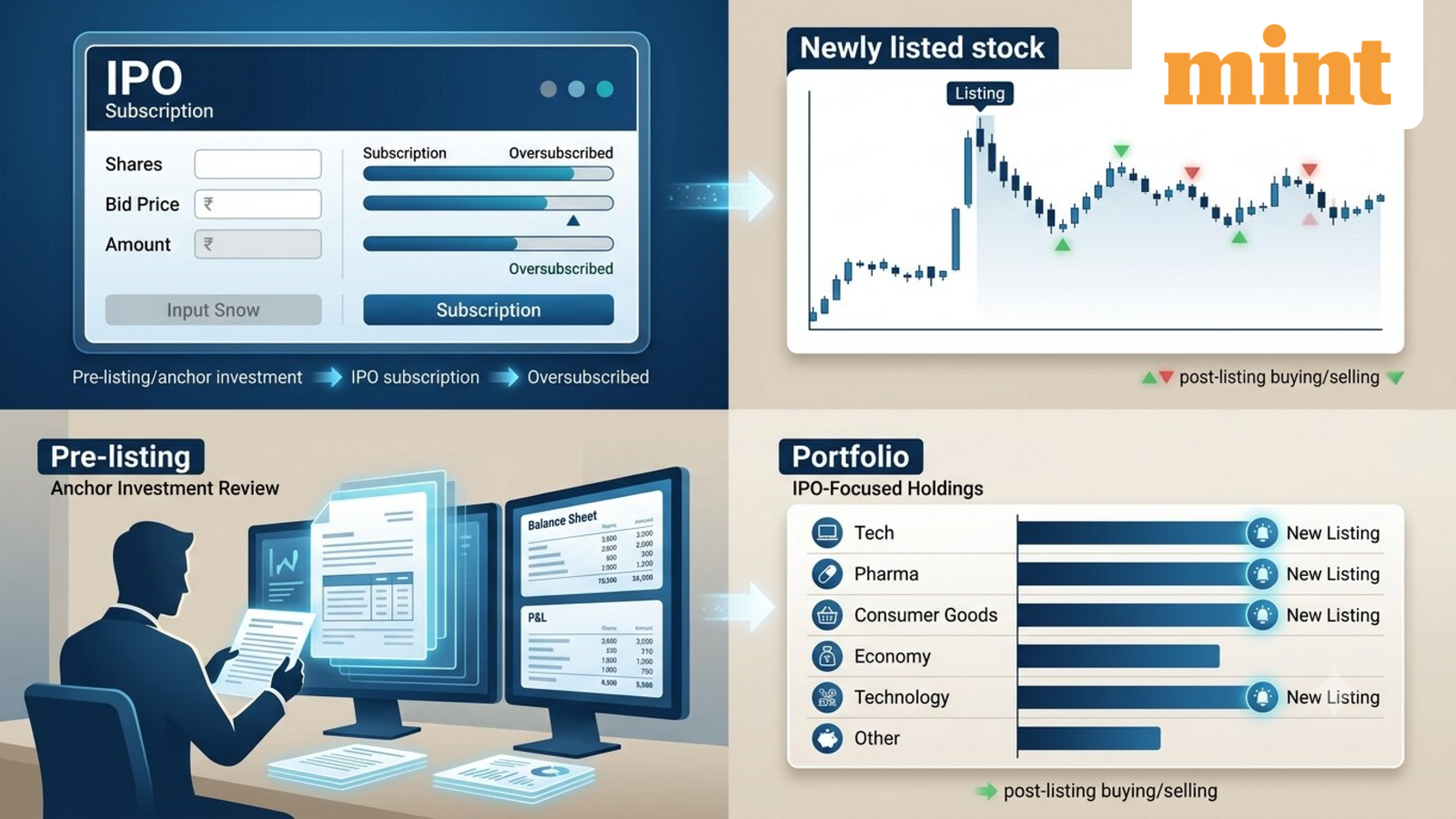
Manish P. Hingar, Founder and Chief Executive Officer of Fintoo, explained that the IPO-focused mutual funds can buy IPO shares at different stages:
- Pre-listing: As anchor investors where large institutional investors can receive shares a day before the IPO opens to the public. However, these shares are subject to a lock-in period.
- During the IPO subscription: Mutual funds can apply for shares along with other institutional investors when the IPO is open to the public.
- Post-listing: Mutual funds can buy shares from the stock market once the company is listed. In this case, a fund manager has the option to wait until the initial excitement settles or until the company has reported a few quarters of results.
- However, mutual funds cannot buy through pre-IPO placements, as per a SEBI notification.
“Buying shares from unlisted markets before the IPO is launched doesn’t apply here since it is a different type of investment activity,” Piyush Jhunjhunwala, Founder and CEO, Stockify, added.
What prompts an IPO fund manager to sell a stock?
An exit from a position will not typically be dictated simply by financial results. The fund manager will continue tracking the stock’s valuation, the prospects for its earnings, its cash flows, the way it operates, its competition, and its corporate developments, Jhunjhunwala added.
A stock may be sold even after strong returns if its valuation runs ahead of expected earnings growth. Weakening business prospects, poor earnings visibility, governance concerns, or a change in the investment thesis can also prompt an exit, he added.
“Portfolio turnover will depend on the investment philosophy of the fund and the current market environment. However, high turnover in itself cannot be seen as a positive,” Jhunjhunwala noted.
Do these funds invest only in mainboard IPOs?
The mainboard is likely to remain the larger opportunity set for most IPO-focused strategies because these companies generally offer greater scale, disclosure, and liquidity. Whether a particular fund can invest in SME IPOs depends on its mandate, Agarwal mentioned.
What should investors look at while analysing these IPO funds?
An IPO fund is better viewed as a small addition to an equity portfolio rather than a core holding. Investors should look beyond returns and popular IPOs and check the portfolio’s sector exposure, number of holdings, allocation to newly listed stocks, valuations and concentration, Hingar said.
Investors should also assess whether the portfolio reflects the fund’s stated strategy, including its market-cap and recent-listing exposure. Don’t judge portfolio based on listing day gains, Agarwal said.
Expense ratio, portfolio turnover ratio, downside risk and consistency of returns are also useful indicators. Investors should also check how much of the fund is actually invested in newly listed and IPO companies, Jhunjhunwala added.
Disclaimer: This story is for educational purposes only. The views and recommendations made above are those of individual analysts or broking companies, and not of Mint. We advise investors to check with certified experts before making any investment decisions.
About the Author
Sheetal Goel is a Content Producer at Livemint, where she covers corporate developments, personal finance, business trends, markets, and SEBI-related updates. She focuses on simplifying complex financial concepts and presenting them in a clear, reader-friendly manner, thereby helping audiences better understand investment trends, personal finance, and market developments. Her writing focuses on making finance more accessible to everyday readers while maintaining clarity, accuracy, and relevance.
She holds a degree in Economics (Hons.) along with an MBA in Finance, which has helped her develop a strong foundation in financial analysis, market understanding, and business reporting. Before joining journalism, she worked with finance and broking firms, where she closely followed market developments, investment strategies, and evolving industry trends. This practical exposure strengthened her understanding of financial markets. She has also written content across multiple formats and platforms, including YouTube, LinkedIn, and Instagram.
Over time, she has developed expertise in covering market-linked stories, investor-focused topics, and regulatory updates in a simplified yet informative style. She also enjoys reading and listening to Hindi poetry, reflecting her appreciation for literature and creative expression beyond the world of markets and numbers.