
ConocoPhillips’ Chairman Says Oil’s Price Floor Is Rising to $70 a Barrel. Here’s What That Means for Oil Stocks.
In mid- to late-2025, the U.S. Energy Information Administration (EIA) was quite bearish on oil, forecasting that a barrel of Brent crude would hit $50 by early 2026.
Not only did that not come to fruition, as we all know, but oil may not get that low for a very long time, if ever, according to ConocoPhillips (COP +1.37%) Chairman Ryan Lance.
At a forum in London, Lance said he sees the floor on oil prices at around $70, according to Reuters. He also expects the mid-cycle price to be around $65-$70 per barrel for West Texas Intermediate (WTI) crude oil, the benchmark for U.S. oil.
Here’s what this means for oil stocks.

Image source: Getty Images.
It will take time for the oil supply chain and demand to normalize
Lance said that while the Iran war certainly pressured the global oil system, it didn’t break it. However, it could take until 2028 or 2029 for global demand to rebound.
“The real strategic question for companies like mine is where is the conventional (production) going to come from to satisfy that growing demand,” Lance said, according to Reuters.
Additionally, Lance said ConocoPhillips is currently more focused on upstream exploration than on midstream oil investments.
Upstream involves finding and producing oil, while midstream transports and stores it, connecting upstream producers to downstream companies, which refine crude oil into products like gasoline, diesel, and jet fuel.
While the Iran war may not have broken the global oil system — at least not yet — it has left it vulnerable.
For instance, in the U.S., where oil tends to be cheaper than in Europe, the U.S. Strategic Petroleum Reserve (SPR) fell below 284 million barrels for the week ending Sept. 25, according to the EIA.
That’s near the lowest levels seen since the SPR began in the early 1980s. The SPR requires 250-300 million barrels of oil to function properly.
Saudi Aramco’s CEO, Amin Nasser, also said at the same forum where Lance spoke that it will likely take up to two years to rebuild global oil inventories.
He noted that global oil inventories were at about 10 billion barrels heading into the conflict. Roughly 3 billion barrels of supply were lost, roughly half of what would normally have moved through the Strait of Hormuz since the conflict began.
What this means for oil stocks
The short answer is that it’s good news for most, if not all, major oil stocks, because higher oil prices mean they can sell oil at higher prices and make more money.
ConocoPhillips reported second-quarter adjusted earnings per share up 128% year over year. ExxonMobil tells a similar tale, with adjusted earnings per share up more than double year over year.
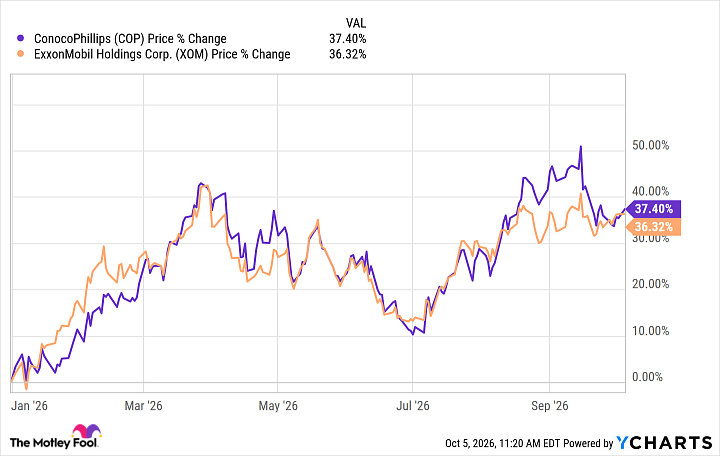
These companies are also significantly increasing free cash flow, which gives them more money to pay down debt, strengthen their balance sheets, and return capital to shareholders, making their stocks more attractive. So, higher oil prices are a big positive.
However, one thing investors should keep their eye on is how the world continues to view oil from a geopolitical perspective following this conflict.
Given that Iran has been able to leverage the Strait of Hormuz as a major strategic advantage in the war, many experts say it makes sense for the U.S. to build new oil routes and focus on domestically produced renewable energy, due to national security concerns.
Long term, that could lead to lower oil prices, although given the demand for power right now, whether due to the rise of artificial intelligence or other factors, I think it’s likely the world will need as much power as it can get from many different energy sources, including oil and renewables.
Still, it’s something for oil investors to monitor.