Is the buy-and-hold era over? Key portfolio strategy lessons for investors from Quant Mutual Fund’s October factsheet
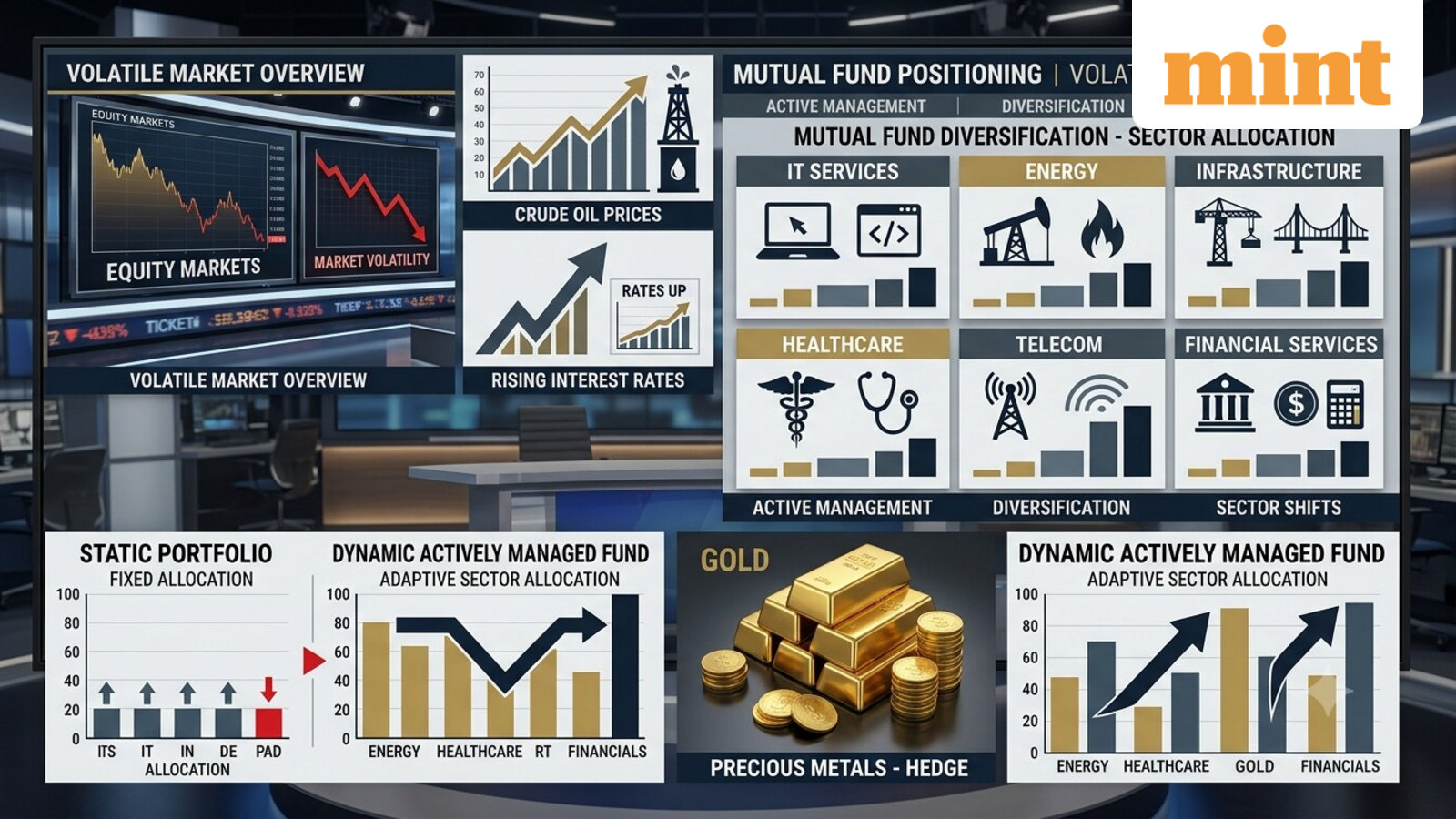
Mutual fund investors may need to prepare for a more volatile market environment as higher interest rates, elevated crude prices, a stronger US dollar, and shifting global capital flows create pressure on equities.
In its October 2026 factsheet, Quant Mutual Fund has highlighted a preference for dynamic, active, and multi-asset portfolio management, while identifying sectors where it sees relatively better opportunities. Here’s what you need to know.
Why is Quant MF calling for a shift from static investing?
Quant MF believes the traditional buy-and-hold approach may face greater challenges in the current environment. The factsheet states that the “era of static buy & hold strategies has passed. It is an era of dynamic style of money management”.
The fund house said its investment approach is focused on being “outcome-driven, style-agnostic, multi-asset, dynamic, adaptive, active, unconstrained and pure opportunistic”, rather than being benchmark-centric or style-bound.
Global equities faced a sharp correction in September amid concerns over a “higher-for-longer” interest-rate environment. The Nifty 50 fell about 6%, while the Hang Seng and Shanghai indices declined around 3.5%.
For investors, this suggests maintaining an active allocation across asset classes and sectors rather than maintaining a fixed portfolio positioning.
Which sectors is Quant MF positive on?
Quant MF said it is looking for opportunities in areas that are “under-owned, under-researched, under-valued and neglected”.
Its current sector preferences include IT services. It has increased exposure as the sector entered what it described as “neglected territory” amid the broader AI-led technology boom.
The fund house remains constructive on energy, large infrastructure, select NBFCs, AMCs, auto ancillaries, hotels, pharmaceuticals, telecom and data centres, indicating a preference for sectors it sees as relatively under-owned or offering better opportunities.
This view could be relevant for investors considering sectoral and thematic mutual funds focused on these areas.
Why is Quant MF underweight on manufacturing?
Quant MF said it is “relatively underweight manufacturing companies”, citing uncertainty around input costs and supply chains.
This is important for investors in sectoral/thematic funds because the fund house is effectively signalling that it does not want to aggressively chase manufacturing exposure.
What about gold investing?
Precious metals suffered heavy selling pressure in late September, with gold falling 6.45% during the month and silver declining towards $60 an ounce.
Quant MF attributed the pressure to a stronger US dollar, rising US Treasury yields and the Federal Reserve’s 25-basis-point rate hike, which reduced the appeal of non-yielding assets.
However, the fund house continues to view “gold as a strategic asset”. It highlighted China’s reported purchase of more than 1,000 tonnes of gold in the first eight months of 2026, following 886 tonnes bought in 2025.
What does this mean for mutual fund investors?
“In such times when large global stock market indices of countries such as Taiwan and South Korea behave like nano-cap stocks, it is important to stay agile in one’s own portfolio and allocation,” the factsheet mentioned.
For mutual fund investors, the key takeaway is to track how actively managed schemes respond to changing market conditions and how their own portfolios are invested across sectors.
Disclaimer: This story is for educational purposes only. The views and recommendations made above are those of individual analysts or broking companies, and not of Mint. We advise investors to check with certified experts before making any investment decisions.
About the Author
Sheetal Goel is a Content Producer at Livemint, where she covers corporate developments, personal finance, business trends, markets, and SEBI-related updates. She focuses on simplifying complex financial concepts and presenting them in a clear, reader-friendly manner, thereby helping audiences better understand investment trends, personal finance, and market developments. Her writing focuses on making finance more accessible to everyday readers while maintaining clarity, accuracy, and relevance.
She holds a degree in Economics (Hons.) along with an MBA in Finance, which has helped her develop a strong foundation in financial analysis, market understanding, and business reporting. Before joining journalism, she worked with finance and broking firms, where she closely followed market developments, investment strategies, and evolving industry trends. This practical exposure strengthened her understanding of financial markets. She has also written content across multiple formats and platforms, including YouTube, LinkedIn, and Instagram.
Over time, she has developed expertise in covering market-linked stories, investor-focused topics, and regulatory updates in a simplified yet informative style. She also enjoys reading and listening to Hindi poetry, reflecting her appreciation for literature and creative expression beyond the world of markets and numbers.