L.A. Might Be Commercial Real Estate’s Best-Kept Secret – Commercial Observer
For at least the past six years, finding investors with positive sentiment around investing in Los Angeles has felt more difficult than finding a taker for your Chargers season tickets.
That’s changing, albeit slowly.
After all, pandemic-battered San Francisco up the coast has soared recently due to both demand for office and residential space from AI company principals and executives. Maybe L.A. can start charting a positive investment trajectory as well.
In mid-September, the Urban Land Institute (ULI) convened its Advisory Services Program to evaluate Downtown L.A. and to present ideas and initiatives to resuscitate the beleaguered urban core, which isn’t exactly a vote of confidence for existing or prospective investors.
The presentation started with discussions on the market’s three key challenges. One is helping the unhoused community, and tackling crime and a deteriorating public realm. And, while the Greater Los Angeles area would be among the world’s 20 largest economies if it was its own country, it remains painfully difficult and expensive to do business relative to other U.S. cities. Finally, the area is stuck in the grip of decades-long housing and affordability challenges.
“The overwhelming impression was that there are so many assets here, and this downtown was hopping along until the pandemic, and there’s no reason it can’t return and will return,” said Marilee Utter, president of Citiventure Associates and a prominent ULI member.
There’s no quick fix when it comes to Los Angeles, which goes double for its downtown, which still finds its office vacancy rate routinely above 20 percent. But there’s a potential for long-term deals that may be starting to entice more and more investors, including those from outside the region. Bill Witte, the recently retired real estate developer who founded Related California almost 40 years ago with Stephen Ross, summed up an optimist’s case for the city, in particular downtown, late last year.
“It’s not as bad as you think it is. It’s better than you think it is. It’s still the cultural core of the region.”
Pragmatists, on the other hand, see the region’s challenges as a reason in and of itself to make moves.
David Brickman, president of Residential Real Estate and partner at D2 Asset Management, said during a late September roundtable that his firm has been active in Los Angeles recently because he views the outlook as steady due to affordability challenges, and solid middle-income workforce housing presents a great opportunity for debt to get a higher return amid the region’s moderate-income neighborhoods.
In addition, New York-based G4 Capital Partners also announced an expansion in the Los Angeles market in April, opening an office to provide private lending for residential projects. While others have fled the region, Larry Grantham, senior managing director of G4, said that the capital reset that has taken place across the L.A. area has set the stage for an uptick in deal volume. With enormous amounts of capital on the sidelines, he wants to be ready when the pendulum swings back.
Other investors have looked past the current market, and even the next few quarters, and taken a longer view.
Groups such as Uncommon Developers aim for long-term holds instead of quick flips, and have locked in lower values that can pay off over the long term. Most notably, the firm picked up the Figueroa at Wilshire office tower downtown in summer 2025 for a 40 percent discount at $210 million.
With small or nonexistent development pipelines in most major submarkets, constrained supply will remain steady for a long time, helping the market achieve more balance over the long run.
“Family offices, they’re all looking for places to deploy capital, and, if you have a generational vantage point or that sort of time frame, Los Angeles looks cheap,” said Jonathan Roth, managing partner and co-founder of 3650 Capital. “A family office can look at an asset and say, ‘We’re going to look at this generationally.’”
There are also other big out-of-town players making selective deals in L.A. New York’s Fortress Investment Group, for instance, provided $96 million to Cityview’s Jasper multifamily project in Downtown L.A.
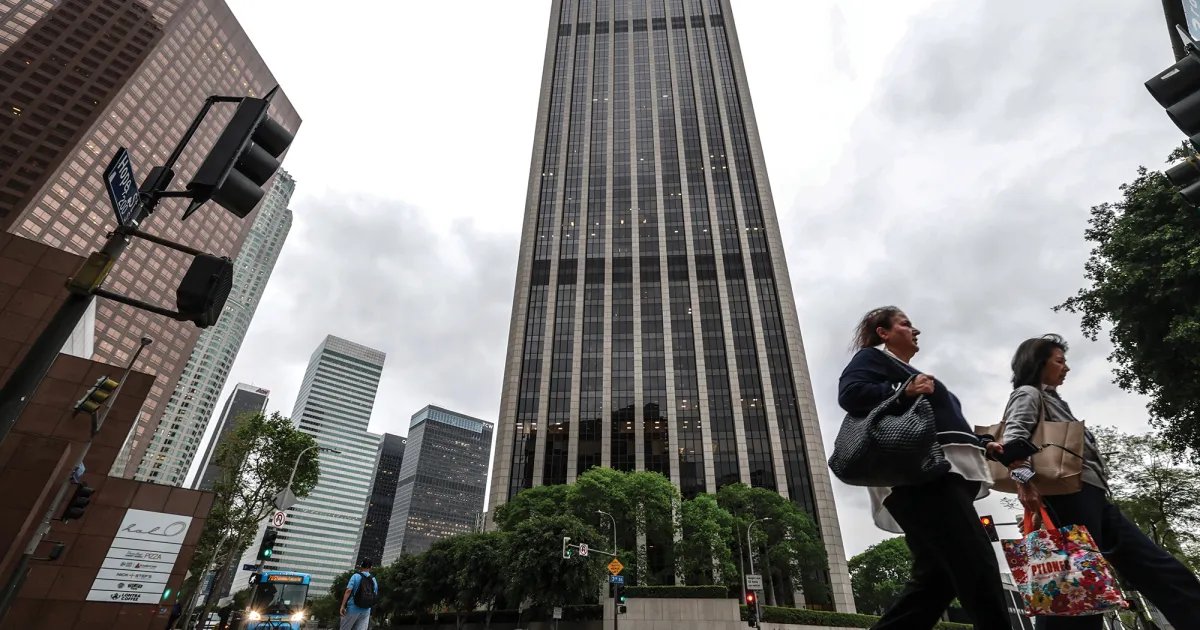
Users, too, are picking up assets in Downtown L.A. on the cheap with a long-term focus. Capital Group, one of the world’s largest investment firms, acquired the Bank of America Plaza office tower — its corporate headquarters — for $210 million in March, picking up part of Brookfield’s formerly expansive real estate holdings at a steal of a price.
Sales comps have demonstrated deep discounts in the market: Bank of America Plaza traded at near $150 per square foot, while the Aon Center sold for roughly $130 per square foot, significantly lower than the pre-pandemic $450-per-square-foot neighborhood average. Through the last half of 2025 and first half of 2026, half the office sales in metro L.A. were sold at a loss, according to Newmark data. Cushman & Wakefield analysts expect more activity from value-add investors, owner-users and public-sector buyers as pricing adjustments continue.
“The broader repricing of Downtown Los Angeles office assets has created an attractive entry point that fundamentally changes the competitive position of new ownership,” Ran Eliasaf, founder of Northwind Group, a Manhattan-based real estate private equity group, said in a statement after picking up the office complex at 333 South Grand Avenue in June at a steep discount.”
Utter noted that the ULI’s recommendations to create a downtown development corporation and to set up a tax-increment finance district downtown both arose in part because the group believed there was sufficient investor interest to utilize these mechanisms to fund and fix up the city center.
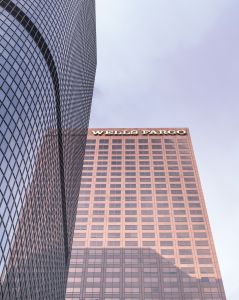
The office market has shown some signs of life. A recent Savills report found 4 million square feet of leasing activity in the third quarter, a 15 percent jump from the same time last year.
Renewals represented the bulk of the leasing volume during those three months, but technology, advertising and media firms such as Universal Music Group inked new deals. Banc of California recently opened a new 40,000-square-foot downtown office. Ad agency Innocean relocated offices from Orange County to a 100,000-square-foot space in El Segundo, closer to L.A., a reversal of a more traditional move out of Los Angeles County.
And, early next year, the 730,000-square-foot 1950 Avenue of the Stars, a new development in L.A..’s red-hot, supply-
constrained Century City market, will come online.
“There’s life to the market,” said Savills research director Dalton Brusseau. “We’re seeing activity, a lot more than years past.”
There’s also hints of additional deal-making opportunities around the corner. Brusseau noted that the loan maturities for Los Angeles office space will peak in 2027, with $6.2 billion in loans maturing, which he believes can “absolutely spur investor activity.”
“We’ll have new ownership that comes in and resets that basis, and, as a result, spurs leasing activity, because now they’re able to cut deals because they have capital, whereas the previous owner didn’t,” he said.
There’s continued optimism about the potential impact of the city’s megaevent era as well, including the expansion of the Convention Center and the attention that the 2028 Olympic Games will generate. “The Olympic Games give DTLA a deadline to start, not finish,” Nate Hommel, director of the Philadelphia nonprofit University City District, said during the September ULI conference.
Of course, even some of the more potentially positive developments in the future of downtown and Los Angeles in general — the approval of the $2 billion, 10-building, mixed-use Fourth and Grand project, and the cleanup and potential redevelopment of the Oceanwide Towers complex — both require substantial funding that hasn’t been finalized.
That may be one of the most challenging aspects of any Los Angeles recovery because, even if demand does begin to return, and the price remains right for deeply discounted deals, getting lenders to bet on a buildout with today’s interest rates remains a challenge.
Multifamily developers remain mostly sidelined, unable to justify new projects due to a combination of rising costs, tough financing and challenges with Measure ULA, a 3-year-old tax on pricier real estate trades. And those that are building build small to avoid transfer taxes.
“There’s not much you can do about it except wait,” said Utter. “This financing situation is really the holdup. The demand is coming back. But bankers aren’t going to give you a loan, even if it’s the nicest thing you could ever do for the community.”