Saving vs Investing in Personal Finance: A UK Guide
Many Indian households treat saving and investing as the same habit. Yet they serve different jobs in a financial plan. Saving keeps money safe for near needs and quick access. Investing accepts price swings to seek growth over time. Inflation, tax, and life goals can reduce money’s real value.
Savings tools include savings accounts, fixed deposits, and recurring deposits. These options aim for stability and easier withdrawals. Investing uses assets like mutual funds, shares, bonds, ETFs, gold, real estate, and retirement products. Their values can move up or down, but they may beat inflation over longer periods.
Investing is putting money into an asset to earn future returns. Returns may come from price gains, interest, dividends, rent, or a mix. Unlike savings, the invested amount may not stay constant at all times. Market moves and product risks can change value, sometimes for long stretches.
An example is buying units of an equity mutual fund. The fund buys shares of listed companies. When companies grow and markets rise, unit values may increase. When markets fall, values can drop for a while. This possibility of loss is why investors need a plan and patience.
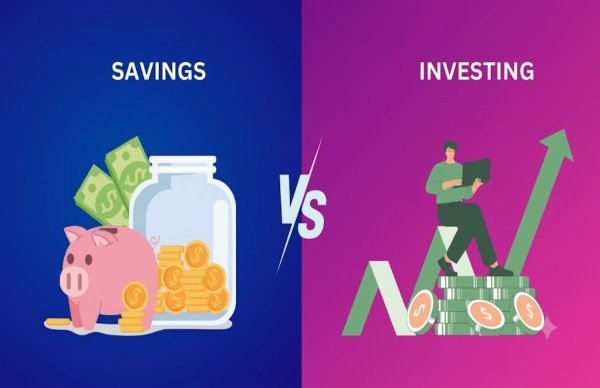
Saving mainly focuses on safety and availability. Investing mainly targets long-term growth. Savings usually support emergencies and planned near-term bills. Investments suit longer goals like retirement, children’s education, home purchase planning, or wealth creation. Choosing the wrong tool can create stress when time is short.
The differences are easier to compare side by side. Savings often have lower risk and modest returns. Investing risk depends on the asset chosen. Liquidity can be high for savings, but it varies for investments. Time horizon also differs, which affects suitable products and expected ups and downs.
| Factor | Saving | Investing | Primary aim | Preserve money | Grow money |
|---|---|---|
| Risk level | Usually low | Varies by asset |
| Time frame | Short term | Medium to long term |
| Return potential | Generally modest | Potentially higher |
| Liquidity | Usually high | Depends on product |
Saving vs investing: inflation and tax impact
A savings account is built for access and stability, not wealth building. Fixed deposits may pay more than savings accounts, but post-tax returns can still lag inflation. This matters when money sits idle for years. A balance may look unchanged, yet it can buy less later.
Investing can help manage inflation risk over longer periods. However, it introduces market risk and product-specific risk. Tax also affects outcomes. Interest from most bank deposits is taxed at the investor’s income tax slab. Mutual funds, shares, and other assets follow capital gains tax rules.
/img/2026/10/682698c6-2ce9-4b68-97a4-3a48210fa4f01-60461791164177.jpg "Saving and Investing: Balance Safety")
Saving vs investing: why both matter in a plan
Most strong financial plans use both saving and investing. Savings act as the base for stability. Investments aim to build wealth on top of that base. Without savings, emergencies may force the sale of long-term assets. Without investments, long-term targets may stay out of reach.
An emergency fund is often the first step. Many planners suggest keeping several months of essential expenses in liquid, low-risk options. This may include a savings account, sweep-in deposit, or a liquid mutual fund. The amount depends on job stability, family duties, and monthly commitments.
After short-term safety is set, investing can start in a structured way. For many salaried investors, mutual fund SIPs are a common entry point. Other options used for different goals include Public Provident Fund, Employees’ Provident Fund, National Pension System, sovereign gold bonds, and direct equities.
No single product fits every investor. Equities may offer stronger long-term growth, but prices can be volatile. Debt products can be steadier, yet returns can change with interest rates and credit quality. Gold may diversify a portfolio, but it pays no regular income. Real estate needs larger capital and is less liquid.
Saving vs investing: how to decide where money should go
Start with the time limit for the goal. Money needed within one year should usually avoid high market risk. Funds required in two to three years may need a cautious mix. Longer goals can take more growth assets, if the investor accepts temporary declines and stays invested.
Risk tolerance matters as much as returns. Some investors panic after a 10% fall. Others can stay invested through deeper drops. Costs also need attention. Mutual funds charge expense ratios, and share investing may add brokerage. Insurance-linked investment products may have complex charges and limits on access.
For beginners, diversification often helps more than chasing the top return. Spreading money across suitable assets reduces reliance on one outcome. It does not remove risk, but it can reduce damage from one poor phase. Reviews are also important as income, goals, and market conditions change.
Saving supports present needs and keeps emergencies manageable. Investing aims to support future goals through long-term growth. The practical choice is using each tool for its purpose. Keep accessible money for near bills and short targets. Invest steadily for goals far enough away to benefit from compounding.