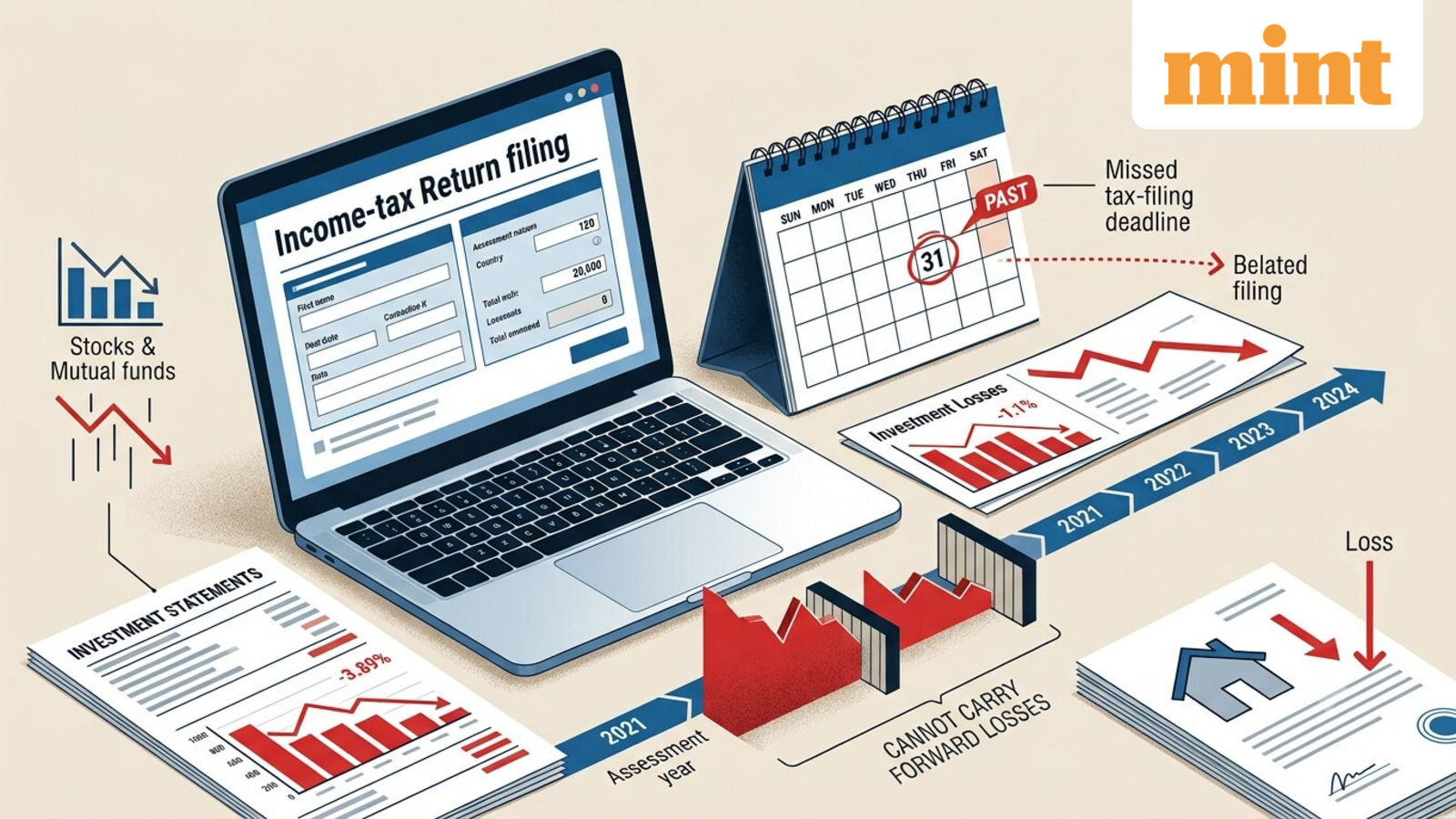
Filing belated ITR for AY 2026-27? Know which losses you can carry forward under income tax rules— and ones you can’t
Missing the ITR deadline does not necessarily mean you can no longer file your return. For AY 2026-27, taxpayers who missed the applicable due date can file a belated return until 31 December 2026.
However, filing late can affect your ability to carry certain losses into future years. This is particularly important for taxpayers who have incurred losses from shares, mutual funds, property or other capital assets.
What happens if you file your ITR after the due date?
Under Section 139(4) of the Income-tax Act, 1961, a belated return for AY 2026-27 can be furnished by 31 December 2026 or before completion of assessment, whichever is earlier.
A late-filing fee under Section 234F can also apply. It is ₹1,000 if total income does not exceed ₹5 lakh and ₹5,000 in other cases.
For taxpayers who missed the July or August deadlines, this provides an additional window to submit their return. But filing within this extended period does not necessarily preserve every tax benefit.
Which losses are affected by a belated return?
Capital losses are the key concern. If you want to take an unused capital loss into later years, the return for the year in which that loss arose must have been filed by the original due date under Section 139(1).
This covers both short-term capital loss (STCL) and long-term capital loss (LTCL).
For example, suppose you incur a ₹2 lakh STCL in AY 2026-27 and have ₹1 lakh of eligible short-term capital gains (STCG) in the same year. The loss can be used against those gains even if you are filing a belated return this year. If you subsequently earn ₹1 lakh in short-term capital gains next year, the carried-forward loss can reduce the taxable gain to ₹1 lakh.
But if the original return was not filed by the Section 139(1) due date, the capital loss cannot be carried forward. Filing a belated return later does not restore that benefit.
How do short-term and long-term capital losses differ?
STCL can be adjusted against both short-term and long-term capital gains. LTCL can be used only against long-term capital gains.
Eligible capital losses can be carried forward for eight assessment years, subject to the timely-filing requirement.
Which losses can still be carried forward after a late return?
Not every type of loss is treated in the same manner. A loss from house property can be carried forward for up to eight years even if the return reporting that loss is filed after the Section 139(1) deadline.
For example, suppose you have a ₹3 lakh loss from house property in AY 2026-27 because the interest paid on your home loan is higher than the rental income. The eligible loss can be carried forward for up to eight years and set off against house-property income in subsequent years.
This is the key distinction: a belated return can still allow eligible current-year loss to be set off, but the rules for carrying any unabsorbed loss into future years depend on the type of loss.
Disclaimer: This is only for informational and educational purposes. Please consult a qualified expert for the latest laws and regulations.