UPI MDR Charges: Will small-value transactions be impacted? What’s Person-to-Merchant (P2M) fees? Details inside
The Unified Payments Interface (UPI) is set to see a change in the way certain merchant transactions are charged from 15 October 2026.
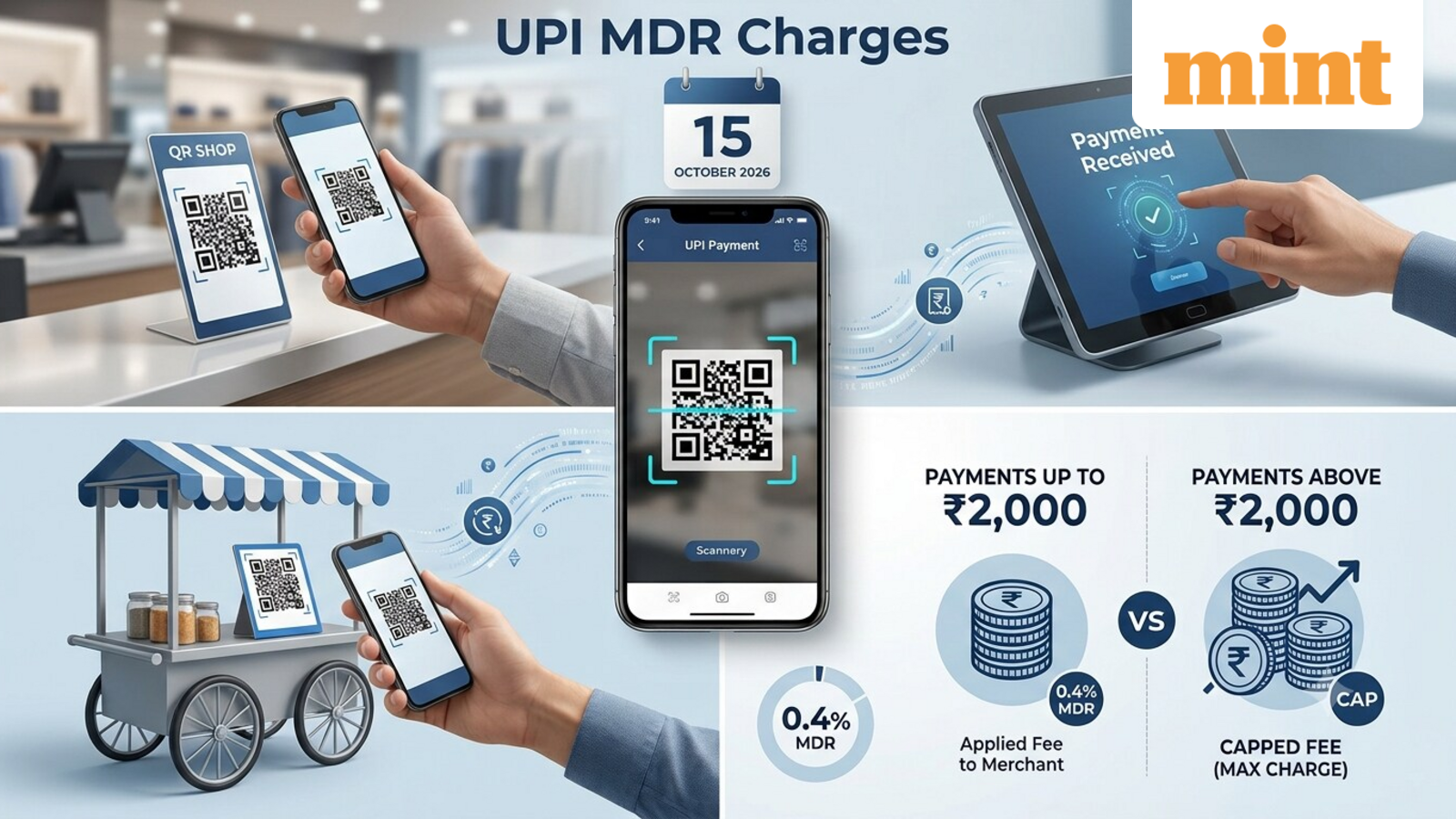
An MDR (Merchant Discount Rate) of 0.4% will apply to eligible P2M UPI payments above ₹2,000. However, this is a charge on the merchant side and not a fee that customers will have to pay for making a UPI payment.
According to the FAQs issued by the National Payments Corporation of India (NPCI) on 15 September 2026, the revised framework has different provisions for regular commercial merchants, small vendors, and certain sectors. Here’s what you need to know.
Will small-value transactions be impacted?
No. UPI P2M transactions of up to ₹2,000 will continue to remain outside the MDR framework.
According to the Ministry of Finance, “approximately 96% of merchant transactions will remain unaffected, as they are either below the ₹2,000 threshold or covered by the zero-MDR framework for small merchants.”
What are Person-to-Merchant (P2M) fees?
For P2M transactions above ₹2,000, an MDR of 0.4% will apply. The charge is borne on the merchant side rather than being collected from the customer making the payment.
There is also a ceiling for larger transactions. For a UPI payment of ₹75,000 or more, the MDR will be limited to ₹300 per transaction.
For example, 0.4% of a ₹1 lakh payment would come to ₹400. However, because of the cap, the applicable MDR would be ₹300.
What does P2M mean in UPI?
P2M stands for Person-to-Merchant. It refers to a UPI payment made by an individual to a business, merchant, or service provider for a purchase or service.
For example, when a customer scans a shop’s UPI QR code and pays for goods or services, it is generally a P2M transaction.
Will small merchants also have to pay MDR?
Not necessarily. Small vendors covered under the P2PM (Person-to-Person-Merchant) framework will continue under the zero MDR framework.
P2PM refers to a special merchant classification for small vendors who receive UPI payments through QR codes directly into their personal bank accounts. Merchants collecting up to ₹1 lakh a month under this category are eligible for zero MDR, including on individual payments above ₹2,000.
Therefore, a P2PM merchant covered by the exemption will continue to receive zero MDR even when a single UPI payment exceeds ₹2,000.
Is GST registration needed to qualify for P2PM merchants?
No. A small merchant does not need GST registration to qualify for the P2PM zero-MDR benefit. Eligibility is based on the merchant’s bank account classification and monthly UPI collection limit of up to ₹1 lakh, rather than whether the business has a GST registration.
What are the other UPI MDR rates apart from 0.4%?
Certain merchant categories, including railways, telecom, insurance, and fuel, will have a different structure for eligible transactions above ₹2,000.
Instead of the 0.4% rate, these categories will attract a flat MDR of ₹5 per transaction. This means the charge does not increase with the value of the transaction once it crosses the ₹2,000 threshold.
However, payments related to mutual funds, securities, and stockbrokers will attract an MDR of 0.02%, with a maximum charge of ₹300 per transaction. Here too, the charge does not apply to the customer or investor.
Will a UPI transfer made directly to another person attract MDR?
No. Person-to-Person (P2P) UPI transactions will remain free, regardless of the amount transferred. This means individuals will not be charged MDR when sending or receiving money through UPI from friends and family.
Disclaimer: This is for informational purposes only. Please visit the official website for the latest updates.