History Says Stocks Typically Fall After a Fed Hike Cycle Begins — Then Gain 6.8% Within a Year. Here’s My Plan.
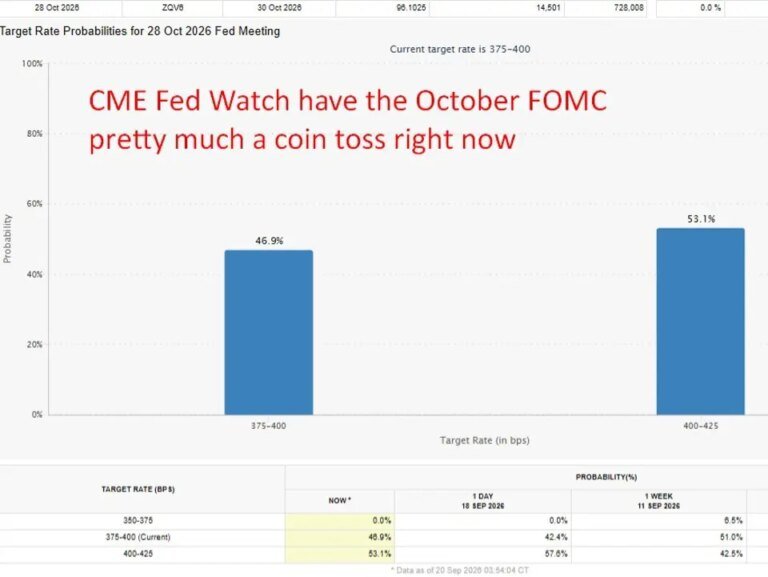
Last month, the Federal Reserve raised interest rates for the first time since 2023. It will likely continue raising them in the near term as it works to get inflation back under control.
The S&P 500 Index (^GSPC +0.73%) has historically declined once the Federal Reserve starts raising rates. However, it typically recovers within a year. That’s why I plan to capitalize on any near-term weakness by adding to stocks I expect to participate in the eventual recovery.

Image source: Getty Images.
The historical pattern
According to data from RBC Capital Markets and LPL Financial, the S&P 500 has declined in five of the last six Fed rate hike cycles. The S&P 500 has fallen between 1.6% and 15.5% three months after the first hike in those down periods. It has fully recovered within 12 months of the first hike in four of those five periods. The only time the S&P 500 didn’t decline during a Fed rate-hike cycle was in 1997, when the Fed raised rates by only 25 basis points. Meanwhile, the only time it wasn’t up one year after the initial hike cycle began was the 2022-2023 cycle, when the Fed’s 525-basis-point hike over 16 months triggered the 2022 bear market in stocks, with the S&P 500 dropping 25% from its peak. LPL Financial found that the S&P 500’s median gain was 6.8% 12 months after a rate hike cycle began.
Most Fed watchers don’t expect a repeat of the 2022-2023 rate hike cycle this time around. The current implied rate path based on Fed Funds futures prices suggests it will raise rates by only about 100 basis points. That would be the second-smallest increase over the past three-plus decades.
My Fed hike cycle playbook
It wouldn’t surprise me if the S&P 500 cooled off a bit over the next few months. We’re entering a Fed rate hike cycle at a time when the market is historically overvalued. That’s why I’m starting to strategically build more cash in my portfolio to capitalize on that potential opportunity by selling some low-conviction holdings and letting my dividend income pile up. I’m also putting together a watch list of stocks I’d like to buy if the market declines.
One company near the top of that list is Berkshire Hathaway (BRKB +0.43%)(BRKA +0.41%). The investment conglomerate is in a strong position to capitalize on a decline in the stock market. Berkshire Hathaway currently has over $365 billion in cash on its balance sheet, about a third of its market cap. That gives it a huge war chest to capitalize on a market decline. It could repurchase additional shares at a lower valuation, purchase publicly traded stocks for its investment portfolio at lower prices, and acquire operating businesses at more attractive values. I plan to buy more Berkshire shares in anticipation of a market decline and will further boost that position if we get one and its stock drops.

Today’s Change
(0.43%) $2.15
Current Price
$502.65
Key Data Points
Market Cap
Day’s Range
$499.01 – $503.62
52wk Range
$464.01 – $537.74
Volume
4.2M
Avg Vol
4.3M
Gross Margin
23.52%
Coca-Cola (KO -0.52%) is also on my watch list. The beverage giant currently trades at 26 times earnings, which is justifiable for a premium brand. However, I’d pounce on the opportunity to add to my position if Coca-Cola stock declines during a stock market sell-off. The company generates durable, growing financial results, driven by consistently strong demand for its beverages. Coca-Cola expects to deliver 4%-6% annual organic revenue growth and 7%-9% comparable currency-neutral earnings-per-share growth over the long term. That positions it to continue increasing its dividend, which it has done for 64 straight years. If Coca-Cola’s dividend yield (currently 2.5%) ever got back up to around 3% (as it did during the last rate hike cycle), I’d guzzle down more shares.
While history might not repeat, it’s always wise to be prepared
I’ve been strategically building cash in my portfolio as the market has risen to capitalize on its next pullback. It wouldn’t surprise me if we got one over the next few months, given the S&P 500’s history during Fed rate hike cycles. That’s why I’m building a watch list of stocks I want to buy if there’s a pullback. While there’s no guarantee we will get a one, it’s always good to prepare in advance just in case.
Matt DiLallo has positions in Berkshire Hathaway and Coca-Cola. The Motley Fool has positions in and recommends Berkshire Hathaway. The Motley Fool has a disclosure policy.