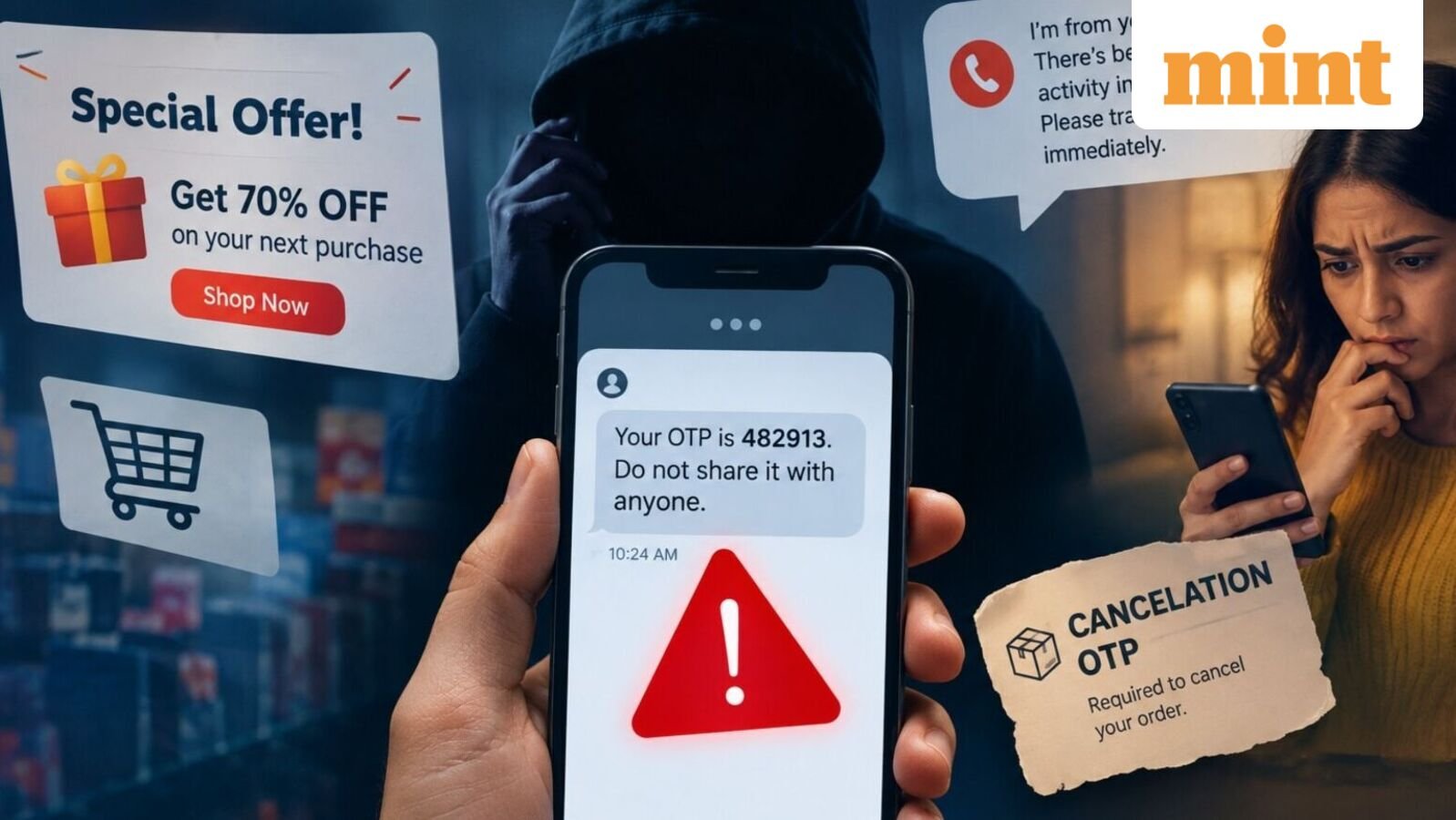
Cancellation OTPs, fake offers, and urgent pleas: How scammers are using tactics to defraud people and how to stay safe
Cyber frauds in India are becoming increasingly sophisticated, making it extremely difficult even for well-educated people to differentiate between a genuine request and a scam.
Scammers use fear and stress to target even the well-educated
Even well-educated people can fall prey to cyber fraud, often when they least expect it. For Prerna (name changed), a highly qualified working professional, it started with an offer that sounded too good to ignore: buy ₹4,000 worth of products from a well-known skincare website and stand a chance to win an iPhone. On another occasion, a random caller claimed that her father had shared her number and asked her to transfer a specific amount of money. Then came another call, this time from someone claiming to be a Valmo delivery partner, who asked for a cancellation OTP for a cash-on-delivery order.
While Prerna did not fall prey to the scams on the first two occasions, even she was confused by the third attempt. How could she possibly receive a message about a product being out for delivery when she had not placed an order? While she decided to ignore it for the time being, she was taken aback by what happened next.
After the delivery partner reached her apartment, she tried convincing him that this was not her order and must have been a mistake. She repeatedly showed him her order page on the app, which did not have the said order. However, the so-called delivery partner refused to budge and sought a cancellation OTP — a move that Prerna initially thought was harmless, until it wasn’t.
After giving him the cancellation OTP, she told her family about the incident. They were aware of this tactic being used to scam people and empty their bank accounts. She immediately went into a state of panic and was asked to change her bank account passwords and UPI app PINs, thereby averting what could have been a traumatic experience for her.
Highly educated people fall prey to cyber fraud, reveals study
However, Prerna’s experience is not an isolated one. A recent study conducted by IIT Madras researchers revealed that even highly educated and digitally experienced people can fall prey to financial cyber fraud, with scammers often using tactics like fear, stress, and urgency to impair their ability to assess the situation properly.
Cyber fraud incidents in India soar
The scale of the problem is reflected in the government’s data. According to the Ministry of Home Affairs, more than 65.89 lakh financial-fraud complaints were reported on the National Cyber Crime Reporting Portal between 2021 and 2025, involving more than ₹55,050 crore. The number of complaints has also risen sharply over the years, from 2.62 lakh in 2021 to 24.02 lakh in 2025, while the amount reported increased from ₹551 crore to ₹22,495 crore during the same period.
Types of cyber frauds
With cyber fraud becoming more widespread, scammers are also using a range of tactics to target victims, often disguising fraudulent requests as routine or legitimate interactions. Some of the most common frauds include digital arrest scams, courier or parcel scams, UPI collect request scams, KYC update scams, and investment/stock-trading scams.
How to stay safe from financial frauds?
Vijay Pal Dalmia, Advocate and Senior Partner at Vaish Associates, shared tips for people to stay safe from financial frauds. Dalmia noted, “Consumers in India can stay safe from cyber fraud by guarding sensitive credentials, avoiding unverified links, and immediately reporting suspicious activity to the national helpline 1930 or the National Cyber Crime Reporting Portal. Consumers should also use Multi-factor authentication and never share OTPs.”
He suggested that if someone becomes a victim of cyber fraud, apart from calling the portal and reporting the incident, they should also “save pictures of fraudulent messages, transaction receipts, chats, and caller numbers, besides keeping emails, text logs, and transaction URLs active until authorities record them/ reporting. The victim should also immediately change passwords and secure accounts.”
For delivery-related scams, Dalmia suggested, “If someone receives a cancellation OTP for a product that was not ordered, the delivery should be refused immediately, and the OTP should never be shared with anyone. This is a well-known financial scam where fraudsters use fake Cash on Delivery (COD) parcels to trick the victim into giving up an authorization code that can compromise the victim’s bank account or data.”
Prerna’s experience serves as a reminder that scammers do not always reach out in the form of an obviously suspicious message or call. They often make their requests appear familiar, credible, and urgent, making it important to pause and verify before sharing an OTP, clicking a link, or making a payment.