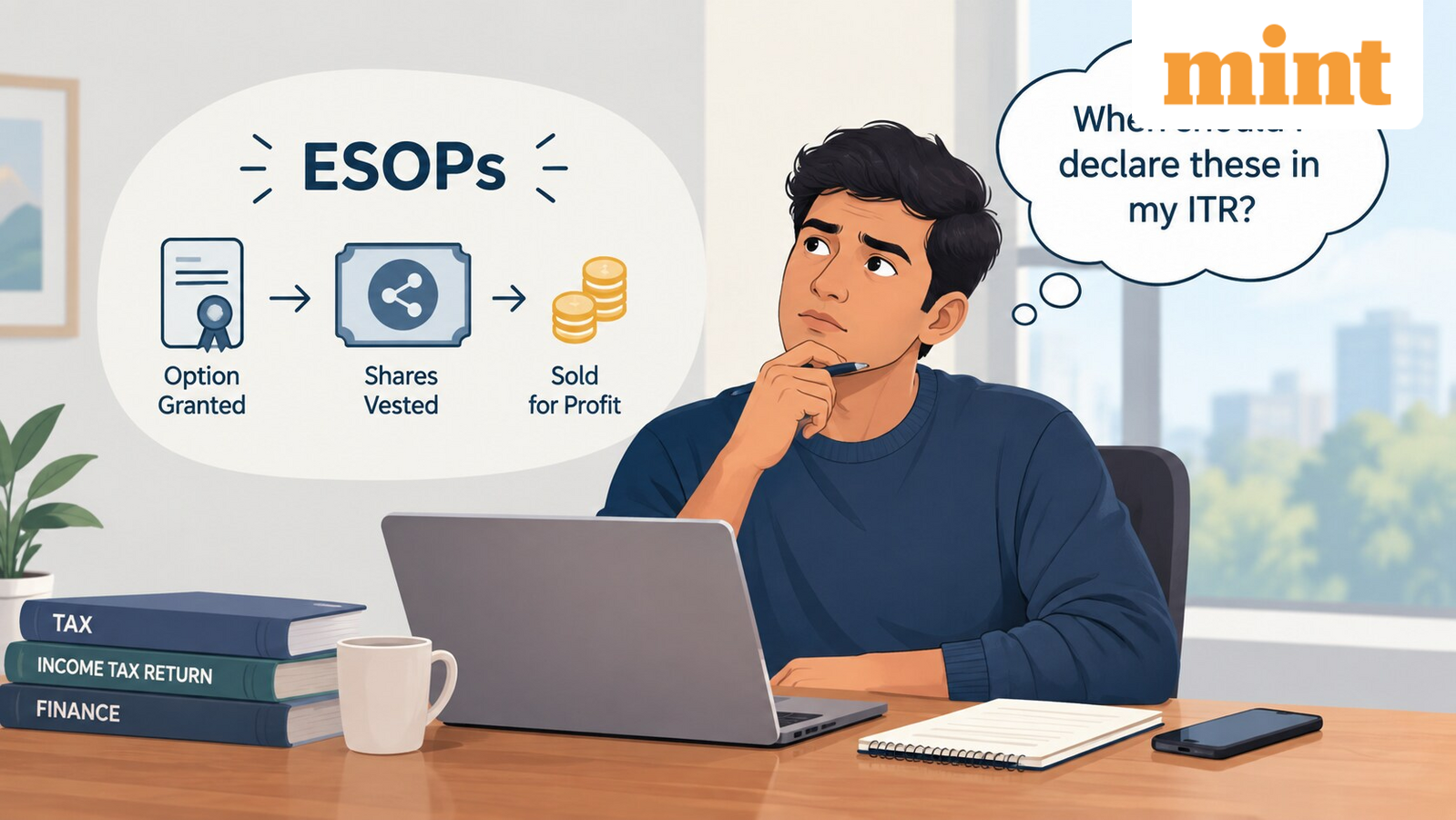
ESOPs as part of salary: When should Indian employees of foreign companies declare these shares in ITR?
Indian employees who work for foreign companies often receive employee stock options (ESOPs) as part of their compensation packages. They give employees the right to acquire equity shares of the company after meeting certain vesting conditions, allowing them to benefit from the firm’s future growth.
If an individual leaves the company before the options vest, they generally lapse, although the exact terms depend on the ESOP scheme.
Foreign ESOPs can also bring tax and disclosure requirements in India. The reporting obligation may depend on the stage at which the employee holds or acquires the foreign shares, making it important to understand when the disclosure requirement actually kicks in.
When should you declare ESOPs for taxation?
Since the financial benefit from ESOPs is not immediate, they do not trigger tax obligation merely because they have been granted to an employee.
In most case, taxpayers report these options only when they generate some income, either in form of capital gains or dividend.
How are foreign ESOPs taxed in India?
The taxation of foreign ESOPs for Indian employees follows a similar structure to that of Indian ESOPs, as outlined in the Income Tax Act, 1961. The process occurs in two different stages.
— At the time of exercise (taxed as a perquisite under salary income)
When an employee exercises the option, they basically agree to buy the company’s shares. At this stage, the difference between the fair market value (FMV) of the shares on exercise date and the exercise price is taxed as perquisite.
The employer then calculates TDS (tax deducted at source) on this perquisite value, which is submitted to the government. The amount is shown in the employee’s Form 16 and must be included under salary income while filing the income tax return (ITR) in the relevant financial year.
— At the time of sale by the employee (taxed as capital gains)
If the employee later sells the shares acquired through ESOPs, a second tax liability arises. In this case, the difference between the sale price and the FMV considered on the exercise date is taxed as capital gains.
If you sold listed shares which were held for more than 12 months, then they are treated as long-term capital gains. Meanwhile, stocks that were sold within 12 months are considered short-term gains.
What about double taxation for Indian employees?
When Indian employees receive equity-based compensation from a foreign employer, they may be concerned about double taxation. This could mean paying tax in both the employer’s country, such as the United States, and India, where the employee is a tax resident.
However, India has Double Tax Avoidance Agreements (DTAAs) with several countries, including the United States, which help ensure that individuals don’t pay tax twice on the same income.
In some cases, a foreign employer may withhold tax in its home country, often through a sell-to-cover transaction, in which a portion of the shares is sold to cover the estimated tax liability. If foreign tax has been paid or withheld, an employee may be able to claim a foreign tax credit while filing their Indian ITR, subject to applicable rules, according to a blog post by Equity List.
The credit can apply to both the perquisite income and capital gains, depending on the nature of the foreign tax paid.
In many cases, particularly for employees of large technology companies, ESOPs can generate substantial wealth if the company’s share price rises. For example, if a person has an ESOP with an exercise price of ₹100 per share and the shares are worth ₹300 when the option is exercised, the employee acquires them at ₹100. If the shares are later sold for ₹400, the employee makes am easy profit.