Tesla Is the Only Magnificent Seven Stock in the Red for 2026
It’s been a good year for most of the Magnificent Seven. As of this writing, Apple and Nvidia are both up over 23% in 2026, and even Microsoft, the smallest gainer, is up about 7%. Alphabet, Meta Platforms (META +0.10%), and Amazon land in between.
Then there’s Tesla (TSLA -0.20%). At roughly $347 as of this writing, the electric-car maker’s shares are down about 23% this year and about 29% off their record close of $489.88, set in December 2025.
It’s the only one of the seven in the red.
The strange part, I think, is that Tesla’s sales are rising again. The gap shows up further down the income statement.

Image source: Getty Images.
Is demand the problem?
Not lately. Tesla delivered 480,126 vehicles in the second quarter, up 25% year over year and a sharp acceleration from 6% growth in the first quarter. This followed a tough 2025, when deliveries dropped around 9% to 1,636,129.
Tesla’s second-quarter revenue climbed 26% year over year to about $28.2 billion, beating the latest-quarter growth rates for Apple (16%), Microsoft (18%), Amazon (20%), and Alphabet (24%).
Yes, some of that’s a rebound from a poor 2025. But on sales alone, Tesla fits right in with the rest of the group.
Tesla’s profits aren’t keeping up
Showing how little of that growth reaches the bottom line, Tesla’s second-quarter operating income dropped 57% year over year to around $398 million. Its operating margin (the share of revenue left as operating profit) shrank to just 1.4%, down from 4.1% in the year-ago quarter, as operating expenses jumped 47%. Non-GAAP (adjusted) earnings per share dropped 18%. And in the first half of 2026, Tesla delivered 16% more vehicles than a year before but earned around the same operating income ($1.34 billion vs. $1.32 billion).
The other six look very different. Five of them raised operating income by double digits in their latest quarters, from 18% at Microsoft to 124% at Nvidia.
Even Amazon, which has the lowest margins among the six, kept about 14 cents of every sales dollar as operating profit. Tesla kept about 1.4 cents.
Meta’s the exception. Its second-quarter operating income dropped 8%, hurt by $2.4 billion in legal charges and $1.18 billion in severance. But its operating margin was still 31%, and management expects full-year operating income to beat 2025’s.
Spending first
Sure, low margins might matter less if the payoff looked close. But Tesla expects capital expenditures of over $25 billion in 2026, due to its AI initiatives. With around $8.3 billion spent in the first half, that implies more than $16 billion in the second. Second-quarter free cash flow was already negative $1.1 billion. And on Sept. 29, Tesla signed $30 billion in new credit facilities, but it doesn’t currently plan to tap them this year.
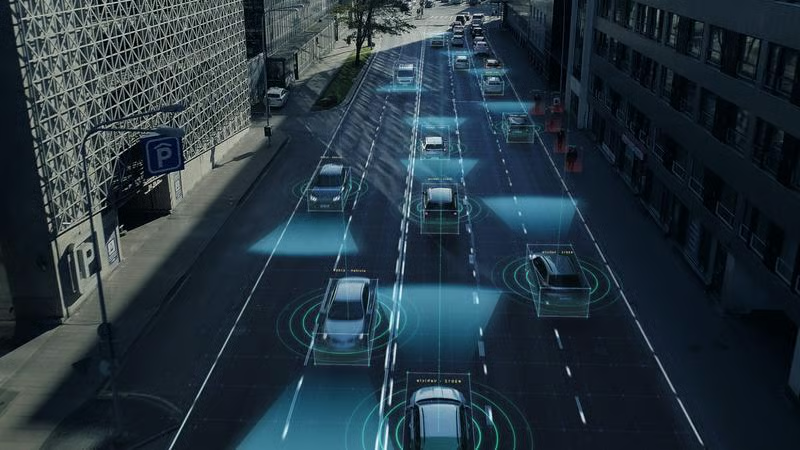
The projects this spending funds are still early. Tesla’s Robotaxi service was live in seven major metro areas by its second-quarter update, and the steering-wheel-free Cybercab began giving rides to Robotaxi app users in a limited part of Austin in early September. But Tesla doesn’t break out robotaxi revenue, so investors can’t yet tell what the service makes.
Meanwhile, the stock already prices in a lot of success. Based on next year’s expected earnings, Tesla’s price-to-earnings ratio is around 155. Nvidia’s stock, in comparison, costs about 15 times next fiscal year’s expected earnings, even though its operating income more than doubled last quarter.

Today’s Change
(-0.20%) $-0.70
Current Price
$354.11
Key Data Points
Market Cap
Day’s Range
$353.80 – $359.79
52wk Range
$297.38 – $498.83
Volume
31.1M
Avg Vol
38.6M
Gross Margin
18.85%
What can the delivery count add?
Tesla hasn’t given a date for its third-quarter delivery release. But its past two quarterly counts came out on the second day of a new quarter, so the next one may arrive within days.
A year ago, Tesla delivered a record 497,099 vehicles, so it probably needs another record just to show growth. Still, even a strong count can’t settle what separates Tesla from the other six this year.
“Tesla vehicle deliveries and storage deployments represent only two measures of the Company’s financial performance and should not be relied on as an indicator of quarterly financial results,” the company wrote in its July 2 delivery report.
In the end, Tesla’s 2026 problem isn’t that customers quit buying its cars. It’s that the business keeps very little of what it sells — while spending heavily on projects that haven’t paid off yet. At around 320 times the past year’s earnings, I’d say Tesla stock’s still too pricey for a company that kept 1.4 cents in operating profit on every sales dollar last quarter.