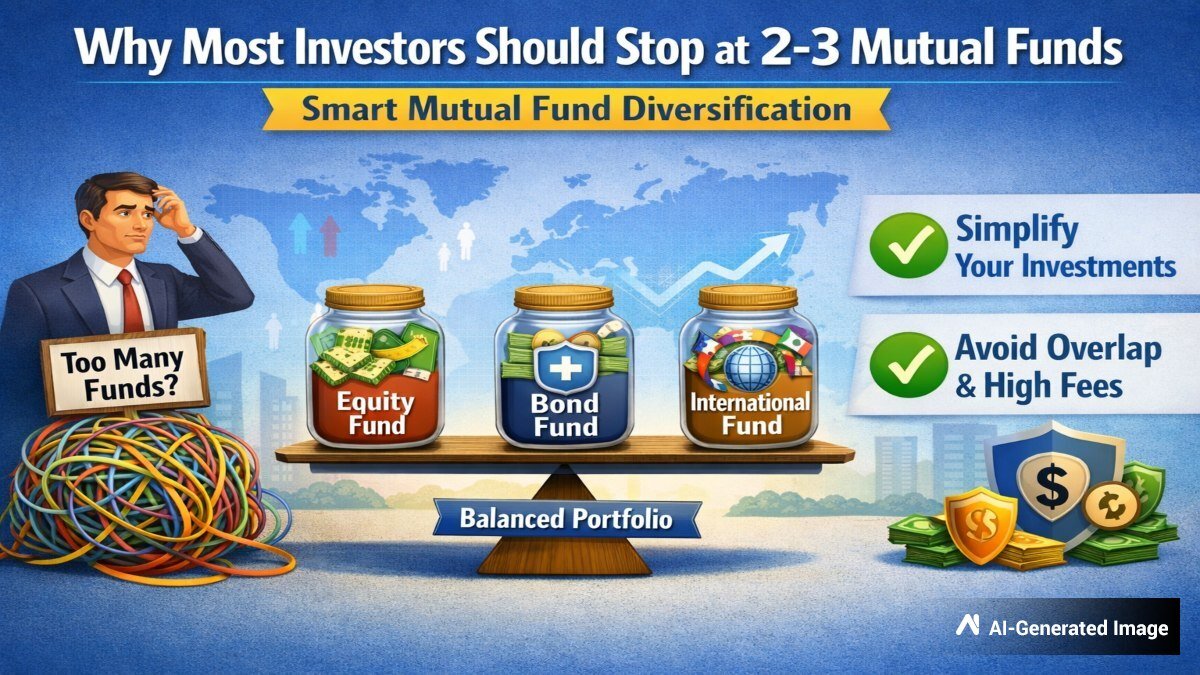
Optimal Mutual Fund Diversification: Why Two to Three Schemes Suffice
World Finance
Many mutual fund investors follow the old rule, “don’t put all your eggs in one basket”. New investors often take it literally. They keep adding schemes for more variety. Yet beyond a point, extra funds stop reducing risk. For most retail investors, two or three carefully chosen mutual funds usually cover enough ground.
Holding many schemes can also hurt results. It may raise costs and reduce clarity. It can make investors less confident during market falls. A smaller set of funds is easier to monitor and review. It also keeps investing habits steady, including regular SIPs, without constant changes and second-guessing.
The main trap is false diversification. Investors may buy several equity funds and assume risk is spread. Often, those funds own many of the same companies. This repeated exposure is called portfolio overlap. Many top funds in one category lean towards the same market leaders. Investors then pay multiple fees for similar holdings.
A tighter mix can reduce this duplication. Two to three schemes with clear roles can help. One example is pairing a Nifty 50 index fund with a mid-cap fund. Each fund then serves a different purpose. The aim is simple coverage across segments, not repeated bets on the same large stocks.
/img/2026/07/mtual-fund6-1782121455.jpg "Two to Three Funds: Smarter Diversification")
Too many funds can turn investing into routine admin work. Each added scheme increases tracking needs. Investors end up checking several NAVs and reading many factsheets. Fund-manager changes also need attention. This effort rarely improves outcomes. It mostly adds noise, especially when several schemes behave in similar ways.
Tax season can make a large portfolio harder to manage. Rebalancing ten funds needs careful calculations. Investors must check whether asset allocation has shifted. Capital gains reporting can also become messy. Consolidated statements may include many entries across schemes. A smaller portfolio keeps records cleaner and reduces time spent on compliance tasks.
Mutual funds and diluted returns
Spreading money across many schemes can weaken performance. Investors may create an expensive version of an index fund. A strong year in one fund may not matter much. That happens when the winning stock is only 0.5% of total wealth. This effect is often described as diluting your returns.
Another issue appears when funds or portfolios become too broad. Some active schemes can turn into “closet indexers” over time. When investors hold too many such funds, the combined portfolio can mimic the market. Yet costs remain higher than a simple index approach. Fewer, higher-conviction holdings can make strong ideas matter more.
Tracking also has a behavioural side. Investors need conviction to stay invested in downturns. It is hard to understand ten different strategies in depth. During a crash, confusion can lead to poor timing. Without knowing the “why” behind each holding, investors may sell low or chase a “hot” fund.
A simpler set of two to three funds is easier to “know”. Investors can understand goals, risks, and key holdings faster. That clarity can support discipline during volatility. It also reduces hidden duplication and keeps monitoring practical. For many retail investors, simplicity helps manage risk while staying invested for long-term wealth creation.