Life-cycle mutual funds vs DIY portfolio: Automate investing or manage it yourself for 30 years—what experts suggest
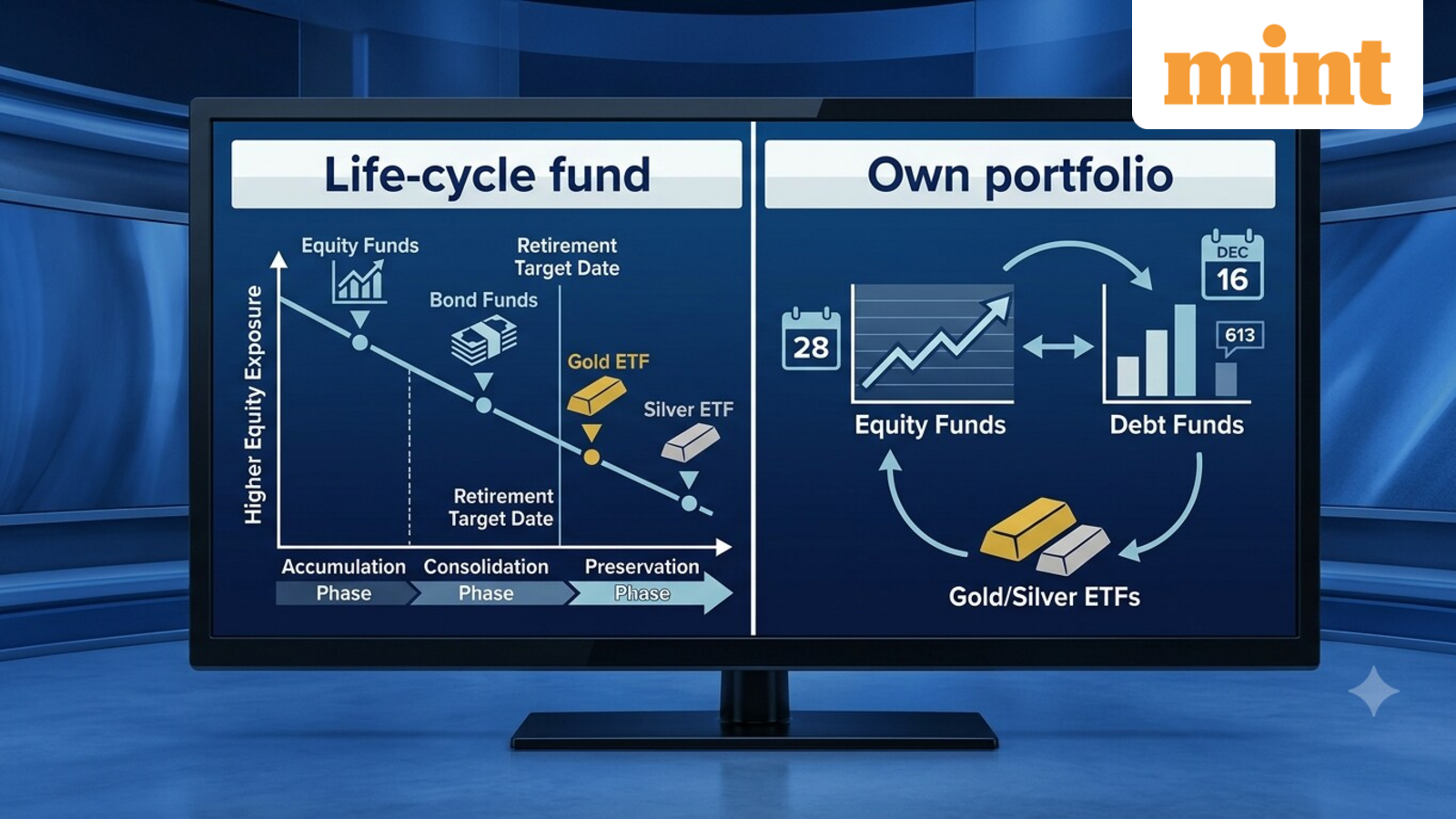
When investing for long-term goals such as retirement or a child’s future, you have two options: choose a life-cycle fund that automatically changes its asset allocation over time, or create your own do-it-yourself (DIY) portfolio of equity or debt funds and gold or silver ETFs.
Life-cycle funds follow a predetermined glide path, gradually changing the asset mix as the goal approaches. However, a self-built portfolio gives investors greater control over their asset allocation. Here’s what experts have to say.
How do life cycle funds work?
SEBI permits life-cycle funds with 5-, 10-, 15-, 20-, 25-, and 30-year maturities. For a 30-year fund, equity can range from 65% to 95% when 15 to 30 years remain, gradually falling to 5% to 20% in the final year. Gold or silver ETFs can account for up to 10% throughout the glide path, Jasmeet Singh, Executive Director, Anand Rathi Wealth, explained.
However, the glide path is not necessarily a smooth year-by-year decline. SEBI has prescribed allocation bands, and where a fund sits within those bands is the fund manager’s decision. Two funds maturing in 2056 can look quite different in 2040, Sougata Basu, Founder and CEO, CashRich, said.
Which life-cycle funds are available?
As of 29 September, seven life-cycle fund schemes from three AMCs were available, with maturity horizons of 5, 10, 15 and 30 years. No 20-year or 25-year fund has been launched yet, Basu said.
Zerodha Fund House currently offers three types, which are the Zerodha Life Cycle Fund 2031 (5-year horizon), 2036 (10-year horizon), and 2041 (15-year horizon). ICICI Prudential has launched funds with target years of 2031, 2036, and 2041. Mirae Asset has launched a 2056 fund for investors with a 30-year horizon, Singh mentioned.
SEBI’s March 2026 master circular also limits fund houses: one that keeps its old retirement fund cannot launch a 30-year life-cycle fund, and one that keeps a children’s fund cannot launch a 20-year fund. Some large houses, ICICI Prudential among them, still run a retirement fund, Basu added.
Who should consider a life-cycle fund and who can avoid it?
A life-cycle fund suits the investor who would otherwise never rebalance. One decision, one SIP, one date. The fund does the rest, and rebalancing inside the fund does not itself trigger capital gains tax for the investor, Basu said.
However, Singh suggested investors could build separate portfolios for different time horizons—a long-term basket, a medium-term basket and a short-term basket. A possible allocation could be 80:20 equity-debt for long-term goals, 70:30 for medium-term goals, and 100% debt for short-term goals.
How can you build a DIY portfolio for a 30-year goal?
Basu suggested the following framework to create your own portfolio:
- For someone with 30 years to retirement, start with 70% to 80% equity through a flexi-cap or broad index fund, 10% to 20% in a short-duration or corporate bond fund, and 5% to 10% in gold or silver ETFs.
- As retirement approaches, equity could be reduced roughly every five years—to about 65% at 15 years, 50% at 10 years, 35% at five years, and 20% in the final two years. Debt would make up the balance, while gold or silver could remain at 5% to 10%.
Does a life-cycle fund make sense for a 5-year goal?
For a 5-year goal, a life-cycle fund starts with 35% to 50% equity and 25% to 50% debt, giving it a hybrid-fund-like allocation with a defined glide path. However, investors should also consider the exit load and whether the goal date is fixed, Basu said.
A fixed goal, such as a child’s college admission in 2031, can suit a life-cycle fund because it reduces the need for regular portfolio management. For a flexible goal, such as a house purchase in about five years, a self-built portfolio (DIY) may offer more flexibility, he added.
The main factor investors should consider while deciding their asset allocation is their time horizon and years left before they need their money, Singh mentioned.
What are the key takeaways for investors?
There is a chance for life cycle funds to gain traction as investors would prefer a hands-off approach. But investors would be more suited to manually construct their own portfolio for different time horizons, Singh said.
The 30-year maturity life-cycle fund may suit investors who are starting out or unlikely to review their portfolio. A 20-year life-cycle fund, once available, could serve a similar investor. At 15 and 10 years, a life-cycle fund may suit those with a fixed goal date, while investors whose timelines can change may prefer to build their own portfolio, Basu said.
A self-built portfolio also offers more flexibility to hold more gold or debt than the prescribed bands allow, he added.
Disclaimer: This story is for educational purposes only. The views and recommendations made above are those of individual analysts or broking companies, and not of Mint. We advise investors to check with certified experts before making any investment decisions.
About the Author
Sheetal Goel is a Content Producer at Livemint, where she covers corporate developments, personal finance, business trends, markets, and SEBI-related updates. She focuses on simplifying complex financial concepts and presenting them in a clear, reader-friendly manner, thereby helping audiences better understand investment trends, personal finance, and market developments. Her writing focuses on making finance more accessible to everyday readers while maintaining clarity, accuracy, and relevance.
She holds a degree in Economics (Hons.) along with an MBA in Finance, which has helped her develop a strong foundation in financial analysis, market understanding, and business reporting. Before joining journalism, she worked with finance and broking firms, where she closely followed market developments, investment strategies, and evolving industry trends. This practical exposure strengthened her understanding of financial markets. She has also written content across multiple formats and platforms, including YouTube, LinkedIn, and Instagram.
Over time, she has developed expertise in covering market-linked stories, investor-focused topics, and regulatory updates in a simplified yet informative style. She also enjoys reading and listening to Hindi poetry, reflecting her appreciation for literature and creative expression beyond the world of markets and numbers.