Gen Z now constitute 38% of investors — Here’s why they choose capital markets, how India’s wealth inclusion has evolved
Gen Z or investors under the age of 30 now comprise 38% of the investor base in India, up from 23% in FY19, according to estimates in EY India’s latest report on wealth inclusion trends in India.
The EY report dated September 2026, titled ‘Wealth inclusion in India: Expanding investor participation beyond metros’, noted that based on how the trends have evolved, India can add 10 crore long-term investors by 2035 as wealth creation expands to tier 2 and 3 cities. In a release on 29 September, it stated new investors can be credited to rising participation from smaller cities, young investors, women and digitally connected households.
As per the data, the opportunity is underpinned by a largely untapped base of financially connected consumers:
- India currently has over 550 million active UPI users.
- In comparison, around 62 million individuals invest in mutual funds and
- Approximately 50 million actively participate in equity markets.
- “The gap indicates that while digital access has scaled rapidly, broad-based wealth participation is still at an early stage,” it added.
Investor growth moves beyond metros
The next wave of wealth creation is expected to emerge from salaried households in Tier 2 and 3 cities, women, young professionals and Gen Z investors, according to Pratik Shah, National Financial Services Leader at EY India. Trends show:
- Cities beyond India’s top 110 cities now contribute 12% of mutual fund assets under management,
- Districts beyond the top ten account for 70% of NSE-registered investors trading in FY25.
- Investors under the age of 30 now represent 38% of the investor base (June 2026), up from 23% in FY19,
- In B30 cities, women investors accounted for 25% of investors in FY24, up from 20% in FY19.
- SIPs now account for 35% of total individual mutual fund AUM, compared with 19% in FY19.
- Micro-SIPs of approximately $2.6 and distribution partnerships spanning more than 2,50,000 rural touchpoints are also supporting participation among first-time, underserved and rural investors, it added.
Capital markets have become mainstream
As per the report, capital markets — including mutual funds, listed equities, SIPs, retirement-oriented investment solutions and simplified fund structures are increasingly becoming part of mainstream household portfolios. “Financial markets are no longer viewed solely as an avenue for affluent or institutionally advised investors; they are rapidly becoming a core component of household wealth creation across income segments,” it noted.
It added that investor participation has expanded dramatically, with the number of demat accounts across NSDL and CDSL rising around 5.5 times since the pandemic, crossing 23 crore accounts, while the number of unique registered investors on the NSE has exceeded 13 crore.
“The next decade is expected to witness an even deeper shift toward direct equity ownership,” it said, adding that individual equity holdings are projected to grow 3-4x to approximately $2.5-$3 trillion (as per World Bank data), accompanied by the addition of more than 12 crore new investors.
Gen Z, millennials to drive investment growth
According to the report, much of the expected growth is likely to be “driven by Gen Z and millennial cohorts, whose investment behavior is characterised by digital-first engagement, greater familiarity with financial products and a stronger orientation toward long term wealth accumulation”.
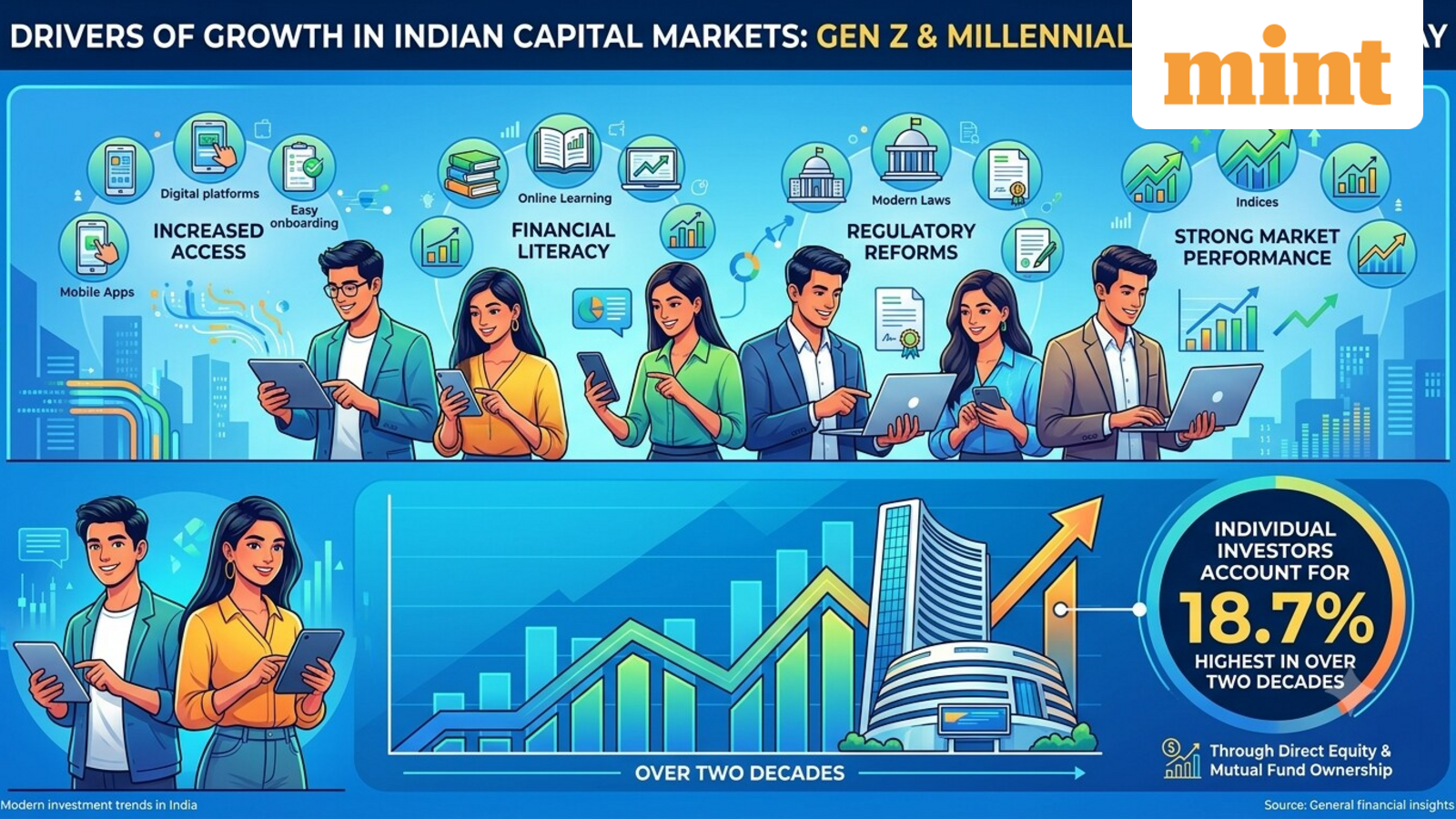
Why are younger investors more engaged in the capital markets? The reasons are numerous:
- Technology: Emergence of digital wealth platforms, discount brokers and mobile-first investment journeys has significantly reduced entry barriers, making market participation simpler, faster and more cost effective.
- Financial literacy: Continuing improvements here have expanded awareness of investing beyond traditional savings instruments, encouraging households to allocate a greater share of their financial assets toward market-linked products.
- Regulatory reforms: While derivatives have attracted significant retail interest in recent years, regulatory reforms introduced by SEBI, including tighter position limits, enhanced surveillance mechanisms and stricter index eligibility norms, are expected to curb excessive speculation and promote healthier participation. Over time, this is likely to support a gradual shift toward long-term investing and balanced portfolio construction, combining direct equities, mutual funds, and risk-managed exposure to derivatives.
- Strong performance: The attractiveness of capital markets has been further reinforced by strong investment performance and a vibrant primary market. Equity markets have delivered robust long-term returns, with the Nifty 500 generating approximately 15% to 17% annualized returns over the last decade, significantly outperforming traditional savings instruments.
- More IPOs: It added that India has witnessed a sustained surge in IPO activity, raising more than $80 billion over the past six years. With an estimated 200-300 IPOs expected over the next two financial years, capital markets are poised to remain a powerful avenue for broadening retail participation and accelerating wealth creation.
From digital access to guided wealth creation
The report highlighted that India’s household asset mix is already changing. Individual investors now accounting for 18.7% of the Indian equity market through direct equity and mutual fund ownership. This is the highest level recorded in more than two decades.
However, it suggested that infrastructure and product access alone will not create durable investor participation. “Many households remain hesitant because investment products can appear complex, volatile or difficult to evaluate,” it said.
Looking ahead, the report estimates that by 2035, individual mutual fund AUM is expected to grow to more than $3 trillion, while individual direct equity holdings are expected to reach between $2.5-3 trillion over the same period. “Success should not be measured solely through account openings or AUM, but through deeper indicators such as investor persistence, diversification, financial resilience and long-term wealth outcomes,” it added.
Key Takeaways
- Gen Z investment participation reflects a broader trend towards equity and mutual fund ownership across diverse demographics.
- Future wealth creation will likely come from tier 2 and 3 cities, alongside growing representation from women and young professionals.
- The shift towards digital engagement and familiarity with financial products positions younger investors to drive transformative changes in capital markets.
Disclaimer: This story is for educational purposes only. The views and recommendations made above are those of individual analysts or broking companies, and not of Mint. We advise investors to check with certified experts before making any investment decisions.
About the Author
Jocelyn Fernandes is a journalist and editor with nearly 13 years of experience covering the business, corporate, economy and markets beats in news.
As chief content producer for around three years at Livemint (Hindustan Times), Jocelyn publishes breaking stories, explainers, features and live blogs on a range of business and economy topics, including the Budget, corporate developments, stock markets, income tax, money and personal finance, cryptocurrency, government policy, impact of US tariffs, international developments and more.
Jocelyn’s writing philosophy is focused on delivering news in an accurate and accessible format for readers. She thus focuses her news coverage on explainers and FAQs in order to breakdown business, corporate, economic, and policy topics that are of importance to everyday readers.
She holds a Bachelors in Mass Media (BMM) and Post Graduate Diploma (PGD) in Journalism and Communication and has previously written for online business and markets news site Moneycontrol (Network18), Business-to-business (B2B) trade publications — the industry magazines Power Today and Solar Today (ASAPP Media), and the national news agency United News of India (UNI).
Outside of work, Jocelyn keeps up-to-date with local and international news, enjoys reading fiction books, novels and short stories, and enjoys movies, travelling and art.
She can be found on X and LinkedIn, and reached by email: jocelyn.fernandes@htdigital.in
X/ Twitter handle: @scribeJocelyn
LinkedIn: LinkedIn