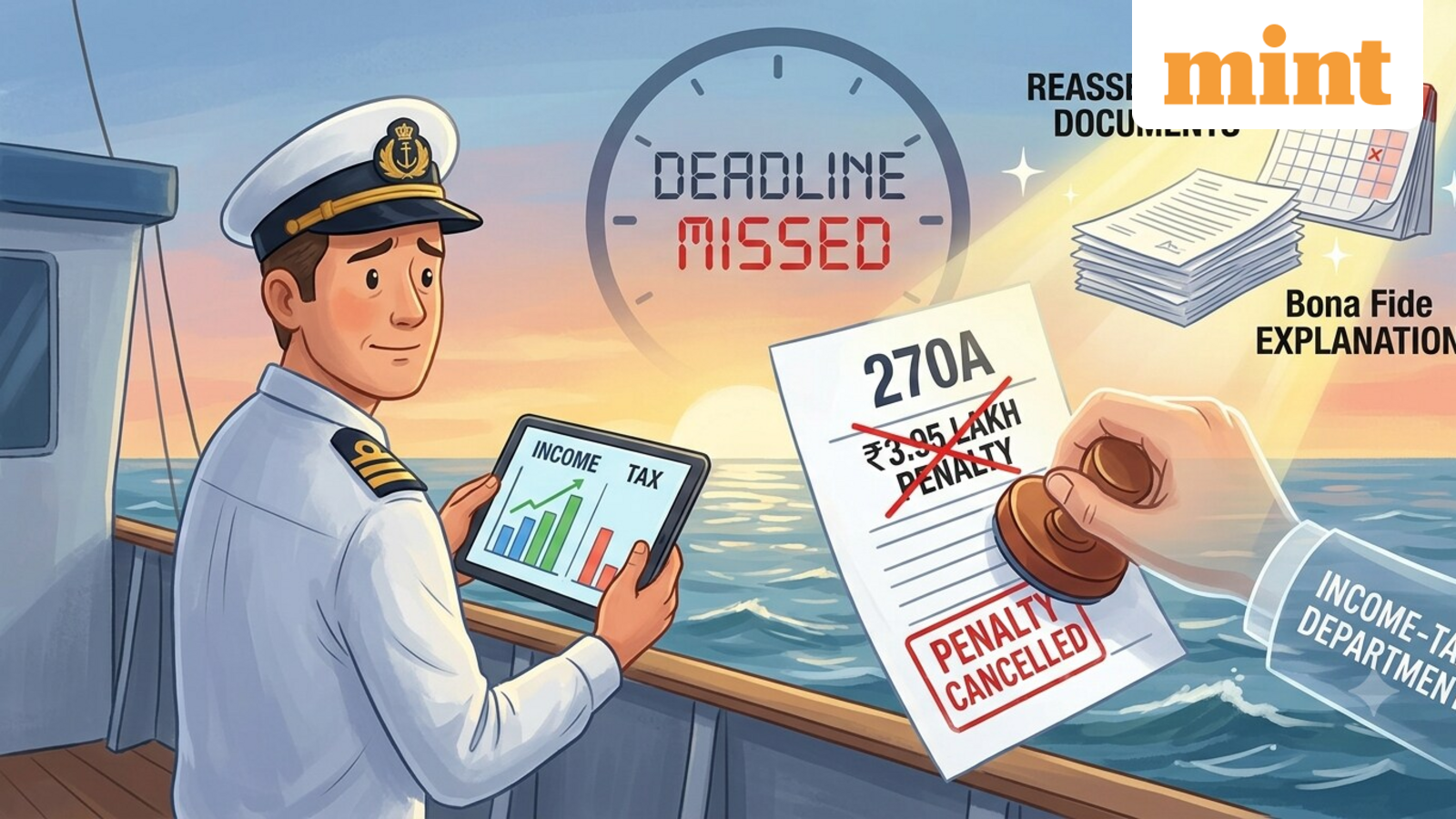
Forgot to file ITR but employer had deducted TDS: When can income-tax penalty still apply? ITAT explains
Not filing an income-tax return on time does not by itself mean that the entire income declared later can be treated as under-reported income for penalty purposes, a recent Income Tax Appellate Tribunal (ITAT) ruling has held.
The Mumbai bench of the ITAT deleted a ₹3.95 lakh penalty under section 270A imposed on a ship captain who had failed to file his income-tax return within the prescribed deadline. The taxpayer subsequently filed his return after receiving a reassessment notice. However, the income disclosed by him was accepted by the tax department without any addition or variation.
The ruling inVivek Trivedi vs ACIT, pronounced on 23 September 2026, is relevant for taxpayers who may have missed the original ITR deadline but whose income is otherwise reported to the tax department, particularly through TDS.
Why was the ₹3.95 lakh penalty imposed?
The taxpayer, Vivek Trivedi, was working as a ship captain with MMS Maritime (India) Pvt Ltd. He had not filed his return for assessment year 2020-21 within the time prescribed under section 139(1).
The income-tax department subsequently received information relating to his financial transactions, including the purchase of an immovable property for about ₹1.43 crore, salary receipts and interest income. It then initiated reassessment proceedings and issued a notice under section 148.
Trivedi filed his return on 27 May 2024, declaring total income of ₹31.58 lakh.
During the reassessment, he provided documents explaining his property purchase and other income. The assessing officer found that ₹1.30 crore of the property purchase had been funded through a housing loan from HDFC Ltd, while the remaining amount was explained through redemption of mutual funds and fixed deposits.
His salary and interest income were also verified. Importantly, the assessing officer did not make any addition to the income declared by Trivedi. The reassessment was completed with his total income remaining at ₹31.58 lakh.
Trivedi’s salary had also already been subjected to tax deduction at source (TDS).
Despite this, the assessing officer imposed a ₹3.95 lakh penalty under section 270A, treating the entire ₹31.58 lakh as under-reported income. The Commissioner (Appeals) subsequently upheld the penalty.
ITAT says late filing and under-reporting are different
The ITAT disagreed with the approach.
The tribunal noted that section 270A deals specifically withunder-reporting and misreporting of income. The assessing officer could not simply treat the entire income declared in the return as under-reported merely because the taxpayer had filed the return in response to a reassessment notice.
In this case, the reassessment did not uncover any additional income. The income declared by Trivedi was accepted by the department, while his property purchase was supported by the housing-loan documents, bank records and redemption statements.
The tribunal also considered Trivedi’s explanation for the delayed filing. He said his profession as a ship captain required him to remain at sea for prolonged periods with limited connectivity and that he was unaware of the requirement to file the return.
The ITAT referred to section 270A(6)(a), under which under-reported income excludes an amount where the taxpayer provides abona fide explanation and has disclosed all material facts necessary to substantiate that explanation.
The tribunal found the explanation credible in the circumstances of the case. It noted that the taxpayer’s salary was already reported through TDS, his financial transactions were explained during reassessment and no additional income was ultimately assessed.
The ITAT therefore deleted the ₹3,95,123 penalty.
The ruling, however, does not mean that a taxpayer who misses the ITR deadline will automatically avoid a section 270A penalty. The outcome depended on the facts of the case, including the taxpayer’s explanation, the supporting documents, the TDS trail and, crucially, the absence of any addition to his declared income during reassessment.