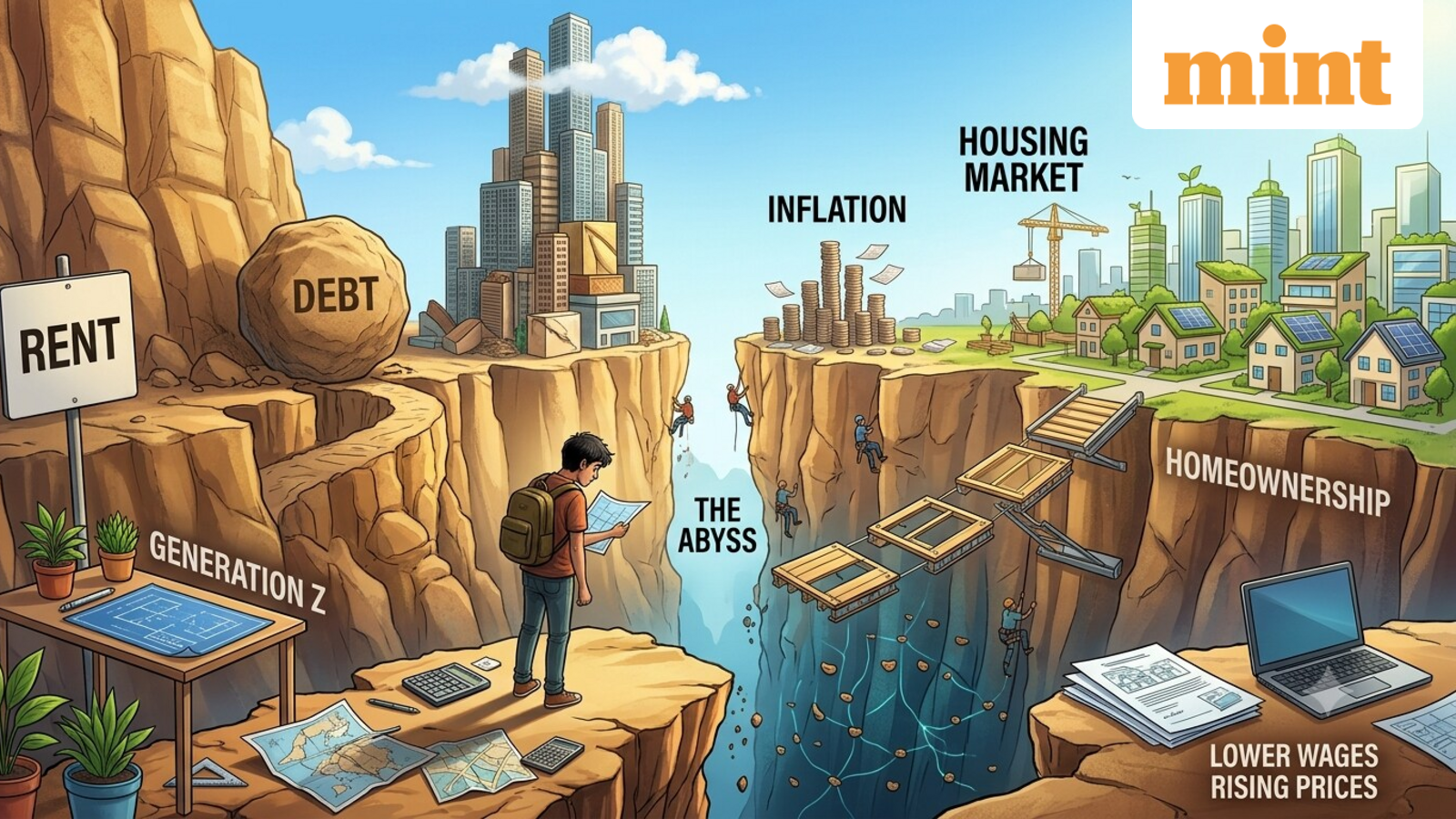
Home ownership is getting tougher for Gen Z: How much salary do you need to buy a ₹50 lakh, ₹75 lakh or ₹1 crore house?
For many young Indians, buying a home is no longer an automatic financial milestone. The aspiration remains, but the numbers have become harder to work with. Property prices in several large cities have risen faster than incomes, affordable homes are becoming harder to find and the upfront amount needed to enter the market can itself take years to accumulate.
“The challenge is less about the aspiration to own a home and more about the arithmetic of getting there,” said Samir Dewan, group chief executive officer at Bajaj Capital. Young professionals are also balancing rent, education loans, emergency savings and investments, while career mobility can make them reluctant to commit to one city or property early in their working lives, he said.
Thomas Stephen, director and head – Preferred, Anand Rathi Share and Stock Brokers, pointed to the widening price-to-income gap. India’s housing price-to-income ratio increased from 6.6 in 2020 to 7.5 in 2024, according to the data cited by him. In Mumbai, the ratio was 14.3, followed by Delhi at 10.1. Chennai and Ahmedabad were relatively lower at 5.1.
A ratio of around three is generally considered affordable internationally, while a ratio of five or above is considered severely unaffordable, Stephen said.
The entry-level home is disappearing
The affordability problem is also showing up in the supply of lower-priced homes. Homes priced below ₹50 lakh accounted for only 17% of housing supply in the first half of 2025, compared with 52.4% in 2018, according to data cited by Stephen.
Developers have increasingly focused on larger and higher-value projects, reducing the number of options available to first-time buyers looking for an affordable entry point, he said.
This means a young buyer may have to compromise on either the size or location of the first home.
“Many are comfortable renting for longer, particularly when their careers are still evolving,” Dewan said. When they eventually buy, they may consider a smaller home, an emerging micro-market or a location farther from the city centre. Joint ownership with a spouse or family member can also change the affordability equation.
How much income do you need to buy a home?
The difference between being eligible for a home loan and being able to comfortably afford one is important for a young buyer.
Stephen’s illustration assumes an 80% loan-to-value ratio, an interest rate of 8.5% and a 20-year tenure. He suggests keeping the home-loan EMI at around 30–35% of monthly take-home income.
|
Property value |
Loan amount |
Approx. EMI |
Indicative annual income |
| ₹50 lakh | ₹40 lakh | ₹34,700 | ₹14–16 lakh |
| ₹75 lakh | ₹60 lakh | ₹52,000 | ₹21–24 lakh |
| ₹1 crore | ₹80 lakh | ₹69,400 | ₹28–32 lakh |
These are indicative calculations, not universal affordability thresholds. The buyer would also need to arrange the down payment and other purchase-related costs.
For a ₹50 lakh property, the upfront requirement could be around ₹12.5 lakh. For a ₹75 lakh home, it could be about ₹18.75 lakh, while a ₹1 crore property could require around ₹25 lakh, including the 20% down payment and an allowance for other upfront costs, Stephen said. Actual costs vary by city and property type.
Dewan’s calculations are broadly similar. He estimates an annual income of around ₹14–15 lakh for a ₹50 lakh property, ₹21–22 lakh for a ₹75 lakh property and ₹28–30 lakh for a ₹1 crore property, assuming a 20% down payment, an 8.5% interest rate, a 20-year tenure and an EMI of roughly 30% of gross monthly income.
The first hurdle comes before the EMI
For a young professional, accumulating the initial corpus can be more difficult than servicing the eventual loan.
A buyer may need to put together the down payment along with stamp duty, registration charges, applicable GST on an under-construction property, furnishing and interiors. For a ₹75 lakh– ₹1 crore property, the initial cash requirement can easily reach ₹20–30 lakh or more, depending on the location and property.
This becomes particularly difficult for someone who is simultaneously paying rent and other loans while trying to build an emergency fund and investments.
Stephen said the housing equation for Gen Z therefore involves three pressures: property prices rising faster than incomes, shrinking entry-level supply and a growing upfront capital requirement.
Gen Z is not giving up on home ownership
The response among young buyers is not uniform. Some are delaying purchases because homes in their preferred locations are unaffordable, while others are buying earlier by changing what their first home looks like.
Home-loan borrowers aged 25–30 reportedly grew 86% over two years, Stephen said. Younger buyers who are purchasing are being supported by dual incomes, parental help with down payments and homes in peripheral locations with improving infrastructure.
For some, the first home is also becoming a stepping stone rather than a forever home.
“Gen Z isn’t necessarily rejecting homeownership. They are either delaying it or redefining what their first home looks like—smaller, farther from the city centre, or supported by family and a second income,” Stephen said.
Dewan similarly said delayed ownership should not necessarily be interpreted as a decline in aspiration. For many young professionals, financial stability is simply coming first, with home ownership following when the numbers support it.