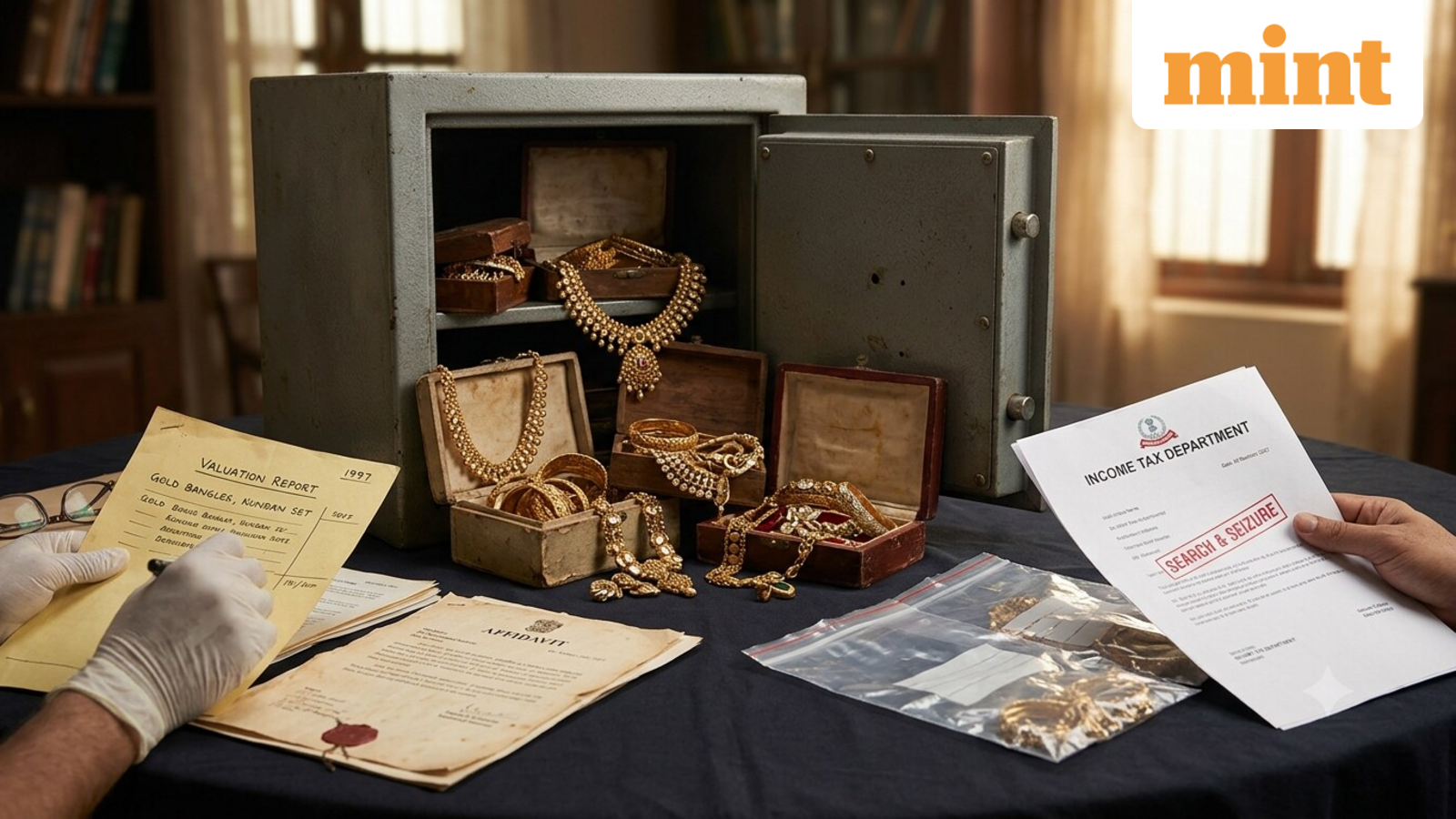
₹14.69 crore jewellery found in tax search: When can inherited gold escape tax scrutiny?
A large jewellery holding discovered during an Income Tax search does not automatically become the unexplained wealth of the person being searched. A recent Kolkata Income Tax Appellate Tribunal (ITAT) ruling shows why ownership records, old valuation reports and evidence about who controlled a family locker can matter when the tax department questions inherited or ancestral jewellery.
In DCIT, Central Circle 1(1), Kolkata vs Miraj Digvijay Shah, the Revenue challenged the deletion of a tax addition of ₹1.56 crore relating to 3,233.11 grams of jewellery. The ITAT dismissed the Revenue’s appeal on 11 September 2026 and upheld the finding that the jewellery belonged to the taxpayer’s deceased family members and not to him.
The case arose from a search conducted on 21 June 2022 at Shah’s residential and business premises. Jewellery and bullion worth ₹14.69 crore were found at his residence and in various bank lockers held by him and family members. Of this, jewellery and bullion worth about ₹14 crore were seized because the authorities were not satisfied with the explanation for the assets.
The ruling came in DCIT, Central Circle 1(1), Kolkata vs Miraj Digvijay Shah, in an order pronounced by the Kolkata ITAT on 11 September 2026.
Why the ₹1.56 crore jewellery was treated as explained
The disputed jewellery weighed 3,233.11 grams and was valued at ₹1.56 crore. Shah said it belonged to his deceased grandmother, grandfather and father, as well as his late father’s HUF.
A key fact was that the jewellery was found in UCO Bank lockers that were not held solely in Shah’s name. The lockers were associated with several family members, including his mother, deceased father and grandfather, brother, aunt and other relatives.
During the search proceedings, Shah had told the authorities that he was not aware of some of the UCO Bank lockers and had not visited them for five to seven years. The ITAT noted this while considering whether the jewellery found in those lockers could automatically be treated as belonging to Shah.
The family also produced valuation reports dating back to 1997. The appellate authority found that the descriptions in those reports matched the jewellery found during the search. Shah’s mother also submitted an affidavit claiming ownership, which the tax authorities did not successfully disprove.
The ITAT agreed with the CIT(A)’s conclusion that these documents and facts supported the claim that the jewellery belonged to the deceased family members rather than Shah personally.
The Tribunal also noted that Shah had not admitted that the jewellery belonged to him. The Revenue had not challenged the veracity of the old valuation reports, and the jewellery was not found in Shah’s personal possession or in a locker held solely in his name.
What this means for inherited gold
The ruling is particularly relevant for families that have held gold jewellery across generations without retaining every original purchase invoice.
The decision shows that the absence of purchase invoices alone does not necessarily end the matter. Other contemporaneous evidence can help establish the ownership and history of inherited jewellery. In this case, the 1997 valuation reports, the location and ownership of the lockers and the mother’s affidavit together formed the evidentiary trail accepted by the appellate authorities.
However, taxpayers should not read the ruling as an automatic exemption for ancestral jewellery. The ITAT’s decision was based on the particular evidence available in Shah’s case.
There is also a separate CBDT Instruction No. 1916 dated 11 May 1994 concerning jewellery found during searches. It says that, for a person not assessed to wealth tax, jewellery up to 500 grams for a married woman, 250 grams for an unmarried woman and 100 grams for a male family member need not be seized. It also allows the authorised officer to consider a larger quantity based on the family’s status, customs and other circumstances.
Importantly, those quantities should not be presented as a blanket rule that a taxpayer can hold that amount of gold without having to explain its ownership or source in every situation. Courts and tribunals have considered the instruction along with the facts and evidence of individual cases.
Another ₹64.93 lakh jewellery claim was accepted
The case also involved 1,293.43 grams of jewellery valued at ₹64.93 lakh, which Shah said belonged to his mother.
The CIT(A) accepted this explanation after considering her 9 April 1997 valuation report and affidavit. The Revenue did not challenge this deletion before the ITAT.
The appellate order also considered the mother’s age, financial position and social circumstances while assessing whether the quantity of jewellery could reasonably be attributed to her. The ITAT noted that the Revenue had not challenged the acceptance of this jewellery as belonging to her.
What records should families keep?
For inherited or old family jewellery, maintaining a documentary trail can make it easier to establish ownership if the asset is questioned later.
Useful records can include old valuation reports, purchase bills where available, wills, succession or inheritance documents, family settlement records and other documents identifying the owner and history of the jewellery.
The Miraj Shah ruling demonstrates that even a valuation report prepared decades earlier can become relevant evidence if its description can be linked to the jewellery found later.
The ITAT also dealt with ₹40 lakh of cash found during the search. It upheld the deletion of that addition after the taxpayer reconciled the amount with the cash balance reflected in the books of his firm. The Tribunal noted that, after excluding post-dated entries, the cash balance on the search date was ₹40.98 lakh, which supported the explanation for the ₹40 lakh found.
The takeaway for taxpayers is therefore narrower than “ancestral gold is safe”. If inherited jewellery is questioned during a tax search, evidence establishing who owned it, where it was kept and how its existence can be traced over time can be crucial. The outcome will depend on the facts and supporting documents available in each case.