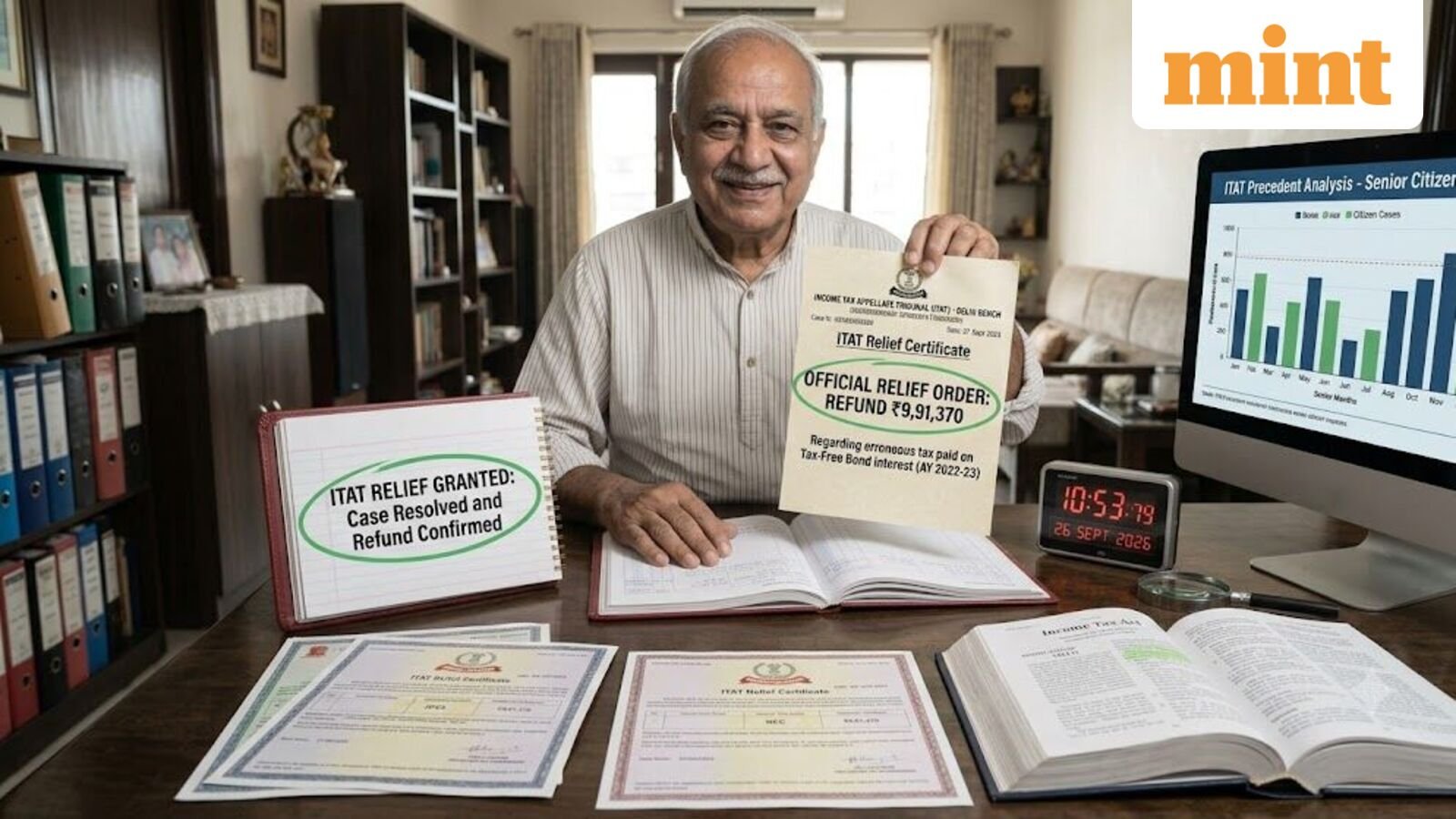
Senior citizen wrongly paid tax on tax-free bonds: What the ₹9.91 lakh ITAT case means
An error in tax filing resulted in a senior citizen paying ₹9.91 lakh in tax on interest from tax-free bonds. The individual has now secured relief from the Income Tax Appellate Tribunal (ITAT). The tribunal, after reviewing the basic facts of the case, has directed the concerned tax authorities to grant relief by issuing a refund along with applicable interest. The final order in this case was pronounced on 23 September 2026.
This is a very important case for taxpayers, as it offers several fundamental and vital lessons for day-to-day tax filing. This is because, in this case, the tribunal primarily distinguished between making a fresh tax-related claim and rectifying an error already apparent from the income tax return initially filed.
Senior citizen mistakenly paid tax on exempt bond interest
In this case, Ajay Kumar Bakaya, a senior citizen and resident of Gurugram, invested ₹3 crore in tax-free bonds in February 2013. Out of this, ₹2 crore was invested in India Infrastructure Finance Company Ltd (IIFCL) bonds. These bonds carried an interest rate of 8.48%. Whereas ₹1 crore was invested in Rural Electrification Corporation (REC) bonds carrying 8.46% interest.
As per the Income Tax Act, 1961, the interest from these bonds was exempt under Section 10(15)(iv)(h). Bakaya had reported the interest earned from these investments as ‘exempt income’ in his return for the assessment years (AYs) 2018-19 to 2024-25.
Still, while filing his return for AY 2022-23, he erroneously reported ₹25.42 lakh of bond interest as taxable income under ‘income from other sources’. This consisted of ₹16.96 lakh from IIFCL and ₹8.46 lakh from REC. The mistake resulted in an excess, i.e., additional tax of ₹9,91,370.
Furthermore, by the time Bakaya discovered the error, the deadline for filing a revised return under Section 139(5) of the Income Tax Act, 1961, had expired. On 19 January 2024, he approached the assessing officer (AO) under Section 154 to seek assistance with rectification and a refund.
The AO rejected the request in an order dated 7 April 2025, relying on the Supreme Court’s decision in Goetze (India) Ltd. v. CIT. The AO stated that the claim can not be entertained without a revised return through appropriate channels.
Why the ITAT ordered the refund
The matter eventually reached the ITAT after the CIT(A) upheld the position. The tribunal clearly noted that Bakaya was not requesting for a new exemption claim. The interest income was already declared in the return without concealment of material facts. The error was that an otherwise exempt receipt had been classified as ‘taxable income’.
The ITAT hence held that a rectification was nothing but a correction of a ‘mistake apparent from the record’ and not a fresh claim. It was also held that the ruling Goetze (India) Ltd. was not applicable to the facts and circumstances of this case.
The tribunal relied on the decision taken in the case law of Kapil Dev Nikhanj v. ACIT, which elucidated that tax must be collected in accordance with the law of the land. The collection should not be arbitrary. The tribunal consequently instructed AO to treat the bond interest as exempt under Section 10(15)(iv)(h) and grant a subsequent refund of ₹9,91,370 along with the applicable interest as admissible under law.
5 key takeaways for taxpayers
- Check exempt income carefully: Interest or other exempt receipts must be reported in the appropriate section or column of the return.
- Keep supporting documents: Taxpayers should retain bond certificates, interest statements and other records establishing the exempt nature of income.
- A mistake is different from a fresh claim: This case involved income that was already disclosed but incorrectly classified as taxable.
- Rectification may be relevant: Where an apparent error exists in the return or assessment, taxpayers may examine whether Section 154 or another applicable remedy is available, depending on the facts and applicable law.
- Do not rely on this ruling as an automatic refund route: The ITAT’s decision turned on the specific facts, including the prior disclosure of the income and the nature of the error. Taxpayers should verify their individual circumstances before seeking relief.
In summary, the broader lesson is straightforward: paying tax on legally exempt income does not necessarily resolve the matter if the mistake is later discovered. Still, taxpayers should not wait for a dispute to arise.
It is prudent to be vigilant and exercise caution when reviewing exempt income, deductions, and tax classifications before filing. Such an approach can help prevent excess tax payments and the need for time-consuming rectification proceedings.
Disclaimer: This article is for informational purposes only and should not be considered as tax or legal advice. Taxpayers should verify the applicable provisions and seek professional advice for their individual circumstances.