Active vs passive small-cap mutual funds: How wide is one-year return gap? Don’t assume index schemes always lag
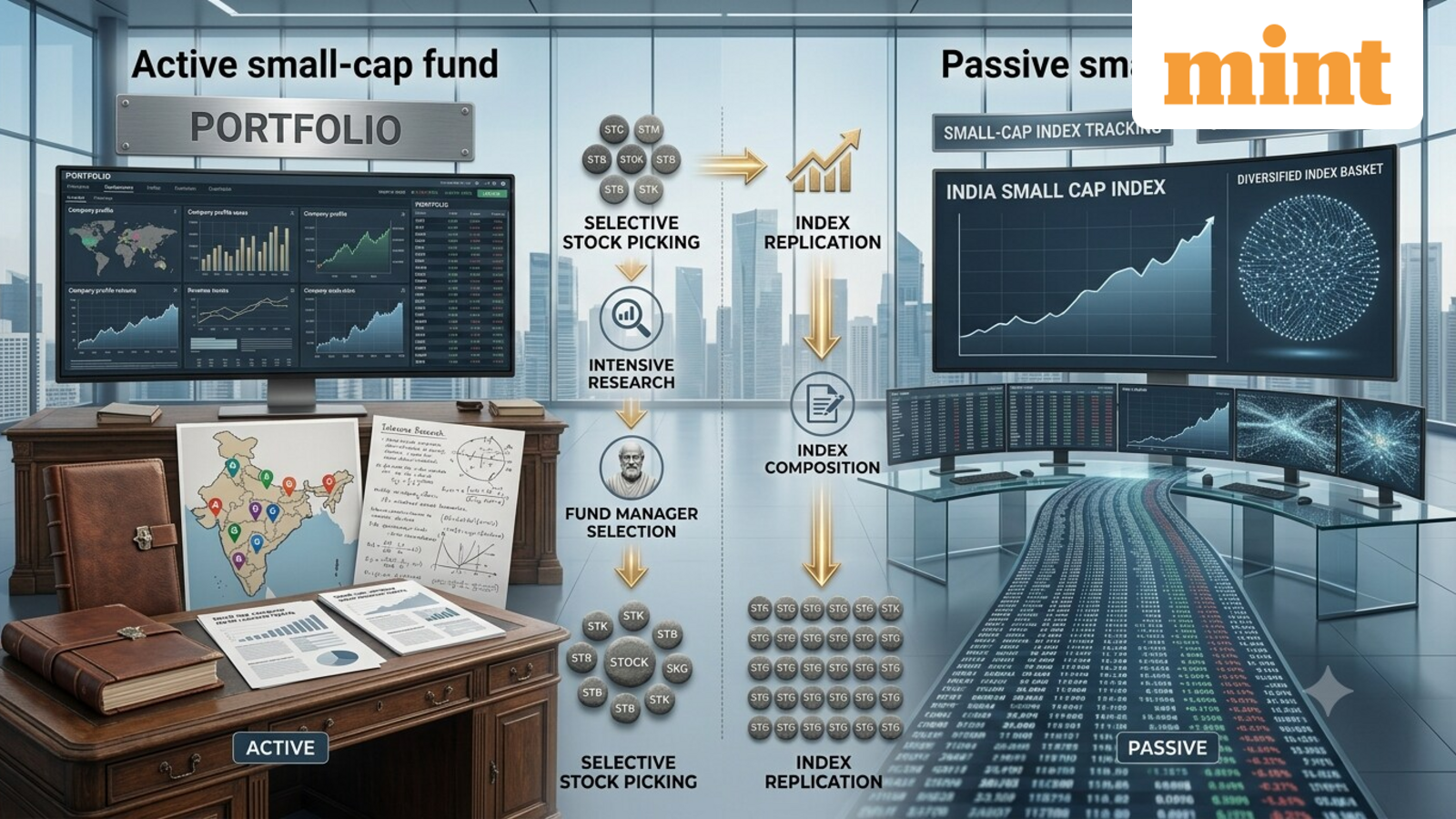
Small-cap funds are equity mutual funds that are required to invest at least 65% of their assets in small-cap stocks. But these are the rules for active small-cap funds, wherein the fund manager has the flexibility to select stocks and build the portfolio based on the scheme’s investment strategy.
There are also passive small-cap funds, which track an underlying index and seek to replicate its portfolio. According to the rules, index funds or ETFs have to invest at least 95% of their assets in the securities of the underlying index.
The Nifty Smallcap 250 TRI (Total Return Index) is a key benchmark for small-cap funds. A TRI captures both changes in stock prices and dividends. In the last 1 year, the index has delivered 6.39% returns.
Here’s a look at the 1-year returns of the funds in both categories and the schemes that have led their respective groups.
Which are the top five active small-cap funds by 1-year returns?
| Active small-cap funds | 1-year return |
| TRUST MF Small Cap Fund | 30.04% |
| Bank of India Small Cap Fund | 26.69% |
| Motilal Oswal Small Cap Fund | 21.30% |
| Union Small Cap Fund | 21.16% |
| ITI Small Cap Fund | 20.94% |
*Source: Value Research, Direct Plans, Returns as on 24 September 2026
The Trust MF Small Cap Fund delivered the highest 1-year return among the active small-cap funds at 30.04%. All five funds delivered returns above the Nifty Smallcap 250 TRI’s 6.39% return during the same period.
Which are the top five passive small-cap funds?
| Passive small-cap funds | 1-year return |
| Edelweiss Nifty Smallcap 250 Index Fund | 6.13% |
| JioBlackRock Nifty Smallcap 250 Index Fund | 6.07% |
| Groww Nifty Smallcap 250 Index Fund | 6.00% |
| Motilal Oswal Nifty Smallcap 250 Index Fund | 5.98% |
| Bandhan Nifty Smallcap 250 Index Fund | 5.95% |
*Source: Value Research, Direct Plans, Returns as on 24 September 2026; Only Nifty Smallcap 250 index funds have been considered for an equivalent comparison with active small-cap schemes, as they track the same benchmark.
The Edelweiss Nifty Smallcap 250 Index Fund delivered the highest 1-year return among the passive funds at 6.13%.
The other four funds delivered returns between 5.95% and 6.07%. Their returns remained close to the 6.39% return of the Nifty Smallcap 250 TRI, reflecting their passive approach of tracking the underlying index.
Why can active and passive small-cap funds deliver such different returns?
Trust MF Small Cap Fund gave 30.04% returns in the last 1 year, compared with 6.13% for the Edelweiss Nifty Smallcap 250 Index Fund—a gap of 23.91%
The difference in returns can be seen from the way the two funds construct their portfolios.
Trust MF Small Cap Fund, an active fund, held 71 stocks, with 75.99% of its portfolio in small-cap stocks and 24.01% in mid-cap stocks. This gives the fund manager greater flexibility to select stocks and allocate more to particular companies or market-cap segments, within the scheme’s mandate.
However, Edelweiss Nifty Smallcap 250 Index Fund held all 250 stocks of the Nifty Smallcap 250, with 92.73% allocated to small-cap stocks and 7.27% to mid-cap stocks.
These differences in portfolio allocation can lead to a significant difference in returns between active and passive funds, even when they are compared against the same benchmark.
Can passive small-cap funds outperform active funds?
Yes. All the passive small-cap funds delivered positive returns over the last 1 year, but active small-cap funds have shown a much wider range of performance.
For example, HDFC Small Cap Fund fell by 2.34%, while Tata Small Cap Fund delivered just 0.13% returns in the last 1 year. This shows that the performance of active funds can vary considerably depending on the stocks selected and portfolio allocations made by the fund manager.
Disclaimer: This is purely for educational/informational purposes and should not be taken as any sort of investment advice. Always consult a SEBI-registered advisor before making any investment decisions.