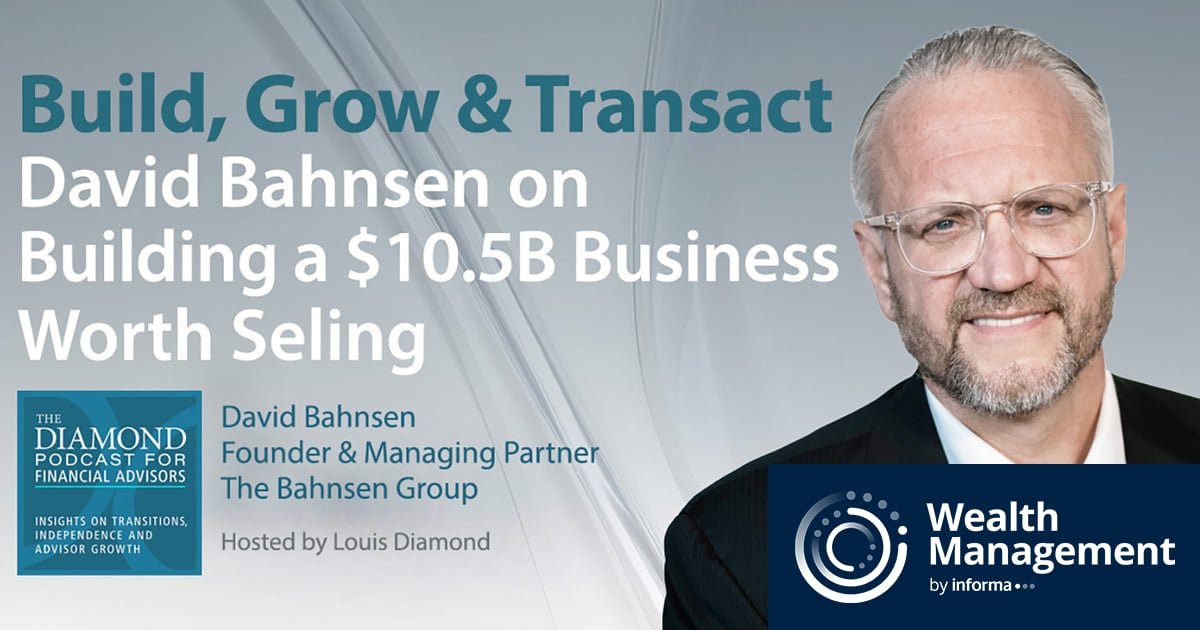
The Diamond Podcast: David Bahnsen on Building $10.5B Firm
David Bahnsen left Morgan Stanley in 2015 with eight people and $600mm in client assets, motivated less by dissatisfaction than by what he calls being “intoxicated by the idea of freedom.” Eleven years later, The Bahnsen Group has grown to $10.5B in assets, 106 employees, and 13 offices—with virtually all of that expansion driven organically.
But the more instructive story is how that growth happened. David explains how original content and thought leadership became a powerful source of new business, why attracting clients only matters if the firm can deliver an experience that keeps them, and how continual reinvestment in people, tax, planning, investment management, and family office services helped turn a founder-led practice into a national enterprise.
He also shares the thinking behind his decision to sell The Bahnsen Group to Hightower after more than a decade of working within its ecosystem. The transaction gives the firm greater resources for technology, HR, supervision, and future inorganic growth while allowing David to maintain control over the brand, P&L, strategy, and client experience.
The Storyline
When David Bahnsen first appeared on the Diamond Podcast in April 2020, The Bahnsen Group was five years removed from its Morgan Stanley breakaway and had grown from $600mm to roughly $2B.
Today, the firm manages $10.5B across 13 offices with more than 100 employees.
The numbers are notable, but David’s approach to building the business provides the real lessons.
Rather than pursue acquisitions, The Bahnsen Group built an organic growth engine around content, thought leadership, and a distinct investment philosophy. David’s Dividend Cafe now reaches roughly 35,000 subscribers organically, but he is clear that attracting prospective clients was only half of the equation. The firm continually invested in the people, capabilities, and services necessary to deliver on what the content promised.
That philosophy extended to how David structured the business. He chose to keep functions that created what Louis describes as “surplus value” inside the firm while relying on Hightower for areas such as supervision, regulatory support, and technology. At the same time, David resisted the temptation to maximize current margins, instead investing in advisor capacity, planning, tax, investment management, family office capabilities, and infrastructure.
The result was a business with significant organic growth and enterprise value.
Now the story enters its transact phase. After years of operating within Hightower’s ecosystem, David agreed to sell The Bahnsen Group to Hightower. Yet the transaction is less an endpoint than another evolution of the model: Hightower becomes owner while David retains substantial operating autonomy and gains resources to professionalize the firm further and supplement its organic growth with carefully selected acquisitions.
It’s the full Build, Grow & Transact arc—and an example of what can happen when independence is treated as the beginning of building a business rather than the destination.
Topics Covered
-
How The Bahnsen Group grew from $600mm to $10.5B
-
Building an organic growth engine through content and thought leadership
-
Why attracting clients is only the beginning of sustainable growth
-
Reinvesting profits to build long-term enterprise value
-
Creating advisor capacity without sacrificing the client relationship
-
Deciding what capabilities to own versus outsource
-
Why maximizing margins can limit the business you ultimately build
-
The evolution of David’s relationship with Hightower
-
Why Hightower became the natural buyer of The Bahnsen Group
-
Preserving autonomy and continuity after a transaction
-
Balancing organic growth with future acquisitions
-
Why independence can be a starting point rather than an end goal

![Update On The SEC’s Work Toward Treasury Clearing Implementation [August 2026]](https://bekun.shop/wp-content/uploads/2026/08/1786181510_Crowdfund-Insider-FIntech-Insider-Digital-Assets-Insider-1024x811-768x608.png)