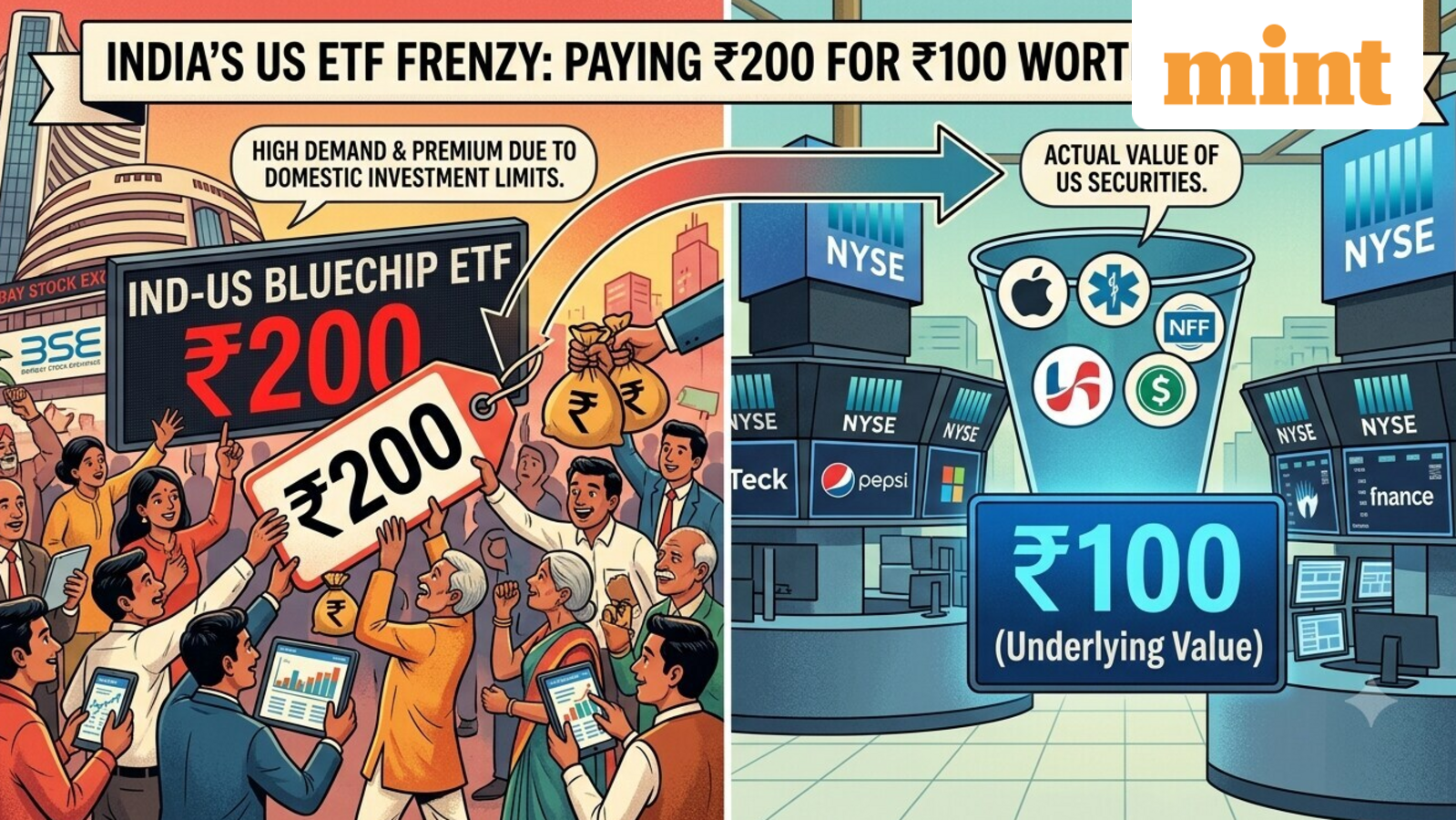
US ETF frenzy: Why Indians are paying ₹150 for ₹100 of assets, and what to do instead
India’s international ETF segment has had a roller-coaster week, with some US-focused ETFs trading at steep premiums to their underlying assets before sharply correcting.
The Motilal Oswal Nasdaq Q-50 ETF (MONQ50), which tracks the Nasdaq Q-50, traded at up to 4 times its net asset value (NAV) earlier this week. It subsequently hit back-to-back lower circuits, falling 20% and then another 15%. On 22 September, the ETF was down another 20% intraday.
But MONQ50 is not the only India-listed international ETF trading above the value of its underlying portfolio. Here’s a snapshot of some India-listed international ETFs and their premiums to NAV as of September 21:
- Mirae Asset NYSE FANG+ ETF (MAFANG) was trading at a premium of around 40%
- Motilal Oswal Nasdaq 100 ETF (MON100) was around 21–24% above NAV.
- Mirae Asset S&P 500 Top 50 ETF (MASPTOP50) was at a premium of about 18.6%
- Nippon India Hang Seng BeES (HNGSNGBEES) had a smaller premium of around 3%.
Why are Indian investors paying large premiums for Nasdaq and US ETF exposure?
According to Viram Shah, founder and CEO of Vested, the premium is less about the valuation of US stocks and more about a supply-demand mismatch in India.
“The issue is not that the Nasdaq or the underlying US stocks have suddenly become more expensive. It is a demand-supply problem in India,” Shah said.
Indian mutual funds face an industry-wide overseas investment limit of $7 billion, including a separate $1 billion limit for overseas ETFs. With limited capacity to create fresh ETF units while investor demand remains strong, market prices can move substantially above the value of the underlying holdings.
This poses a risk to investors who focus solely on the ETF’s market price or past returns.
“If an ETF is trading at a very large premium, investors are effectively paying ₹120, ₹150 or even ₹200 for assets worth ₹100,” Shah said.
The premium can disappear even if the underlying Nasdaq or US stocks remain unchanged, meaning investors can suffer losses without a corresponding fall in the underlying market.
Shah said investors should therefore check an ETF’s NAV or indicative NAV (iNAV) before investing and compare it with the traded price.
What alternatives are available to Indian investors looking to invest directly in international ETFs?
For investors seeking international exposure, another option is to invest directly in overseas-listed ETFs through an international investing platform, subject to the applicable Liberalised Remittance Scheme (LRS) rules.
However, investors also need to consider expense ratios, liquidity, tracking differences, remittance costs, taxation and fund domicile before choosing an international ETF.
“US ETFs can also be bought directly,” Shah said, adding that investors should understand the structure and costs before choosing a route for international exposure.