Trump, Xi AI Talks Won’t Be Like Nuclear Arms Control: Analyst
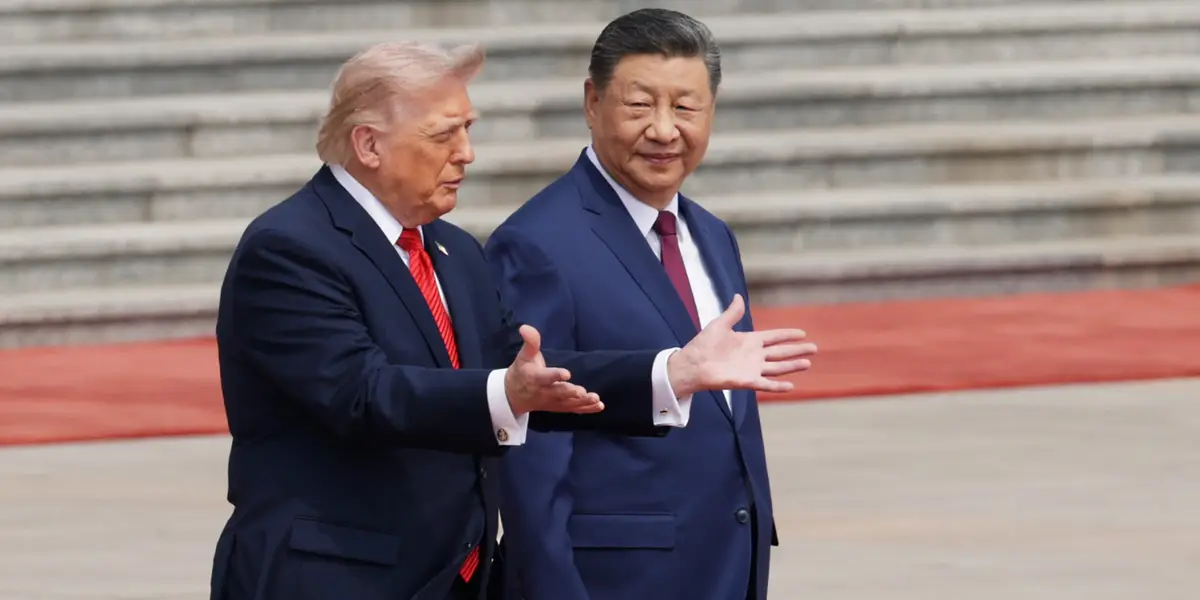
President Donald Trump and Chinese leader Xi Jinping are expected to discuss artificial intelligence when they meet in Washington this week, as Washington and Beijing explore ways to manage the technology’s national security risks despite their broader rivalry.
But one China technology policy analyst says the comparison many draw with nuclear arms control has its limits.
“AI isn’t like nuclear weapons, and where we are with AI is also not like nuclear weapons,” said Antonia Hmaidi, the head of the science, technology, and innovation program at the Mercator Institute for China Studies, at a media briefing on Friday.
“With nuclear weapons, it is relatively simple to verify, at least broad claims that the other side makes. It’s very, very difficult to hide huge numbers of nuclear weapons somewhere. With AI, this is not the case,” she said.
AI is expected to be one of the biggest agenda items when Trump and Xi meet at the White House on Thursday, alongside trade and export controls.
On Sunday, Treasury Secretary Scott Bessent said the US had proposed a new US-China AI dialogue and a notification mechanism for AI-related incidents that rise to the level of national security.
Trump and Xi’s meeting also comes as the debate over AI safety has intensified. Anthropic CEO Dario Amodei recently called for AI companies to slow the pace of frontier AI development.
Trump has pushed back against slowing AI development, arguing the US should maintain its lead over China even as some researchers warn that increasingly powerful AI systems could pose catastrophic risks.
But verification is one of the biggest obstacles to meaningful AI agreements, Hmaidi said.
“How do you verify a claim that, if Xi were to say, ‘Our labs are stopping to develop AI for biotechnology, for bioweapons’? How would you even verify that? And the other way around, of course,” she said.
Hmaidi said those challenges extend beyond formal agreements. and questioned proposals for an AI equivalent of the Cold War “red line” between Washington and Moscow, asking how governments would even know when to use such a mechanism.
“But even there, how would you even decide when to call the red line?” she said.
Another challenge is that AI is still evolving rapidly, making it difficult for governments to agree on what exactly they would be limiting.
“We don’t know where this will take us. Will it take us to AGI, as some are claiming in the US? Will it take us to a stalled situation where progress will stop? We don’t know,” Hmaidi said, referring to artificial general intelligence, or AI that can perform a broad range of intellectual tasks at or above the human level.
That uncertainty makes both countries unlikely to agree to limits on AI development,” she added.
Even if Trump and Xi announce AI initiatives, Hmaidi said they are more likely to involve technical exchanges or broad principles than binding commitments.
She pointed to proposals requiring humans to make the final decision on nuclear weapons use as an example of an agreement that would be politically straightforward but “not in any way binding” and “not even verifiable in any way.”
“I would be surprised if there were anything verifiable, or any AI announcement that would actually increase safety in a real way,” she said.