3 Lessons I Learned From Watching Warren Buffett for 30 Years
Warren Buffett, the former CEO of Berkshire Hathaway (BRKA -1.50%)(BRKB -1.52%), has announced that he is stepping down as chairman of the board of the company he once ran. It was only in January that he handed the CEO reins to his successor, Greg Abel. This transition is huge for Berkshire Hathaway and its shareholders, but it is equally large for an investor like me, who’s watched Buffett for decades.
The so-called Oracle of Omaha helped to shape how I invest. And as I reflect on the legacy he’s handed me, I can think of three important lessons. None of them is really about how to pick stocks. But I wouldn’t be the investor I am today without Buffett’s influence on each of these aspects of my investing life.

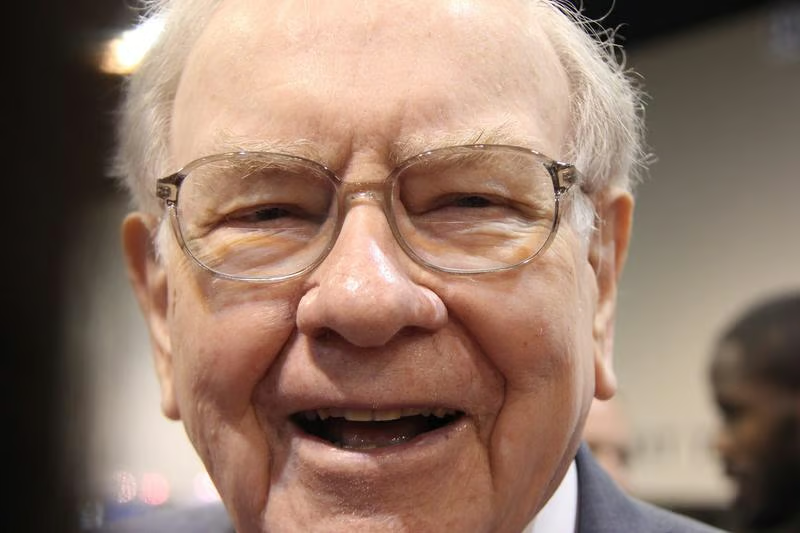
Image source: The Motley Fool.
1. Emotions are more important than intelligence
To paraphrase Buffett, all you need is average intelligence to be a good investor. After that, it is about having the right temperament. My undergraduate degree is in psychology, and I have a Master’s degree in Social Work (and, for reference, an MBA). I have long valued understanding why people do the things they do. This interest is partly why Wall Street is so exciting to me, since stock prices are largely driven by emotion. But Buffett’s point is incredibly important.
You can be the smartest person in the world, but if you can’t control your emotions, you will likely make emotionally driven mistakes. Perhaps the most important thing you can do as an investor is identify the big mistakes investors make (and the one’s you are most prone to make) and put roadblocks in place to stop yourself. If you don’t, you’ll repeatedly fall into the same old investment traps.

Today’s Change
(-1.52%) $-7.76
Current Price
$502.01
Key Data Points
Market Cap
Day’s Range
$501.98 – $510.50
52wk Range
$464.01 – $537.74
Volume
4.8M
Avg Vol
4.5M
Gross Margin
23.52%
Every year, I reread a book called The Little Book of Behavioral Investing. It is short, easy to read, and it refreshes my memory about all of the mistakes humans make when investing. I see myself in every chapter of that book, and it keeps me humble and focused on controlling the only thing I can truly control on Wall Street: my emotions.
2. Buy the company, not the stock
Buffett’s investment approach is pretty simple to describe: Buy well-run companies while they are attractively priced and hold for the long term. His approach is much harder to put into practice, but there’s an important undertone here that often gets overlooked as people focus on finding cheap stocks. Some of Buffett’s best investments have been stocks he’s held for decades. Others are companies that he’s purchased outright, making them subsidiaries of Berkshire Hathaway.
The key in both cases is that he isn’t buying a stock, he’s buying a business. You are, effectively, part owner of a company when you buy shares in it. Buffett is looking to own a company he believes is well-run and has a long-term growth opportunity. The real goal is to grow along with the company. I can’t buy whole companies, but I’m basically looking to do the same thing through long-term stock price appreciation and increasing dividends. The best part of buying the company and not the stock, however, is that it allows me to control my emotions. I focus on how a business is performing rather than on how its stock price is performing, saving me from a plethora of emotionally driven investing mistakes (see above).
3. How much is enough?
Buffett is pretty famous for living a simple life despite being incredibly wealthy. That’s kind of a rarity these days, as jet-setting billionaires seemingly fight to see who can build the biggest yacht, live in the largest house, and, generally, spend the most lavishly. Buffett did the exact opposite, happily living a comparatively simple life.

Today’s Change
(-1.50%) $-11,420.00
Current Price
$752,180.01
Key Data Points
Market Cap
Day’s Range
$752180.01 – $764309.65
52wk Range
$698000.00 – $806102.81
Volume
283
Avg Vol
180.7
Gross Margin
23.52%
I’m not going to say that I don’t own nice things. Or that I never spend money in what might be looked at as a wasteful manner. However, I do make a habit of living as simply as possible and usually well below my means. This is more of a life lesson than an investment lesson, but it’s had a huge impact on my family’s wealth.
The money we didn’t spend on things we really didn’t need mostly got put to work investing. That allowed the money to compound and grow, giving my family the freedom to spend more comfortably in the future. Watching Buffett live a modest life while others live lavishly has helped my family and me avoid the trap of trying to keep up with “the Joneses”, as the saying goes. Buffett’s life makes it clear that your benchmark for happiness and success should be personal, not based on other people.
Watching Buffett leave is harder than I thought
I’ve never met Warren Buffett, and I probably never will, but he’s still been an important part of my life in many ways. As he steps away from public life, I feel like I’m losing something. But the truth is, what I’ve learned from Buffett, his “gift” to me, is investment and life lessons that I’ll always have and cherish, such as control your emotions when investing; buy the business, not the stock; and don’t judge your financial success by how other people choose to live.