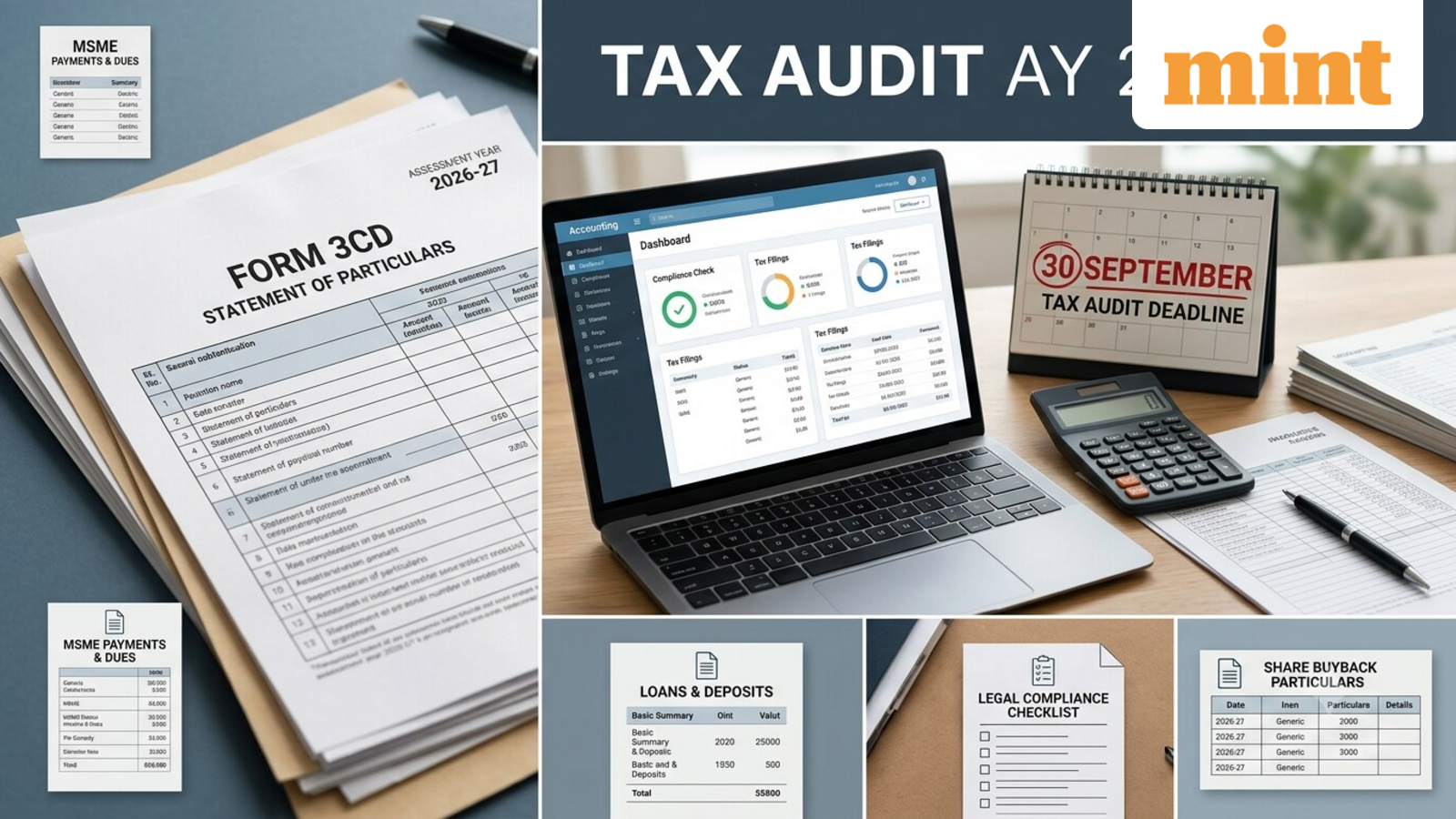
Tax audit for AY 2026-27: Key changes in Form 3CD you should know before 30 September deadline
If you are filing an income tax return for AY 2026-27 and are covered by a tax audit, this must be completed by 30 September. However, the ITR filing deadline is 31 October 2026.
Here’s what you need to know about the key changes in the tax audit forms for AY 2026-27.
What are the different tax audit forms applicable for AY 2026-27?
Siddharth Maurya, Managing Director, Vibhvangal Anukulara, mentioned that the main tax audit forms are Forms 3CA, 3CB and 3CD.
“Form 3CD is submitted along with either Form 3CA or Form 3CB and provides the required particulars of the tax audit,” he added.
Maurya said that an audit of an entity’s accounts is required if the annual accounts exceed ₹1 crore. The limit is extended to ₹10 crore if cash receipts and cash payments are within 5% of the total. An audit is also required if gross receipts exceed ₹50 lakh.
Which tax audit form has been revised?
For AY 2026-27, Maurya said the overall tax audit framework remains the same. Forms 3CA, 3CB and 3CD continue to apply. However, amendments to Form 3CD effective from April 2025 need to be complied with.
These cover reporting of MSME payments, Section 43B liabilities, loans and deposits, specified expenditure and share buy-backs.
The main modifications to Form 3CD concern Clauses 12, 19, 21, 22, 26 and 31. Clauses 28 and 29 have been removed. Clause 36 has been included for the first time to report buyback of shares/deemed dividend. Reporting under Clause 22 has also been expanded to include details of transactions with MSMEs, he explained.
What has changed in Form 3CD?
Isha Sekhri, Founder, Isha Sekhri & Associates LLP, explained the key changes under different clauses and sections.
MSME reporting: The three-way split
Clause 22 now requires a three-way bifurcation: the total amount payable to micro or small enterprises under Section 15 of the MSMED Act, the amount paid within the prescribed time, and the amount unpaid and therefore inadmissible for the year.
Clause 26 has also been modified. It excludes Clause (h) from the general Section 43B provisions and replaces “allowed” with “allowable”. MSME payments must fall within the MSMED Act’s 15/45-day window to be deductible in the year of accrual, unlike other Section 43B items that get relief if paid before the ITR due date.
Taxpayers need to track vendor-wise MSME status and payment dates and reconcile the MSME ledger with Form 3CD.
Settlements and legal contraventions go global
Clause 21(a) has been broadened so that expenditure for a purpose that is an offence or prohibited by law – whether Indian or foreign – must now be disclosed.
A new row also captures expenditure incurred specifically to settle proceedings for contravention of central Government-notified laws. This is particularly relevant for global companies.
Loans and deposits: Descriptive reporting is gone
Clause 31 has moved from free-text descriptions to a mandatory nature-code system (Codes A through L) for every loan, deposit, or repayment.
This matters because non-cash movements that adjust loan or deposit balances, often glossed over in the old format, are now explicitly reportable.
Buybacks get a dedicated clause
A new Clause 36B has been inserted following changes in the taxation of buybacks.
It requires the taxpayer to disclose whether they received any amount from the buyback of shares referred to in Section 2(22)(f) of the Income-tax Act, 1961. If yes, the auditor must report the total amount received and the cost of acquisition of the shares bought back.
This is important for computing deemed dividend income or capital gains under the prevailing law, particularly for individuals who have received income from buybacks of shares.
Streamlining
Clause 19 has dropped reporting rows for Sections 32AC, 32AD, 35AC, and 35CCB, all past their sunset dates.
Clauses 28 and 29, dealing with share premium and gift-related inclusions, have also been omitted, as these items are now tracked through the ITR forms directly.
Revision relief
Rule 6G(3) allows a revised audit report where a post-filing payment, such as one curing a Section 40(a) disallowance, is made before the ITR due date.
For example, if a taxpayer clears an outstanding liability after the audit is completed but before filing the ITR, the audit report can be revised to reflect the payment.
“Build your MSME vendor ledger now, get your Clause 31 nature codes right, and document any settlement or buyback transaction thoroughly before the 30 September deadline,” Sekhri concluded.
Disclaimer: This is only for informational and educational purposes. Please consult a qualified expert for the latest laws and regulations.