President Donald Trump Just Admonished the Fed for “Doing the Wrong Thing” on Interest Rates, but Ignores the 2 Biggest Inflation Catalysts
It’s the dawn of a new era on Wall Street. For only the fourth time this century, the Federal Reserve has kicked off a rate-hiking cycle.
On Sept. 16, Fed Chair Kevin Warsh and the Federal Open Market Committee (FOMC) announced a 25-basis-point rate hike to the federal funds target rate, pushing the new range to 3.75%-4.00%. Wall Street’s major stock indexes, the Dow Jones Industrial Average (^DJI -0.18%), S&P 500 (^GSPC +0.17%), and Nasdaq Composite (^IXIC +0.39%), sank following the announcement. But it was President Donald Trump who was, arguably, the most disappointed.

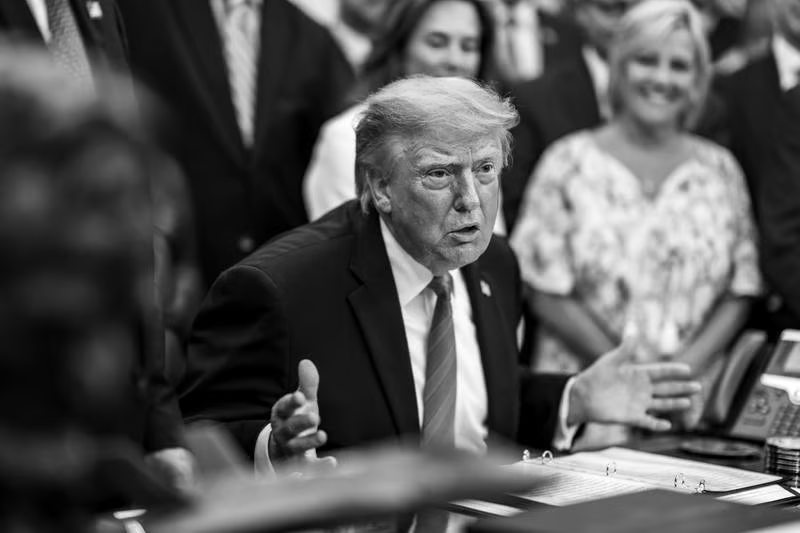
President Trump has been vocal about his displeasure with the FOMC. Image source: Official White House Photo by Daniel Torok.
Trump, who has opined on several occasions that interest rates should be slashed to 1% or lower, told reporters:
The board is very hostile. They’re very political. They’re doing the wrong thing.
However, President Trump appears to be completely overlooking the two biggest inflation catalysts as the reason why lower interest rates can’t currently be justified.
Trumpflation is driving up consumer prices
One of the primary reasons Warsh and the FOMC aren’t considering rate cuts is persistent Trumpflation (i.e., inflation specifically driven by the president’s policies).
PRESIDENT TRUMP SAYS HE TOLD FED CHAIR KEVIN WARSH TO “VOTE WITH THE BOARD” ON TODAY’S RATE HIKE BECAUSE “IT’S NOT GOING TO MATTER” 🇺🇸
Asked if he still has confidence in Warsh, Trump said yes, then went after the rest of the Fed.
“He’s got a very tough board. He’s got a board… pic.twitter.com/VdLmgxTjzZ
— WOLF (@WOLF_Financial) September 17, 2026
For starters, the Trump administration reinstated sweeping global tariffs on more than 80 countries in late July. Assigning duties to imported goods risks increasing domestic manufacturing costs, which are then passed on to consumers. Trump’s Liberation Day tariffs, which were struck down by the U.S. Supreme Court in February 2026, were responsible for boosting Social Security’s cost-of-living adjustment in 2026.
The Trump-led Iran war is also having a meaningful impact on consumer prices. Iran’s closure of the Strait of Hormuz was the catalyst for the largest energy supply disruption in modern history.
Not only has the Iran war led to higher fuel prices, but the price stickiness of Core Personal Consumption Expenditures points to the effects of this war reaching the broader economy. In other words, Trumpflation has evolved and become entrenched in the U.S. economy.

Image source: Getty Images.
The AI revolution is accelerating data centers and inflation
The other reason President Trump’s repeated calls for interest rate cuts aren’t being taken seriously by the FOMC is due to the inflationary effects of the artificial intelligence (AI) infrastructure build-out.
On the one hand, the AI data center build-out is the best thing that’s happened to the Dow Jones Industrial Average, S&P 500, and Nasdaq Composite since the advent and proliferation of the internet. This technological revolution is lifting corporate growth rates and fueling innovative spending.
At the other end of the spectrum, persistent AI hardware supply shortages (e.g., graphics processing units and high-bandwidth memory), coupled with insatiable enterprise demand, have bestowed AI companies with otherworldly pricing power. While that’s excellent news for investors in these public companies, it’s terrible news for consumers who are paying higher prices downstream.
Fed now officially blaming AI for rise in core inflation:
“Core goods price inflation had risen relative to a year earlier, which the staff judged as largely reflecting the effects of tariffs and AI-related price pressures”
* * *
“Some participants remarked that productivity… https://t.co/ne8TnjRV8s— zerohedge (@zerohedge) July 8, 2026
Despite the best efforts of contract chip manufacturers to bolster their production, supply shortages have shown no signs of abating. The FOMC regularly mentions the AI infrastructure build-out as a source of inflation at its meetings.
With inflation marking its 66th consecutive month above the FOMC’s long-term 2% target in August, Trump’s FOMC scoldings are likely to fall on deaf ears.