Large-cap funds in the red: 29 of 33 schemes deliver negative returns in 1 year, category average at -3.09%
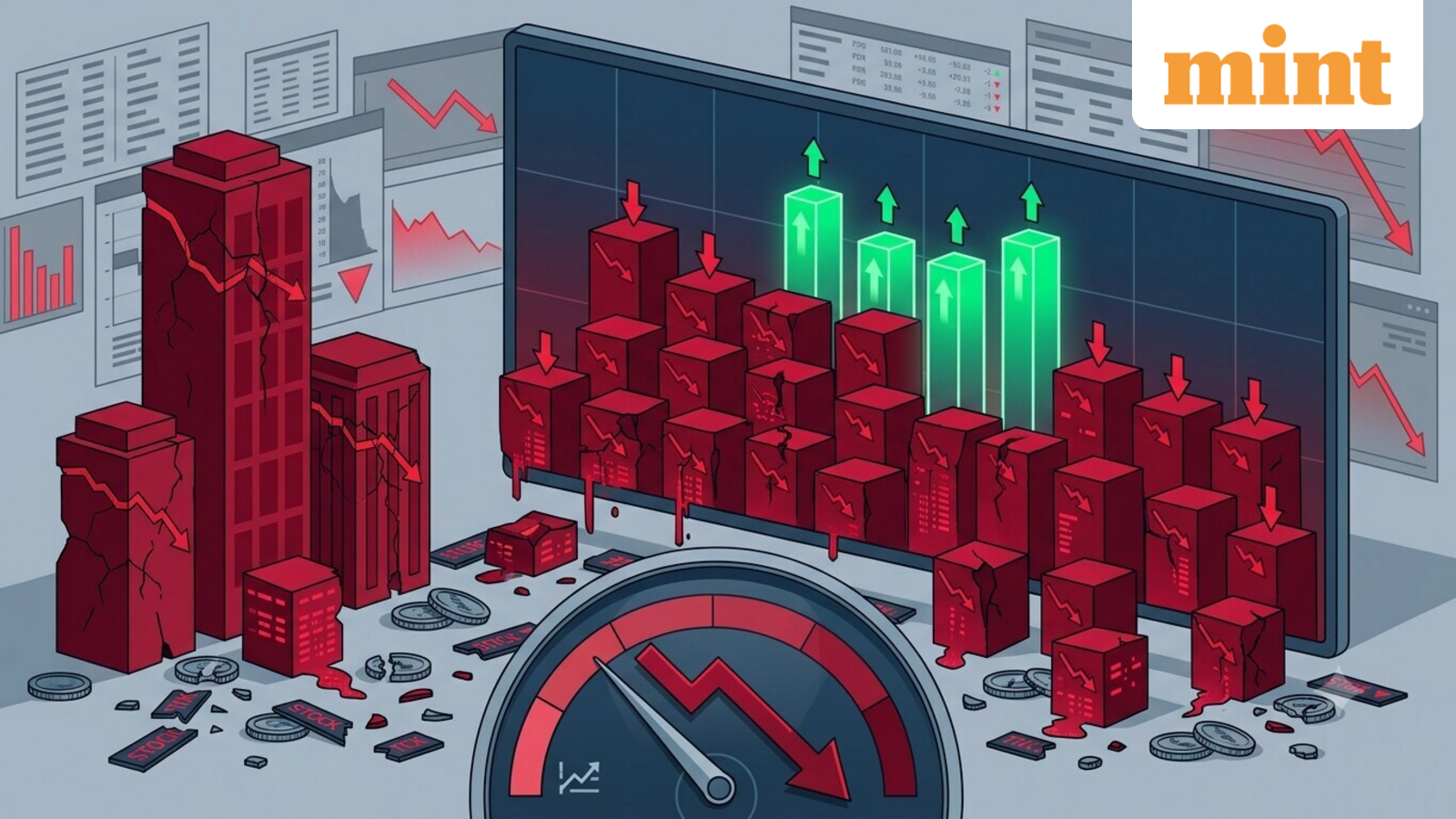
Active large-cap mutual funds have had a difficult year. The category average return stands at -3.09% over the past one year, with only four of the 33 funds in the category delivering positive returns. For investors who expected large-cap funds to provide relatively stable equity exposure, the latest numbers make for a disappointing one-year snapshot.
Quant Large Cap Fund topped the category with a 5.68% return, followed by Taurus Large Cap Fund at 5.13%. Bank of India Large Cap Fund and Invesco India Large Cap Fund were the only other schemes to remain in positive territory, with returns of 2.84% and 1.30%, respectively.
The remaining 29 funds posted negative returns. That means an investor looking only at the past one-year period would not have seen FD-like returns from any of these equity funds. However, large-cap funds are market-linked equity investments and are not comparable with fixed deposits in terms of risk or return.
Only four large-cap funds delivered positive returns
The gap between the top-performing fund and the rest of the category is notable. Quant Large Cap Fund’s 5.68% return was followed closely by Taurus at 5.13%, but the returns fell sharply thereafter. Bank of India Large Cap Fund delivered 2.84%, while Invesco India Large Cap Fund returned 1.30%.
|
Fund |
1-year return |
| Quant Large Cap Fund | 5.68% |
| Taurus Large Cap Fund | 5.13% |
| Bank of India Large Cap Fund | 2.84% |
| Invesco India Large Cap Fund | 1.30% |
| Source: Value Research. Data as of 20th September 2026 | |
ITI Large Cap Fund was almost flat at -0.19%, while Bajaj Finserv Large Cap Fund returned -0.78%. Baroda BNP Paribas Large Cap Fund and Bandhan Large Cap Fund fell 1.10% and 1.24%, respectively.
At the other end, Samco Large Cap Fund was the worst performer in the dataset, declining 9.08% in one year. This creates a 14.76 percentage-point gap between the highest and lowest returns in the category.
Even the biggest large-cap funds were mostly in the red
The negative returns were not restricted to smaller schemes. Several of the largest large-cap funds by assets also recorded losses over the past year.
ICICI Prudential Large Cap Fund, the largest fund in the dataset with ₹80,206 crore in net assets, returned -6.04%. SBI Large Cap Fund, with ₹55,140 crore, fell 2.63%, while Nippon India Large Cap Fund, with ₹54,134 crore, declined 5.83%.
|
Fund |
1-year return |
Net assets |
| ICICI Prudential Large Cap Fund | -6.04% | ₹80,206 crore |
| SBI Large Cap Fund | -2.63% | ₹55,140 crore |
| Nippon India Large Cap Fund | -5.83% | ₹54,134 crore |
| HDFC Large Cap Fund | -3.95% | ₹39,933 crore |
| Mirae Asset Large Cap Fund | -4.16% | ₹38,166 crore |
| Axis Large Cap Fund | -4.09% | ₹31,376 crore |
| Aditya Birla Sun Life Large Cap Fund | -5.14% | ₹29,711 crore |
| Source: Value Research. Data as of 20th September 2026 | ||
HDFC Large Cap Fund, which manages ₹39,933 crore, returned -3.95%, while Mirae Asset Large Cap Fund and Axis Large Cap Fund fell 4.16% and 4.09%, respectively. Aditya Birla Sun Life Large Cap Fund, with ₹29,711 crore in assets, declined 5.14%.
This means the one-year weakness was visible even among several of the category’s biggest schemes, rather than being limited to funds with relatively small asset bases.
What should investors make of the one-year performance?
The data shows that negative one-year returns have been widespread across active large-cap funds. Only four of the 33 funds were able to generate positive returns, while the category as a whole remained down 3.09%.
However, a one-year return alone does not establish whether a large-cap fund is suitable for an investor or whether it should be switched. Equity funds can go through periods of negative returns, and a meaningful assessment would also require longer-term performance, benchmark comparison and consistency across market cycles.