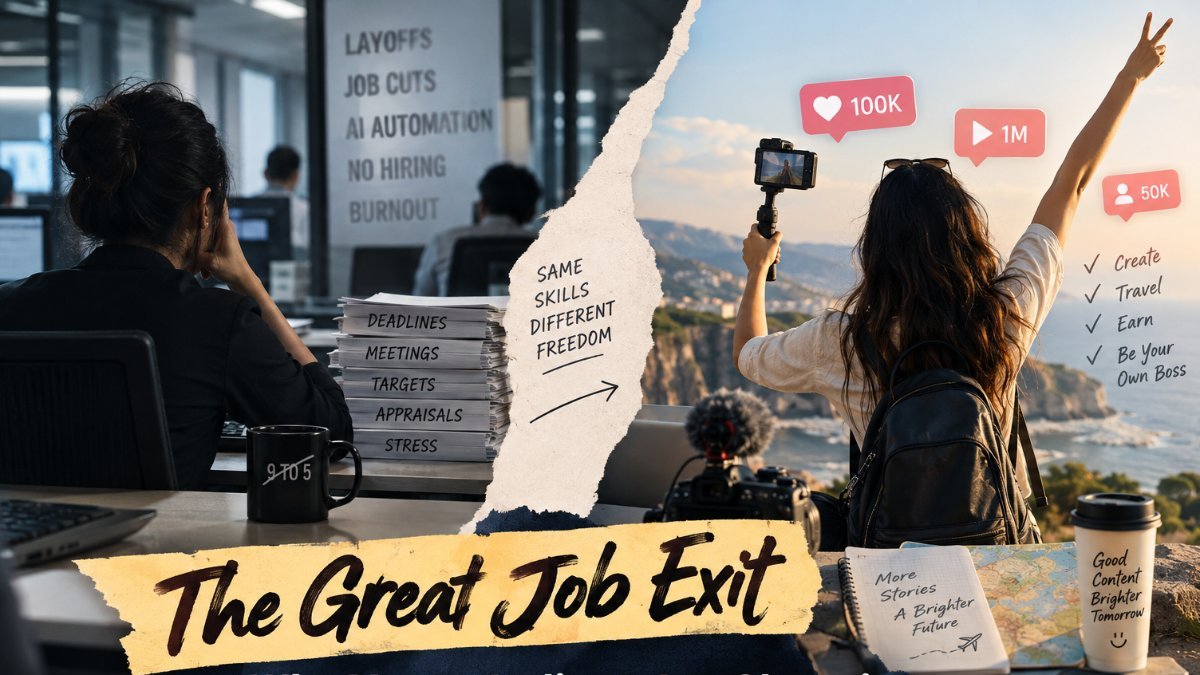
The Great Job Exit: Why Young Indians Are Choosing Content Creation Over Corporate Careers
The buzzword this year was ‘layoffs’, which was on everyone’s lips. According to data by Trueup, more than 1.8 lakh people lost their jobs in 2026 so far, which comes to around 722 people per day.
2026 has been one of the roughest years for salaried jobs in recent memory, and the timing matches the current creator boom era almost exactly.
While Corporate India is feeling this impact, millions of people are turning cameras and phones into full-time careers because they actually pay now.
Earlier, if someone said I make videos for a living, people would mock me. Now the same people are supporting the ones who are becoming influencers and making more money than the corporate world would ever provide them.
/img/2026/09/thegreatjobexit6000-98331789813497.jpeg "The Great Job Exit")
The Exodus From Corporate India
According to the data from the staffing firm TeamLease, around 10,000-15,000 tech professionals had already gone through “silent” exits by May 2026, with the full-year toll projected at 25,000-35,000.
India’s Economic Survey 2025-26 says that the cause behind this is mainly because of AI adoption and automation, due to which many of the roles are now redundant.
The same report stated that Fresher IT hiring has reportedly collapsed by as much as 80% from its peak, and active tech job openings fell to a 28-month low of around 93,000 in June 2026.
So for people who are watching the corporate ladder shaking, a phone and a good number of followers can look like the safer option.
Earlier, content creation was just a side hustle that people used to do out of a hobby, but now things have changed.
Speaking to Goodreturns, Priyanka Prasad, who goes by the handle @seagullsgirlfriend, an automotive influencer, said that she quit her software job to pursue content creation full-time.
“I was a senior software engineer for 5 years at a Japanese fintech company, earning around Rs 2 lakh a month. After five years there, it felt like I was always working with no leave. My heart was always racing. Then burnout happened, and I quit. Now my Instagram page has 90k followers. I’m travelling, and I have freedom. I’m my own boss, and I can choose what to do and what not to do.”
/img/2026/09/thegreatjobexit12-53811789813497.jpeg "The Great Job Exit")
India Went Online Faster Than Ever
The foundation for this shift was built over the last five years by cheap data and cheaper smartphones.
If we look at the data from TRAI, India’s internet base grew from roughly 622 million users in 2020 to around 958 million by 2025.
Even in rural India, the growth has been enormous due to the popularity of the regional languages, and small-town creators have become the fastest-growing part of the creator economy.
The creator base over the years has exploded. According to the Creator Economy report by the Indian School of Business, there are more than 4.12 Cr estimated creators in India by 2025, which is up from 96 lakh in 2020. The report says that 1 out of 10 Internet users in India now creates content in some form, and 66% of India’s creators are now based outside metro cities.
/img/2026/09/thegreatjobexit600-88651789813497.jpeg "The Great Job Exit")
How Lucrative Is the Content Creation Career?
The real test comes here: how much does content creation pay? India may have crossed 4 crore creators, but only 8-10% of all creators actually monetise effectively and are making real money from it.
Talking about the earnings from content creation, Priyanka said, “Things were a little difficult in the beginning, but with consistency, within 6 to 8 months I started monetising on Instagram. Now I get 30-40k per reel, so five videos a month gets me what I used to earn earlier.”
“Though the earnings vary month on month since they’re variable. Sometimes I earn less than I used to, sometimes more. On some reels I even get up to Rs 1 lakh.”
What Do YouTube and Instagram Actually Pay?
The payment from YouTube comes in the form of ad revenue. India’s YouTube ad rates are among the lowest in the world.
Most channels earn roughly Rs. 50 to Rs. 200 per 1,000 views on long-form video, and Shorts earn only about 10% of what long videos do.
Another factor is the niche; entertainment content can pay quite little, Rs. 10 to Rs. 40 per 1,000 views, while finance and investing content can reach Rs. 80 to Rs. 250.
Meanwhile, viewers from US audiences can pay about Rs. 670 to Rs. 1,340 per 1,000, which is why overseas viewers add more money for Indian channels.
Instagram does not pay per view in India either, so its income comes almost entirely from brand deals.
Nano creators who have less than 50k followers charge roughly Rs. 1,000 to Rs. 12,000 per sponsored post, and micro creators who have 50k-100k followers charge around Rs. 8,000 to Rs. 80,000.
The Government’s Efforts to Build India’s Creator Economy
The government of India has lent support to the creators and is actively trying to build the creator economy.
During the 2026 budget, the government has proposed setting up AVGC Content Creator Labs in 15,000 secondary schools and 500 colleges across the country. This initiative was allocated Rs. 250 crore and will provide students with opportunities in digital content creation.
Apart from that, a National Creator Economy Bill was passed in the Rajya Sabha in April 2026, which proposes formal recognition for digital influencers and YouTubers. As per PIB, the bill standardised contracts for brand collaborations, registration requirements for high-earning creators, and a Creator Welfare Fund to support health insurance and retirement benefits.
Worth A Career Shift?
People who are considering making this transition should also know that it is not just about the possibility of earning through reels and brand collaborations. If they are successful, they get awarded flexibility to work creative independence as well.
Now that India’s creator economy is rising, it will be interesting to see whether a career built around digital platforms will offer the financial stability and long-term security that 9-5 has been providing.
Disclaimer: The views and recommendations expressed are solely those of the individual analysts or entities and do not reflect the views of Goodreturns.in or Greynium Information Technologies Private Limited (together referred as “we”). We do not guarantee, endorse or take responsibility for the accuracy, completeness or reliability of any content, nor do we provide any investment advice or solicit the purchase or sale of securities. All information is provided for informational and educational purposes only and should be independently verified from licensed financial advisors before making any investment decisions.