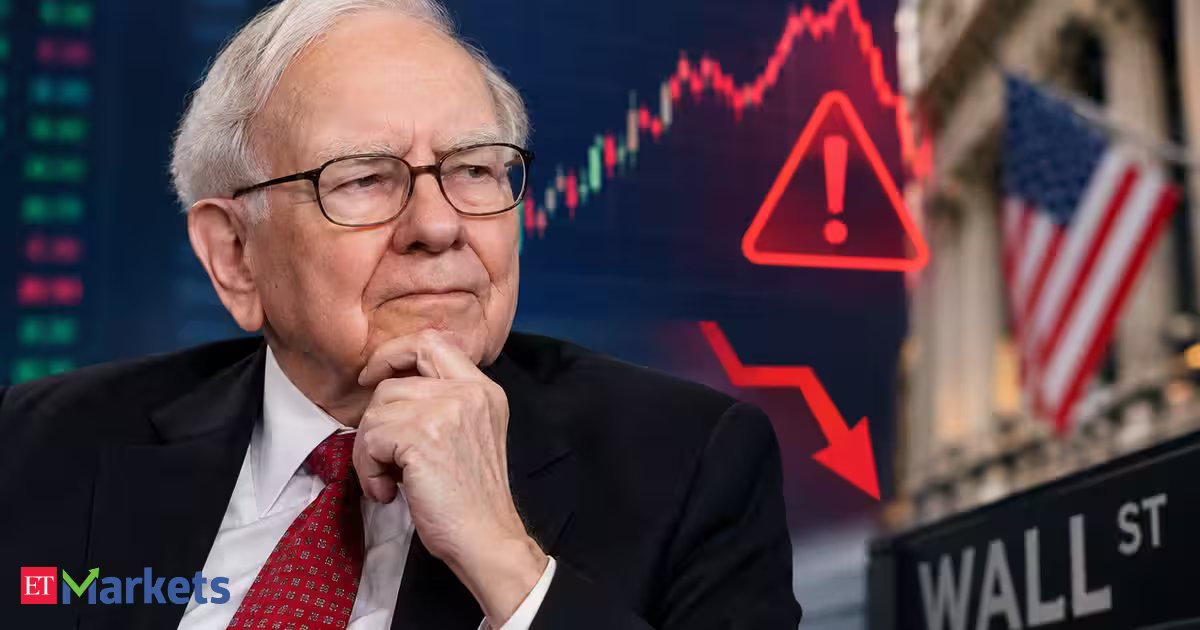
Warren Buffett sounds alarm as stock market warning returns for only second time in 155 years
That backdrop comes as Warren Buffett, one of the most closely watched investors in the world, has issued a blunt message about the current market mood. Between 1965 and 2025, Berkshire Hathaway, the company he once led, delivered an annual compound return of about 19.7%, compared with 10.5% for the S&P 500 including dividends.
In a recent conversation with CNBC’s Becky Quick, Buffett said, “It’s tough to find values when everybody is preferring gambling.” The Oracle of Omaha has made a similar point in recent months, describing the market as a church with a casino attached and saying he had never seen people in more of a gambling mood.
Buffets approach
Buffett’s approach to investing has long centred on businesses that can earn more than they spend over an extended period. That is why he places so much emphasis on economic moats and competitive advantages. A moat can come from a strong brand, scale, switching costs or a network that becomes more valuable as more people use it. Such advantages can support durable cash flow, which companies can use to pay dividends, buy back shares or reinvest in their operations. Over long periods, that compounding can drive portfolio returns.
Buffett has also generally preferred buying when investors are less interested or more fearful, rather than when a particular story has taken over the market. Berkshire Hathaway remained relatively cautious on the artificial intelligence (AI) trade for a long time as the frenzy pushed valuations higher. It was only about a year ago that Berkshire initiated a position in Alphabet.

What does that mean for investors?
That does not necessarily mean the current AI boom will follow the same path as the dot-com era. The two periods also have important differences.
A high CAPE ratio remains significant because elevated readings have generally pointed towards more modest future returns. The current level can therefore be viewed as a warning about valuations rather than a signal that a market crash is about to happen. Markets can remain expensive for extended periods, just as inexpensive markets can become even cheaper. The CAPE ratio is therefore more useful for considering the next few years than trying to predict the next few weeks.Buffett’s investment approach has instead focused on owning businesses that can compound through different market cycles, with attention to economic moats, quality management teams and durable cash flows. Those cash flows can either be returned to shareholders or reinvested in the business. Holding such positions over long periods also means that a few difficult years do not necessarily determine the overall investment outcome.
Buffett steps down as chairman
Buffett, 96, is stepping down as chairman of Berkshire Hathaway after more than six decades at the helm of the company. He will become chairman emeritus with immediate effect and will remain a director.
His oldest son, Howard Buffett, will succeed him as chairman, marking another step in Berkshire’s long-planned succession. Howard has been a member of Berkshire’s board since 1993.
As he moves into the chairman emeritus role, Buffett said he remains confident about Berkshire’s future and will continue as a shareholder. “The company is in excellent hands, and I look forward to remaining a shareholder alongside you.”
(Disclaimer: Recommendations, suggestions, views and opinions given by the experts are their own. These do not represent the views of The Economic Times)