Large-cap or aggressive hybrid? The mutual fund category that leads in returns may surprise you
Investors looking to gain stock market exposure often turn to equity funds, especially large-cap funds, to reduce volatility. However, one hybrid category also offers meaningful equity exposure while combining it with debt.
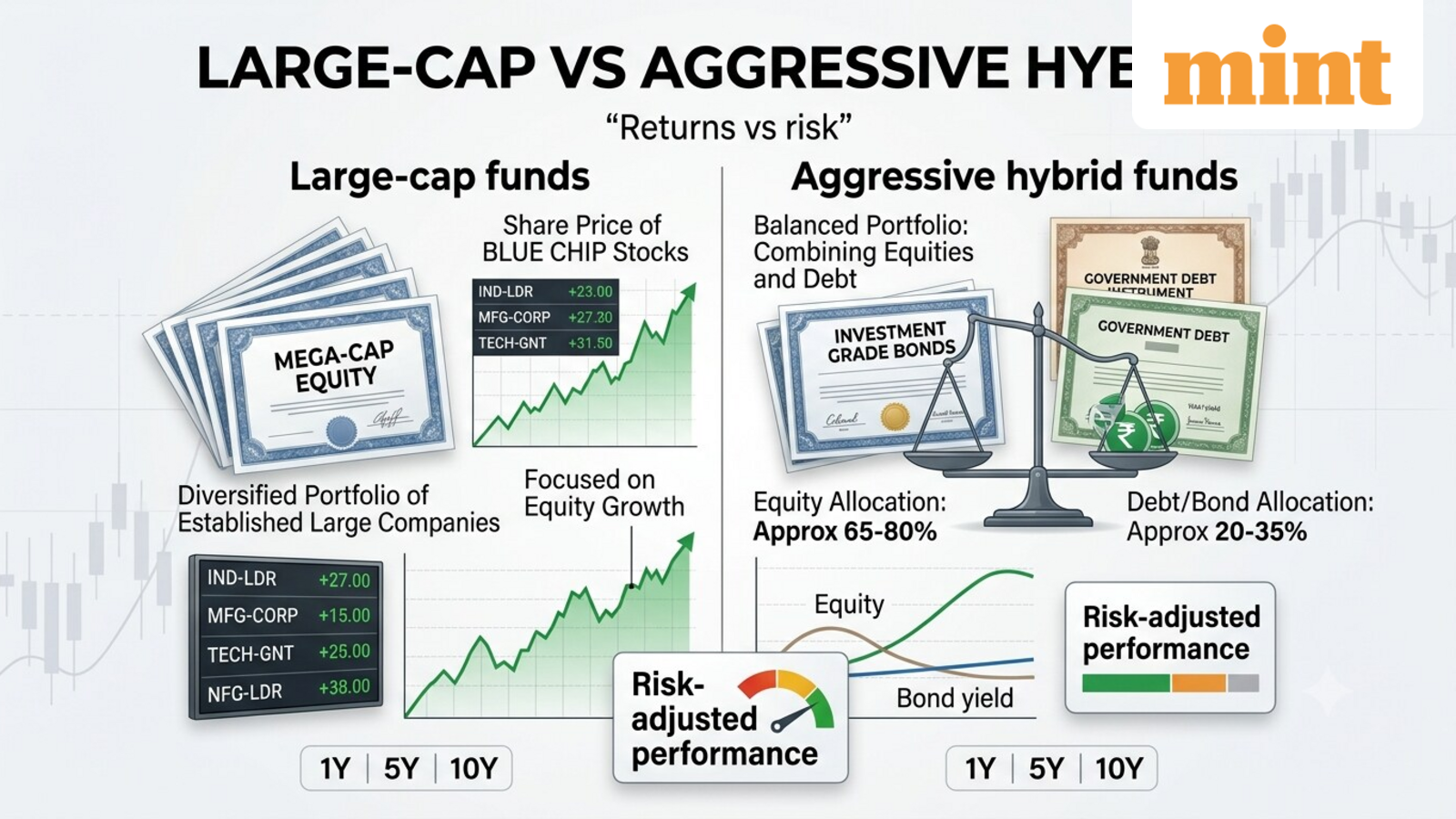
Under SEBI‘s categorisation, aggressive hybrid funds invest 65–80% of their total assets in equity, with the remaining 20–35% in debt instruments. However, large-cap funds must invest at least 80% of their total assets in large-cap stocks.
A comparison of category-average returns shows that the two categories have delivered broadly similar returns over the long term. Here’s what you need to know about risk-adjusted performance.
Large-cap vs aggressive hybrid funds: How do their returns compare?
| Period | Large-cap funds | Aggressive hybrid funds |
| 1 year | -3.72% | 0.61% |
| 3 years | 9.52% | 10.65% |
| 5 years | 8.98% | 10.12% |
| 7 years | 14.30% | 14.55% |
| 10 years | 12.04% | 12.07% |
*Source: Value Research, Category Average Returns, CAGR as on 17 September 2026
Aggressive hybrid funds recorded higher category-average returns across the 1-, 3-, 5-, and 7-year periods, while the 10-year returns were almost identical.
The gap was relatively small over the longer periods. For example, the 7-year annualised return was 14.55% for aggressive hybrid funds versus 14.30% for large-cap funds, while the 10-year figures were almost the same at 12.07% and 12.04%, respectively.
How are the equity portfolios of these categories different?
| Segment/ Stocks | Large-cap funds | Aggressive hybrid funds |
| Large-cap | 92.99% | 61.00% |
| Mid-cap | 7.71% | 23.08% |
| Small-cap | 4.78% | 17.89% |
*Source: Value Research, Category Average Allocation, Data as on 31 August 2026
According to the category average, the table shows that aggressive hybrid funds have considerably lower exposure to large-cap stocks and higher exposure to mid- and small-cap stocks than the other mutual fund category.
What does the Sharpe ratio reveal about the two categories?
The Sharpe ratio measures excess return earned for each unit of volatility. A higher ratio indicates better risk-adjusted performance of a fund or category.
| Category | Sharpe ratio (%) |
| Large-cap funds | 0.44 |
| Aggressive hybrid funds | 0.57 |
*Source: Value Research; Risk measures have been calculated using calendar month returns for the last three years; Data as on 31 August 2026
The category-level Sharpe ratio was 0.57 for aggressive hybrid funds, compared with 0.44 for large-cap funds. This means that the aggressive hybrid category generated a higher amount of excess return per unit of volatility than the large-cap category.
The comparison shows that aggressive hybrid funds have delivered similar or higher category-average returns, while also recording a higher Sharpe ratio.
It is important to note that the two categories have materially different mandates and portfolio structures. While category-level data provides a broad comparison, returns and risk measures can vary significantly from fund to fund.
Investors should look beyond category averages and consider a fund’s asset allocation, portfolio composition, and volatility before making a decision.
Disclaimer: This is purely for educational/informational purposes and should not be taken as any sort of investment advice. Always consult a SEBI-registered advisor before making any investment decisions.