People use AI to gauge banks’ reputations, and its verdicts are harsh
- Key insight: Reputation management was never optional — especially for banks — and the emergence of AI as a new, central stakeholder with significant reach and influence has raised the stakes even further.
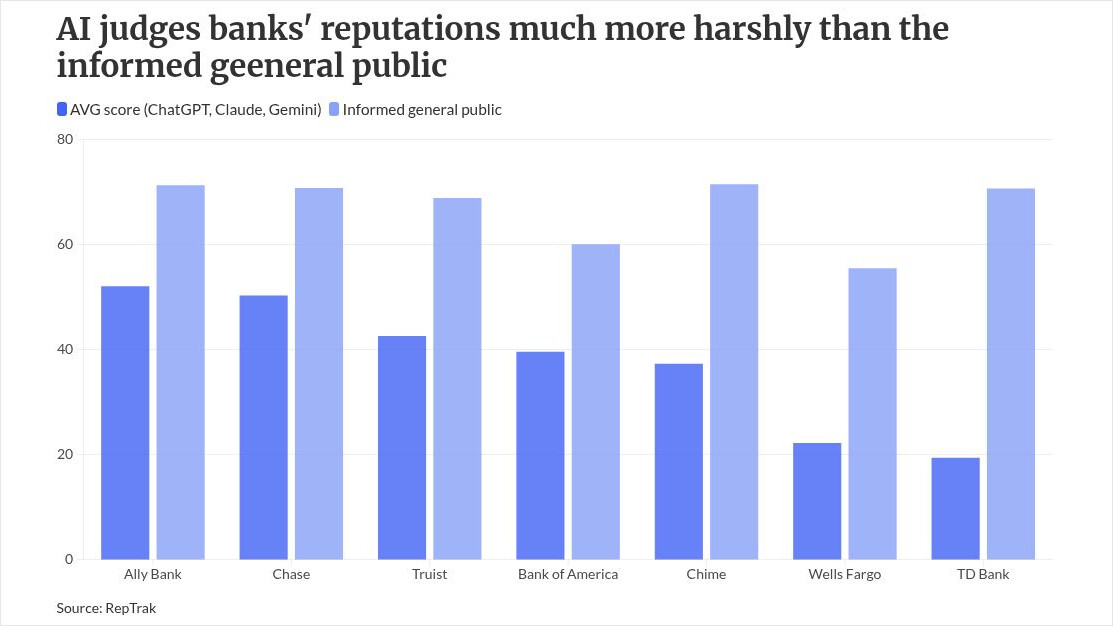
- Supporting data: Among the measured banks in a RepTrak study, Ally Bank was rated most positively by AI on a 100-point scale (averaged across all 3 platforms) but at a relatively low level of 52.1. It was followed by Chase at 50.3, Truist at 42.6, Bank of America at 39.6, Chime at 37.3, Wells Fargo at 22.2 and TD Bank at 19.4.
- Forward look: With banks’ own voices still accounting for a relatively small share of the sources AI platforms draw on — including both recent and legacy content — they must redouble efforts to ensure their perspectives are authentic, accessible, and readily discoverable.
Reputation isn’t a soft metric — it’s a leading indicator of business outcomes and an insurance policy in times of crisis. This is especially true in banking: Over my organization’s more than 20 years of cross-industry reputation measurement,
Processing Content
Building and protecting reputation is an exercise in understanding and communicating with multiple stakeholders that matter to the organization, including addressing sometimes diverging priorities and aligning the latter with key corporate priorities. It is in that context that
People increasingly turn to AI to research companies — including banks. Our own research in this year’s American Banker
AI searches about banks analyze information across a wide variety of sources, whether bank-owned or not. The AI platforms themselves decide which sources to prioritize, interpret the content, and ultimately render a verdict on how reputable they are and how they perform across different parts of the business. Yet despite the increasing influence of generative AI platforms, most companies are struggling to answer the following critical questions: How is AI “portraying” the company, and what narratives does it amplify or suppress? What are the sources AI bases its assessments on — and are they accurate? How prominent is the company’s voice in shaping the narrative that AI returns?
We leveraged data from this year’s study to illustrate how AI based judgements — including those made by Claude, ChatGPT and Gemini — compare to perception-based assessments of the informed general public, using the same set of questions that make up the RepTrak normative framework. The latter evaluates both a company’s reputation as well as perceived business performance across 23 reputation factors, aggregated into 7 drivers: products & services, innovation, workplace, conduct, citizenship, leadership and performance.
For illustrative purposes we selected a mix of different institutions: Ally Bank, Bank of America, Chase, Chime, TD Bank, Truist and Wells Fargo.
Our first insight was that AI judges banks’ reputations much more harshly than the informed general public.
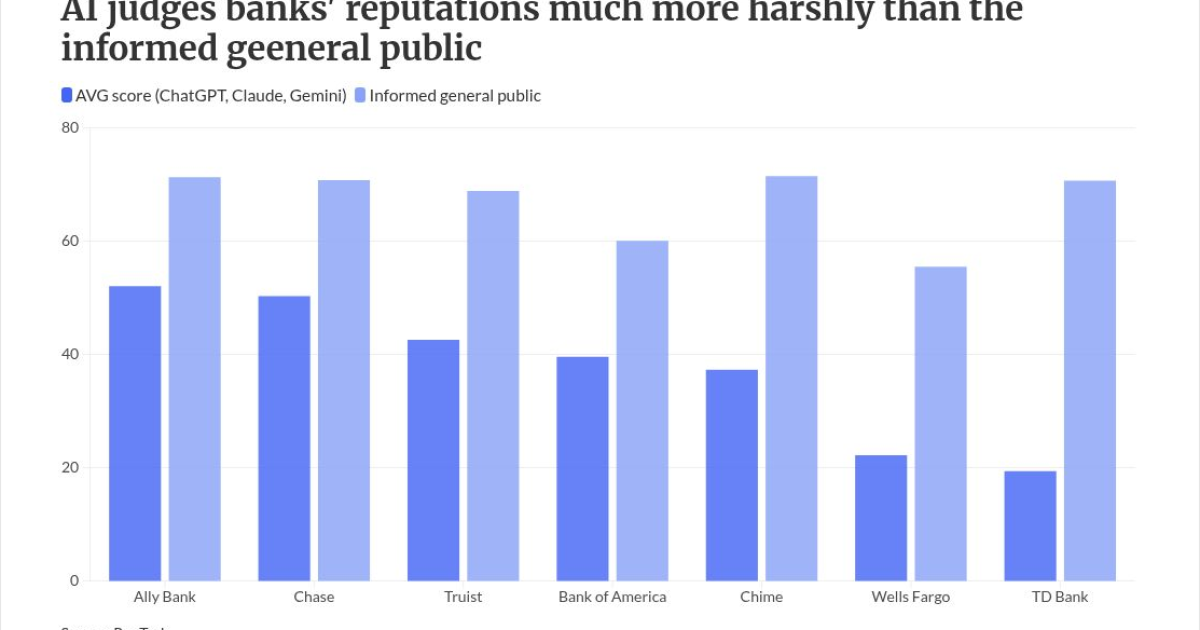
Among the measured banks, Ally Bank was rated most positively by AI on a 100-point scale (averaged across all 3 platforms) but at a relatively low level of 52.1. It was followed by Chase at 50.3, Truist at 42.6, Bank of America at 39.6, Chime at 37.3, Wells Fargo at 22.2 and TD Bank at 19.4.
The informed general public consistently scored the same banks higher, with an average of 70.0 ranging from 55.5 for Wells Fargo to 71.5 for Chime. Neither bank type nor “human” rating levels were consistently correlated with AI reputation assessment.
A second insight was that AI-based driver scores were also lower relative to survey-based perceptions in areas that matter the most: products/services, conduct and citizenship. Only banks’ financial performance is shown in a more positive light.
The reputation drivers AI judges banks on most harshly are those that the public cares most about to evaluate banks’ reputations. Average AI evaluated conduct score was 26.1 vs. 68.0 for the informed general public; products/services score was 42.0 vs. 71.0; and banks’ citizenship credentials were rated a 50.4 vs. 66.3.
Read more:
AI is especially critical of banks not standing behind their products and services, their lack of ethical behavior and environmental shortcomings.
Perceived financial performance was the only driver that received a significantly higher AI-based score earning an average rating of 81.5 compared to an average human rating of 72.3. Banks’ profitability stood out as the most positively evaluated factor.
A third insight was that no single bank “wins” on all reputation drivers, and legacy actions matter much more to AI platforms than humans.
While Ally received the highest scores for 4 out of the 7 drivers of reputation, other banks rose to the top for the remaining ones. For example, Bank of America was rated highest on innovation and financial performance, while Chase came out on top in the leadership category.
A final insight was that when AIs create their assessments of banks, bank-owned sources make up less than 10% of the information they consult.
The most frequently cited source was the news media, followed by websites that produce rankings, like J.D. Power and Glassdoor. Other sources consulted included government websites, including the Consumer Financial Protection Bureau, and public customer reviews and social media accounts.
Not only do banks need to understand which sources are the most impactful for their company’s reputation — including by AI platform type — but also how much their own voice is breaking through. This is especially critical as respondents from RepTrak’s
Reputation management was never optional — especially for banks — and the emergence of AI as a new, central stakeholder with significant reach and influence has raised the stakes even further. Our findings provide strong preliminary evidence that banks, whose reputations have historically faced pressure in the court of public opinion, are facing an additional challenge through the lens of AI. Notably, AI judges banks most harshly in the areas that matter most to consumers: products/services and conduct.
With banks’ own voices still accounting for a relatively small share of the sources AI platforms draw on — including both recent and legacy content — they must redouble efforts to ensure their perspectives are authentic, accessible, and readily discoverable. Doing so will help reinforce AI-identified strengths, address areas of weakness, and build a credible, evidence-based narrative around the issues that matter most to stakeholders.