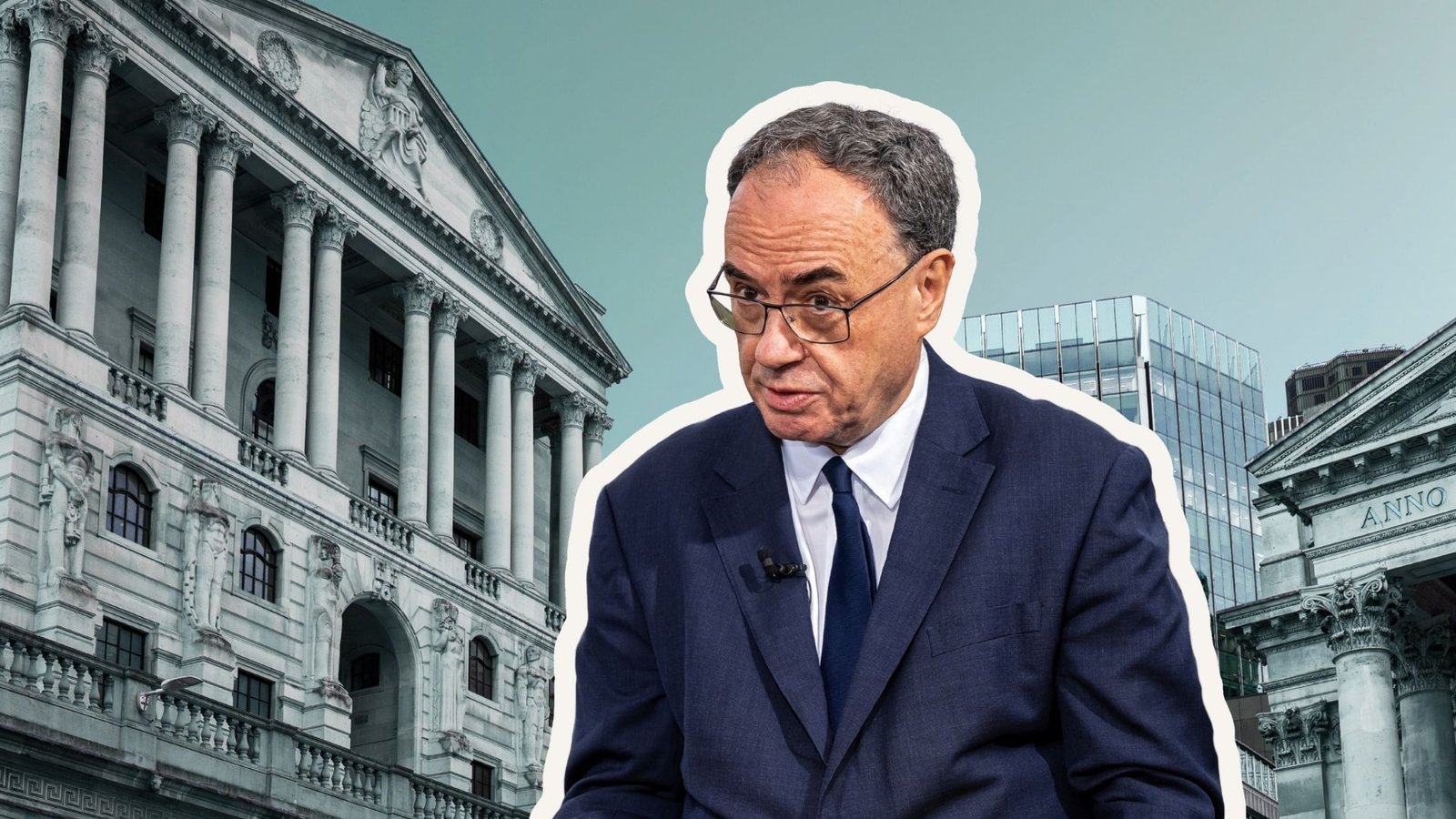
Live: Will the Bank of England keep interest rates at 3.75%?
What is the bank rate and why is it important?
When we talk about the BoE raising or cutting interest rates, this refers to the ‘bank rate’, or the ‘base rate’.
The bank rate is the core interest rate in the UK, and is the rate of interest the BoE pays to commercial banks, building societies, and financial institutions that hold money with the central bank.
The bank rate is also the interest rate that the central bank charges on loans made to other financial institutions, therefore affecting their own lending and savings rates.
The reason the BoE moves interest rates is typically to achieve certain economic goals for the country. The most important of these, but not the only one, is achieving the bank’s target inflation rate of 2%.
Broadly speaking, when inflation is too high, interest rates will be raised in order to rein in consumer spending and push down demand.
For example, this may mean your mortgage payments increase and you therefore have less money to spend elsewhere. Meanwhile, people are also encouraged to save more money as higher interest rates are offered on savings accounts.
On the other hand, interest rates may be lowered in order to try to stimulate the economy and encourage people to spend more – mortgage payments will be lower and savings rates will be far less appealing.
This may be done when inflation is below target, but could also be done to bring the base rate back down to a neutral level.
Where have interest rates gone recently?
In the last six years, interest rates have gone from being as low as 0.1% to as high as 5.25%. Much of this period is dominated by the Covid-19 pandemic and its consequences.
When the pandemic first hit, the MPC cut rates to 0.1% to help stimulate economic activity.
Then, when the economy opened back up and the cost of living crisis began to be felt, interest rates were hiked consecutively from December 2021 to August 2023 to combat rising inflation.
More recently, the Bank of England started to ease rates. Between August 2024 and December 2025, the MPC voted to cut interest rates six times, each time by 0.25 percentage points.
This gradually brought the Bank rate down to 3.75% in the last MPC meeting of 2025.
At the end of 2025, most experts believed that interest rates would be brought down by another 0.5 percentage points by the end of 2026, settling at around 3.25%.
However, the Iran war made the MPC change course. Since the war began on 28 February, rates have been on ice at 3.75%, although pressure is growing to raise rates.
Why do some MPC members want to raise interest rates?
At the MPC’s last meeting on 30 July, three of its nine members voted to raise interest rates by 0.25 percentage points.
The members were BoE chief economist Huw Pill, and external members Megan Greene and Catherine L Mann.
Although they all had a slightly different rationale, they all believe that raising interest rates now will do a better job of protecting the UK from inflation if the inflationary shock is worse than expected, considering how volatile the economic outlook is.
Pill explained his reasoning last week, warning that the “wait-and-see” approach the Bank is currently taking will not stave off inflation if price growth is worse than the Bank’s current predictions.
He said the current approach of keeping rates at 3.75% means the Bank of England may fall “fall ‘behind the curve’ in addressing emerging inflationary risks” if the economic damage from the Iran war is more substantial than expected.
Recap: Where did inflation go in August?
Inflation rose to 3.1% in August, the latest data from the Office for National Statistics (ONS) shows.
The main driver was a sharp rise in the price of fuel which pushed price growth higher in August. Other contributing sectors were higher airfares, housing and household services, and recreation and culture.
Grant Fitzner, chief economist at the Office for National Statistics, added that rising crude oil and petrol prices increased the cost of raw materials and price of goods leaving factories.
Some of the rise was offset by a fall in furniture and household good prices and clothing and footwear prices.
What to expect from tomorrow’s interest rates announcement
Most experts expect that interest rates will be held at 3.75% tomorrow as the MPC remains in “wait-and-see” mode.
However, with the latest inflation data showing prices grew by 3.1% in the year to August, pressure to hike rates to respond to rising inflation is likely to grow among the MPC members.
Sanjay Raja, chief UK economist at Deutsche Bank, said: “We don’t expect any change to Bank Rate, with the MPC likely to remain on the sidelines relative to other central banks. But we do think the tides are turning on the inflation backdrop.
“Higher energy prices are here to stay for longer than expected. Inflation is no longer missing to the downside as it did throughout Q2-26. The economy has been far more resilient than the BoE envisaged. The labour market is showing some signs of stabilisation. And risks around wage settlements remain skewed to the upside.
“Put simply, we think the MPC’s patience may be running thin. And the case for staying on hold is weakening slowly.”
What is the Monetary Policy Committee?
The Bank of England’s Monetary Policy Committee (MPC) is the body that is responsible for setting interest rates..
The committee is made up of nine members and is chaired by BoE governor Andrew Bailey.
Five of the members are internal staff, while the remaining four are external experts appointed to make sure the MPC benefits from expertise outside the Bank of England.
The internal members are governor Andrew Bailey, deputy governors Sarah Breeden, Clare Lombaredelli, Dave Ramsden, and chief economist Huw Pill.
The external members are Alan Taylor, Catherine L Mann, Megan Greene, and Swati Dhingra.
During each meeting, the committee votes on whether to cut, hold or raise interest rates.
When will the interest rates decision be announced?
The latest interest rates decision will be announced tomorrow (Thursday, 17 September) at 12:00pm.
The minutes of the MPC’s meeting will be released at the same time. MoneyWeek will report on the breaking news as it comes.
The interest rates meeting itself usually takes place the day before the MPC’s announcement, meaning the MPC will be able to make its decision with the latest inflation data released this morning.