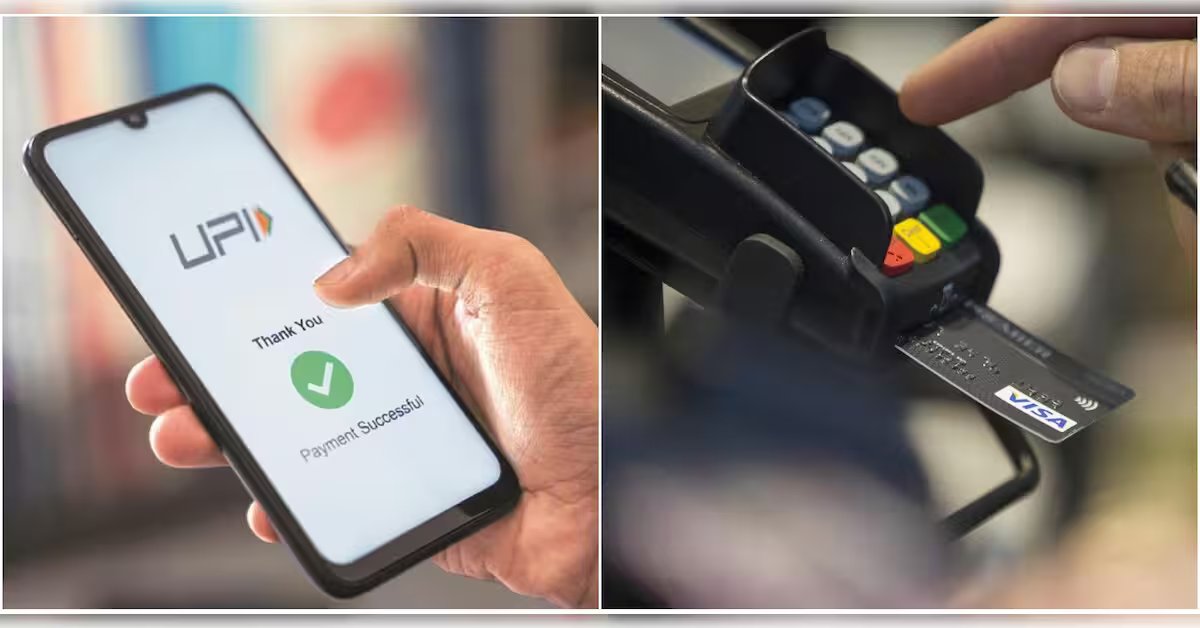
UPI versus cards: What merchants will pay under the new MDR regime | Finance News
From October 15, merchants will have to pay a 0.4 per cent Merchant Discount Rate (MDR) on specified UPI person-to-merchant (P2M) transactions above ₹2,000. Consumers, however, will not bear the cost.
The move marks a shift for UPI, which has had no MDR since 2020. It also raises a question for businesses: once merchants start paying to accept UPI, how does its cost compare with debit and credit cards?
The new UPI cost
Under the revised framework, merchant payments of up to ₹2,000 will also remain free. Small merchants receiving up to ₹1 lakh a month through UPI QR codes under the P2PM category will continue to get zero MDR.
For transactions that do attract the standard MDR, the rate is 0.4 per cent. That means a merchant accepting a ₹10,000 UPI payment would incur ₹40 in MDR, while a ₹50,000 transaction would cost ₹200. At ₹75,000, the 0.4 per cent calculation reaches ₹300, and the same ₹300 cap applies to higher-value transactions.
Some sectors have separate rates. Transactions above ₹2,000 in railways, telecommunications, insurance, fuel and agricultural inputs will attract a flat ₹5 MDR. Payments involving mutual funds, securities, stockbrokers and dealers will attract 0.02 per cent, capped at ₹300.
How does that compare with debit cards?
Under RBI’s existing framework, debit-card MDR for merchants with turnover above ₹20 lakh a year can be as high as 0.9 per cent for physical POS and online card transactions. For QR-code-based card acceptance, the ceiling is 0.8 per cent. For smaller merchants, the corresponding ceilings are 0.4 per cent and 0.3 per cent, respectively.
The RBI figures are maximum rates, not a claim that every merchant pays 0.9 per cent. Actual merchant costs can depend on the merchant’s size, payment channel and commercial relationship with the acquiring bank. For example, if a large retailer accepts a ₹10,000 debit-card payment, RBI rules may allow the acquiring bank to charge up to ₹90 as MDR. But the retailer may have negotiated a lower rate, say 0.5 per cent, in its agreement with the bank.
So for a ₹10,000 transaction, therefore, the comparison at the prescribed rates is ₹40 for UPI against as much as ₹90 for a larger merchant using debit cards at the 0.9 per cent ceiling.
Credit cards are a different proposition
Credit-card payments typically carry higher merchant charges than debit cards. One reason is that card payments involve several participants and fees, including an interchange fee paid by the acquiring bank to the card issuer for each transaction. NPCI says the MDR is determined through individual negotiation between the acquiring bank and merchant. Its latest FAQ puts standard credit-card MDR typically at 1.5-2.5 per cent.
At those headline rates, a ₹10,000 credit-card transaction would cost a merchant ₹150-250 in MDR. A ₹50,000 transaction would cost ₹750-1,250.
On a ₹1 lakh transaction, the new UPI framework would result in an MDR of ₹300 because of the cap. Applying the 0.9 per cent debit-card ceiling gives ₹900, while a 1.5-2.5 per cent credit-card MDR would amount to ₹1,500-2,500.
These are comparisons of headline MDRs, not estimates of what every merchant actually pays.
Why would merchants continue to accept credit cards?
A credit-card payment gives the customer access to a line of credit and can also come with rewards, cashback, discounts and interest-free credit periods. Those features can influence the payment method a consumer chooses, particularly for larger purchases.
For the merchant, the higher MDR can therefore be viewed partly as the cost of accessing a payment instrument that offers customers credit and rewards.
This is also why credit-card-on-UPI needs to be kept separate from ordinary bank-account-funded UPI.
The new 0.4 per cent MDR applies to direct account-to-merchant UPI payments. RuPay credit cards linked to UPI and other credit-linked UPI transactions are governed separately because the underlying funding comes from a credit product. They should not be treated as ordinary 0.4 per cent UPI transactions.
So, is UPI still cheaper?
For eligible transactions, 0.4 per cent is below the 0.9 per cent maximum applicable to larger merchants for debit-card acceptance through physical POS or online channels, and well below the 1.5-2.5 per cent range cited by NPCI for standard credit cards.
The ₹300 cap makes UPI particularly inexpensive for large transactions. A ₹1 lakh UPI payment costs ₹300 in MDR under the new framework, against up to ₹900 at the 0.9 per cent debit-card ceiling and ₹1,500-2,500 at the cited credit-card rates.