77% Would Choose Their Financial App for a Digital Asset Wal…
Digital assets may reach the checkout faster by asking consumers to change less about how they pay.
The July 2026 Payments Innovation Tracker, “From Asset to Everyday Money: Making Digital Currencies Spendable,” says cryptocurrencies and stablecoins are moving beyond investment. Consumers want to use them for purchases and transfers, but merchant acceptance, trust and fragmented experiences still slow adoption.

We’d love to be your preferred source for news.
Please add us to your preferred sources list so our news, data and interviews show up in your feed. Thanks!
The report’s third key finding offers an encouraging path: Linked cards, real-time conversion and modern issuer-processing platforms can connect digital assets to payment habits already in place. It also traces how clearer regulations and cross-border business payments are moving these assets toward broader use.
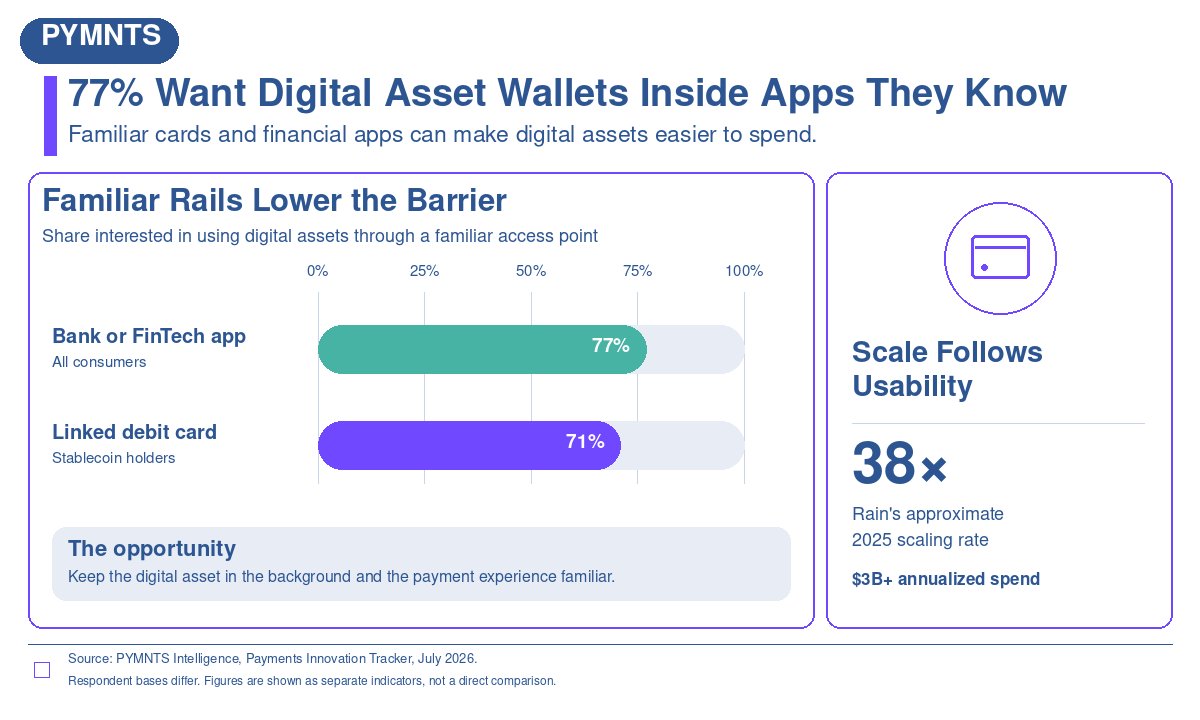
- Familiar apps could open the door. Seventy-seven percent of consumers say they would open a crypto or stablecoin wallet through their current banking or FinTech app if one were available. That finding gives banks and FinTechs an advantage. They already provide the login, customer relationship and familiar interface that can make a new form of money feel less unfamiliar.
- Linked cards can extend acceptance. Seventy-one percent of stablecoin holders say they would use a linked debit card to spend those assets. The card acts like a translator at checkout: It converts the digital asset at the point of sale, sends the transaction across existing payment rails and lets the merchant receive payment through systems it already uses. Consumers don’t need a separate checkout routine.
- Modern processing can turn interest into scale. Issuers need real-time authorization, currency conversion and card issuance that work across digital assets and traditional networks. The report points to Rain, which scaled roughly 38-fold in 2025 and reached more than $3 billion in annualized spending after securing direct Visa network membership. The example shows how infrastructure can support wider reach and faster program development.
The opportunity extends beyond consumer cards. The report says business-to-business cross-border transfers already account for most global stablecoin payment volume, driven by faster settlement, lower costs and access to dollar-linked value in volatile markets. Consumer demand also remains ahead of availability. Forty-two percent of stablecoin holders want to use digital assets for major purchases, while 28% currently do. Nearly half cite limited merchant acceptance as a barrier.
Regulation may help close the distance. Europe’s MiCA rules and the U.S. GENIUS Act have created clearer standards for issuers and service providers. The next step is practical: Give people a trusted way to spend digital assets without forcing them to learn a new payment system.