How banks can calculate the true ROI of AI
A big mistake to avoid when calculating the ROI of an AI investment is failing to account for costs created when the system gets things wrong.
Processing Content
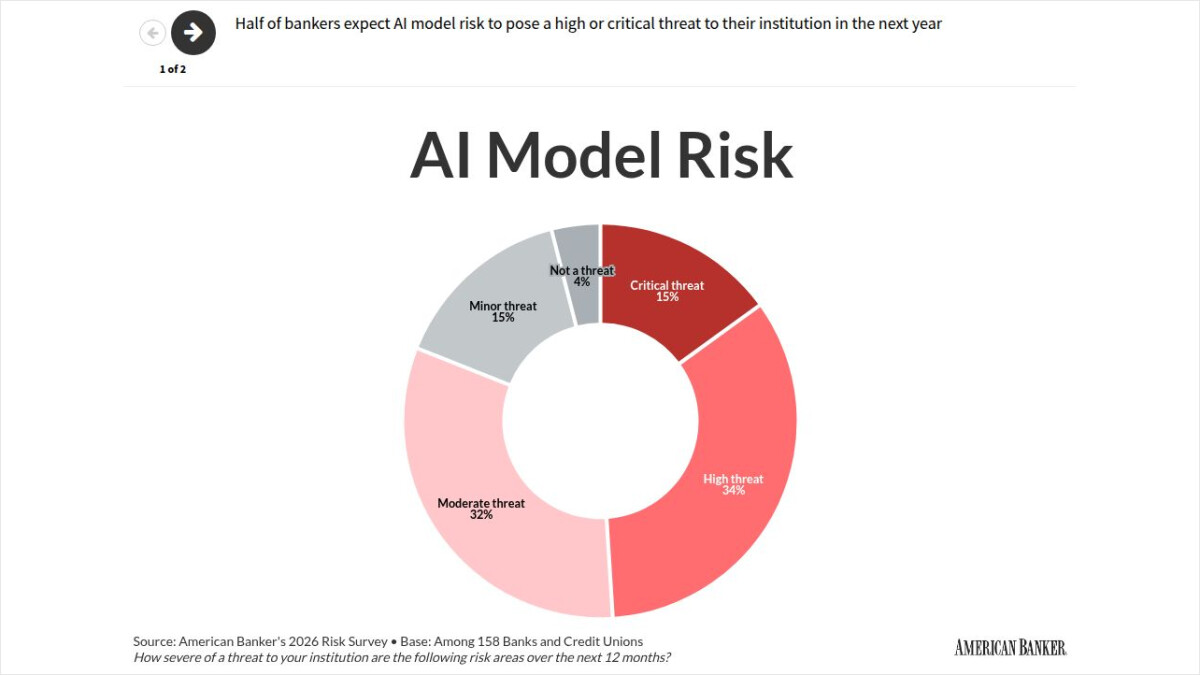
A new risk survey conducted by American Banker’s Market Intelligence unit underscores why the downside matters. Eighty-one percent of respondents characterized AI model risk as critical, high or at least moderate. About 60% also considered a significant loss from AI-enabled social engineering or deepfake fraud somewhat or very likely over the next 12 months. If those risks can produce real losses, remediation costs and additional control expenses, they also belong in the economics of AI.
An application that speeds up a process but produces more errors, false positives or control failures may create much less value than its headline productivity number suggests. A fraud system that reduces losses by $5 million but adds $1 million in investigation costs and customer remediation has not created $5 million of net value. A lending application that generates additional revenue while increasing credit losses should not only count the revenue and not the associated increase in costs.
A useful way to think about the economic impact is:
Net AI initiative value = financial benefits – full life cycle cost – expected costs of errors and control failures
The challenge is less about the formula than about applying ordinary financial principles to AI investments. Three issues deserve particular attention: counting the full lifecycle cost, adjusting value for the downside an AI system may create and matching the financial measure to the timing of the costs and benefits.
For banks, this is an especially important consideration, given the lower error tolerance of the business. A system that works well 99% of the time but still produces a large number of mistakes in popular applications is not cut out for many banking operations. Scale can magnify both the upside and downside of an AI application.
Count the full lifecycle cost
An AI initiative will often require data, compute and staff for integration, business and technology that concretely add to the expense line. They are easier to allocate to the project if the team is organized around the major initiatives, but even then there are still shared costs across teams. So the cost calculation for AI ROI needs to include both direct costs and shared costs over the full lifecycle of the project.
As noted in recent writings, model choice is not only a technology decision but also an economic decision. The right question to ask is not which model performs the best in abstract, but which one delivers the best business result within budget constraints.
Match the measure to the investment
AI investments often require significant upfront spending on data, infrastructure and workflow redesign, while benefits may accumulate over several years. Comparing three years’ of benefits with one year of costs will overstate the return. Comparing the full initial investment with only the first year’s benefit will likely underestimate it.
Banks should therefore measure costs and benefits using appropriate periods to match the costs and benefits of the same product. For more simple applications with short investment cycles, ROI is appropriate and sufficient. For larger or longer-horizon projects, measures such as payback period and net present value can provide a more complete picture.
Payback periods answer a practical question: How long will it take the initiative to recover the investment required to launch it? Net present value goes further by recognizing that a dollar received several years from now is worth less than a dollar received today. Both are standard tools for evaluating investments whose costs and benefits arrive at different times.
In conclusion, once banks have established what AI initiatives actually achieve, the financial question is familiar: What is the benefit worth after accounting for everything required to produce it, the downside it produces and when the cash flow occurs?
The formula is the easy part. Getting the economics right is the real work.