Nvidia CEO Jensen Huang Just Put a Nail in Michael Burry’s Bear Case
Michael Burry is no stranger to controversial market calls. The hedge fund manager and founder of Scion Capital cemented his place in Wall Street history by predicting the subprime lending market crash in 2008. His high-stakes bet earned him $100 million, while his investors banked $725 million. The events were immortalized in the movie The Big Short, and Burry still turns heads with his headline-making calls.
The legendary investor’s most recent target has been artificial intelligence (AI) and, more specifically, Nvidia (NVDA -0.66%). Burry takes issue with the industry’s estimates of the useful life of semiconductors used in AI, believing they are too long.
However, Nvidia CEO Jensen Huang just put a nail in Burry’s bear case.

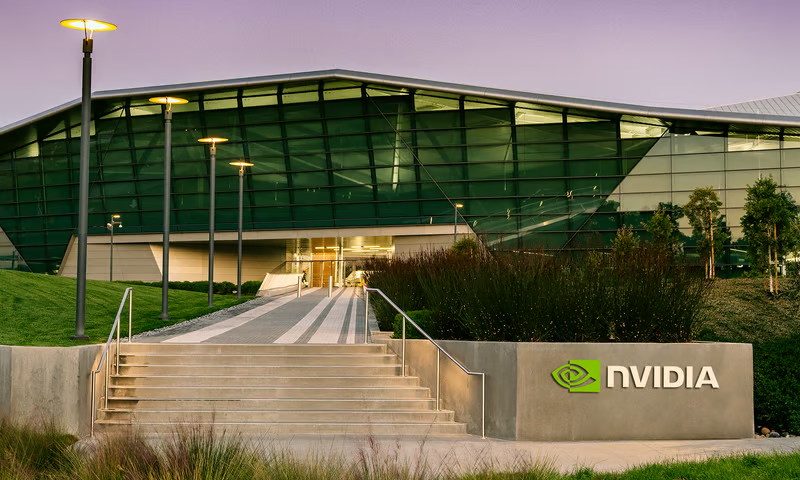
Image source: Nvidia.
A little background
A little context helps illustrate Burry’s concerns. Many technology companies estimate the useful life of Nvidia’s graphics processing units (GPUs) at six years. For accounting purposes, that means the price of these processors is divided by six, and one-sixth of the cost is expensed as depreciation each year. By spreading the cost of these chips over their useful life, the annual expense decreases, resulting in higher annual profits.
Burry believes the lifespan of these chips should be shorter, saying they should be expensed over two to three years. By extending the useful life to six years, Burry argues companies are inflating their profits.

Today’s Change
(-0.66%) $-1.48
Current Price
$224.25
Key Data Points
Market Cap
Day’s Range
$223.51 – $226.18
52wk Range
$164.27 – $236.54
Volume
51.3M
Avg Vol
135.3M
Gross Margin
74.67%
Dividend Yield
0.12%
The proof is in the pudding
Nvidia launched its Ampere A100 Tensor Core GPU in mid-2020. The data center GPU soon became the workhorse of AI, providing 20 times the performance of the previous generation. Yet six years after their introduction, A100 chips are still being used. Just last month, neocloud CoreWeave inked a contract to rent these semiconductors for AI processing through 2029. Far from being obsolete, nine years after they were first released.
Perhaps more telling, the price to rent these older chips is actually increasing. Just this week, in a post on X, financial market platform Ornn Exchange shared details about the use of the slightly newer Hopper H100 chips, noting that the rental price for these processors is up 22% month over month.
Huang shared the post on Tuesday, adding his own .02 cents:
NVIDIA compute is fungible, durable and highly rentable. It is a productive, revenue-generating asset. https://t.co/cvmjaNoiK8
— Jensen Huang (@JensenHuang) September 8, 2026
The evidence clearly refutes Burry’s contention that the useful life of Nvidia GPUs is being overstated. As these examples clearly show, these chips are lasting far longer than their estimated useful life.
What it means for Nvidia investors
The biggest takeaway for investors is undeniable. Even as demand for Nvidia’s latest generation Vera Rubin and Blackwell processors remains strong, so too does demand for its older Ampere and Hopper chips.
Moreover, this puts a nail in Burry’s contention that the useful life of these chips is overstated. If anything, the estimates being used may be too short, and we don’t yet know how long these AI powerhouse chips will last.
It’s also worth mentioning that at 28 times earnings, Nvidia stock is a steal.