Global Market Today: Asian chip stocks rise, oil climbs towards $100
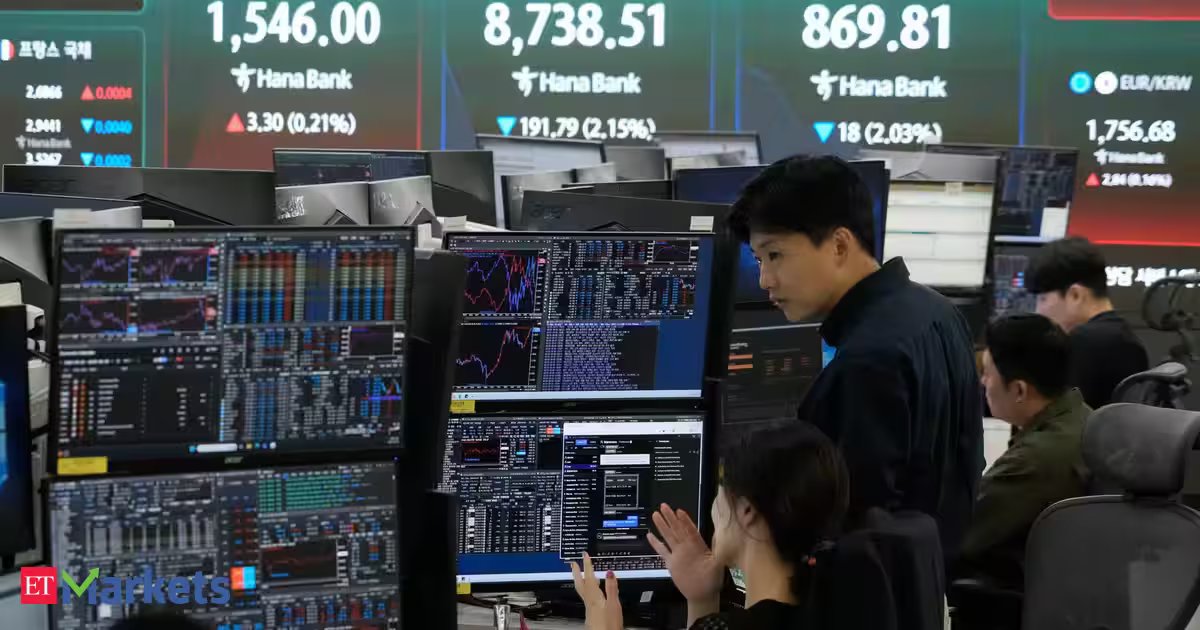
South Korea’s Kospi climbed 1%, helped by gains in both of the nation’s chip giants, SK Hynix Inc. and Samsung Electronics Co. The advance came after the Philadelphia Semiconductor Index, known as the SOX, rose 1.3% in New York. The MSCI Asia Pacific Index of shares rose 0.4%, with the information technology sector making the biggest contribution.
Brent gained as much as 1.6% to $99.50 a barrel, the highest since July. Crude climbed after the US struck Iranian tankers near the vital crude-export hub of Kharg Island, stoking fears of deeper disruptions through the Strait of Hormuz.
With the Iran war now in its seventh month, renewed attacks on energy infrastructure risk keeping oil prices elevated and complicating the outlook for inflation and interest rates. Investors will be watching to see whether the latest escalation further disrupts supplies, with Friday’s US consumer-price report set to provide the next major test of expectations for a Fed rate increase at its Sept. 15-16 meeting.
“With geopolitical tensions and oil prices on the rise, the markets may find it difficult to focus on much beyond the inflation discussion,” said Chris Larkin at E*Trade from Morgan Stanley.

While the US says it has largely shifted its attention toward economic pressure on Iran, repeated outbreaks of violence have kept the conflict simmering.
Earlier, Iran’s semi-official Tasnim news agency reported that a US missile had hit an Iranian tanker off the coast of Kharg. All tanker crews near Kuwaiti and Bahraini piers should “immediately abandon their vessels, whether at anchor or docked, as they will be targeted,” Iran’s state TV reported, citing an Islamic Revolutionary Guard Corps statement.Elsewhere, the yen strengthened for a third day after US Treasury Secretary Scott Bessent said he has “good insight” into what the Bank of Japan will do with the currency. The yen advanced 0.4% to 153.31 per dollar. Bloomberg’s dollar gauge slipped 0.1%.
In trade news, the US moved to ban some Canadian alcoholic beverages, dairy products and motorcycles, according to officials. Meanwhile, the European Union and Canada are pursuing a broader partnership spanning trade and security as they seek to counterbalance US and Chinese global influence.
After a stronger-than-forecast US employment report last week, attention is turning to CPI data due Friday for clues on future Fed policy.
Economists expect the consumer price index to have risen 0.4% in August, accelerating from a month earlier partly because of higher gasoline costs. Excluding volatile food and energy components, core CPI is projected to have increased a more moderate 0.2%, according to the median estimate in a Bloomberg survey.
That would bring the annual measure of underlying inflation down to 2.4%, the smallest year-over-year increase since 2021.
“Brace for a turbulent week, with inflation data set to swing market expectations for a Fed hold or hike next week – with knock-on effects on wider asset markets,” Evercore ISI strategist Krishna Guha wrote in a Tuesday note.