SpaceX Stock Is Down 34% From Its High. History Suggests a $10,000 Investment Will Be Worth This Much by Mid-2027.
By now, you probably don’t need an elaborate explanation about Space Exploration Technologies‘ (SPCX -1.20%) initial public offering (IPO). The company’s June debut was the largest IPO in history, raising roughly $85 billion at a valuation of around $2.1 trillion. For a brief moment, SpaceX was actually more valuable than Amazon. This part of the story is old news for those who have been following the stock, though.
What’s more interesting is how SpaceX has traded since its IPO pop. Just days after the IPO, shares reached an intraday high of roughly $226. However, after the company’s initial euphoric ascent, concerns about SpaceX’s aggressive capital expenditure plans and the potential for post-IPO lockup expirations to pressure the stock fueled a flurry of selling prior to its first earnings report as a public company. After bottoming out at just under $105, shares have started to rebound again.
Still, SpaceX now trades roughly 34% below its post-IPO peak, and in the vicinity of the $150 per share price where it opened on its first day of trading. Investors may be wondering whether this is an opportunity to buy the dip or the precursor to yet another drawdown. While I don’t have a crystal ball, I do have a useful data set that shows a consistent pattern among mega-hyped IPOs. Spoiler alert: The direction of SpaceX stock is anyone’s guess. Investors who want to add it to their portfolios should buckle up and prepare for a bumpy ride.
Image source: Getty Images.
Analyzing blockbuster IPOs
The first IPO I am going to analyze is Palantir Technologies (PLTR -4.49%), which went public via a direct listing in September 2020. Shares opened at $10 and rocketed to a high of around $45 within the first year. At the time, Palantir was not seen as a darling of the artificial intelligence (AI) software complex. Instead, the company’s early ascent was driven by meme stock era updrafts, fueled by Reddit users on the WallStreetBets forum. After that initial parabolic rise, Palantir spent most of 2021 giving back its gains and eventually settled in the mid-$20s range.
Snowflake (SNOW -5.41%) had a similar arc to Palantir, although the degree to which the stock moved was more dramatic and prolonged. The data warehouse specialist priced its IPO at $120, but shares actually opened their first day of trading at around $245. Before the end of 2020, Snowflake stock had surged to almost $400. While shares then sold off from this peak, Snowflake was still changing hands at prices of around $300 one year following its IPO.
Those two performances might suggest IPO investing usually leads to multibagger gains, but smart investors know there is more to this analysis. Figma (FIG -4.36%) is where the cautionary tale begins.
Figma stock opened at $85 last July and closed its debut session above $115. The very next day, shares spiked to nearly $143. Sounds great, right? Unfortunately for those who chased the momentum, Figma stock eventually crashed — bottoming near $17 this spring. While Figma has started to show some signs of a comeback, the stock still experienced a peak-to-trough drawdown of more than 80%. That is absolutely brutal.
Cerebras (CBRS +10.30%) is a semiconductor company that went public earlier this year. While the stock hasn’t reached its first anniversary as a public company, I still see the direction of its price action as useful information.
The Cerebras IPO was priced at $185, but early interest pushed its opening day first-trade price to $350. On that first day of trading, Cerebras stock touched $386. But over the last few months, shares have been all over the place — ranging as low as $170 and swinging as high as $250. Its current price represents a drawdown of roughly 55% from its opening peak.

Space Exploration Technologies
Today’s Change
(-1.20%) $-1.79
Current Price
$147.95
Key Data Points
Market Cap
Day’s Range
$147.32 – $150.85
52wk Range
$104.83 – $225.64
Volume
49.1M
Avg Vol
111.9M
Tech IPOs tend to follow a similar path
Back in July, wealth management firm SCS Financial put together an interesting analysis featuring the performance of nearly two dozen IPOs across the technology and tech-enabled services landscapes.
The data includes offerings as far back as the late 1990s, when Amazon and Nvidia went public, as well as a number of early to mid-2000s names like Alphabet, Netflix, Facebook (now Meta Platforms), Tesla, and Uber. The most recent IPOs in the data set included, unsurprisingly, Snowflake, Palantir, and Cerebras.
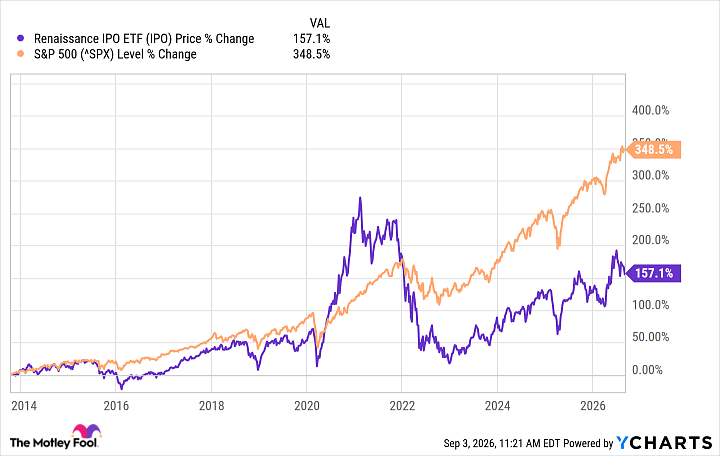
The takeaway was that the stocks in this cohort experienced a median decline of about 53% from their post-IPO highs. The report also found that IPOs as a broader group have trailed the S&P 500 meaningfully over the last decade or so. For reference, since its inception in late 2013, the Renaissance IPO ETF has significantly underperformed the benchmark index. That ETF holds IPO stocks from recent years such as CoreWeave, Astera Labs, Reddit, and Rubrik. The fund holds onto its positions for up to three years before exchanging them for new IPO stocks.
Where could SpaceX stock be trading by June 2027?
If I apply the same median 53% haircut to SpaceX’s $226 peak, then a potential floor for the stock sits somewhere around $105 (which is about where it sat at its lowest point so far). On the more extreme end — closer to what Figma experienced — SpaceX stock could bottom closer to $45. I don’t think that will happen, though.
If I put the entire peer group in this analysis together, a defensible range for SpaceX stock one year after its IPO could be something around $105 on the realistic bearish end, roughly $160 in a base case, and potentially upward of $200 in an upside scenario that mirrors those IPOs that have displayed the rare ability to reclaim and subsequently build on prior highs.
If you invest $10,000 today at SpaceX’s current $147 share price, then it could be worth anywhere between the following by next June:
- Bear case ($105): Worth about $7,100 — a loss of roughly 29%.
- Base case ($160): Worth about $10,900 — a modest gain of roughly 9%.
- Bull case ($210): Worth about $14,300 — a gain of roughly 43%.
While none of this is a perfect forecast, it does represent a series of plausible outcomes supported by comparably hyped IPOs. Ultimately, the analysis here serves as a reminder that even category-defining companies like SpaceX can be particularly risky short-term investments if you chase them when they’re at the wrong altitude.