PPF, NSC, KVP or SSY: How many small savings schemes should you have in your investment portfolio
Investors often assume that spreading money across several government-backed small savings schemes makes a portfolio safer. But these products do not diversify risk in the same way as different asset classes. They largely provide a sovereign-backed fixed-income exposure, with the key differences being their purpose, tenure, tax treatment and liquidity.
“For most investors, one scheme is often enough. But the answer also depends on the problem you are trying to solve,” said Anshi Shrivastava, head of personal finance training at 1 Finance.
“Small savings instruments aren’t meant to be collected like stocks, and diversified for risk. Every scheme here carries the same sovereign guarantee. What separates them is purpose, not risk,” she said.
Sonam Srivastava, founder of Wright Research, also believes one scheme is sufficient for most investors. “PPF covers the long-term, tax-sheltered fixed income need on its own,” she said. SSY can be an additional option for eligible parents saving for a daughter, while holding NSC and KVP alongside PPF may simply duplicate similar exposure.
Shashank Udupa, SEBI-registered investment adviser and founder of Vayu Capital, said multiple schemes should be held only when they serve different objectives. PPF could be used for an investor’s own long-term corpus while SSY could form a separate bucket for a daughter’s future.
Match the scheme to the goal
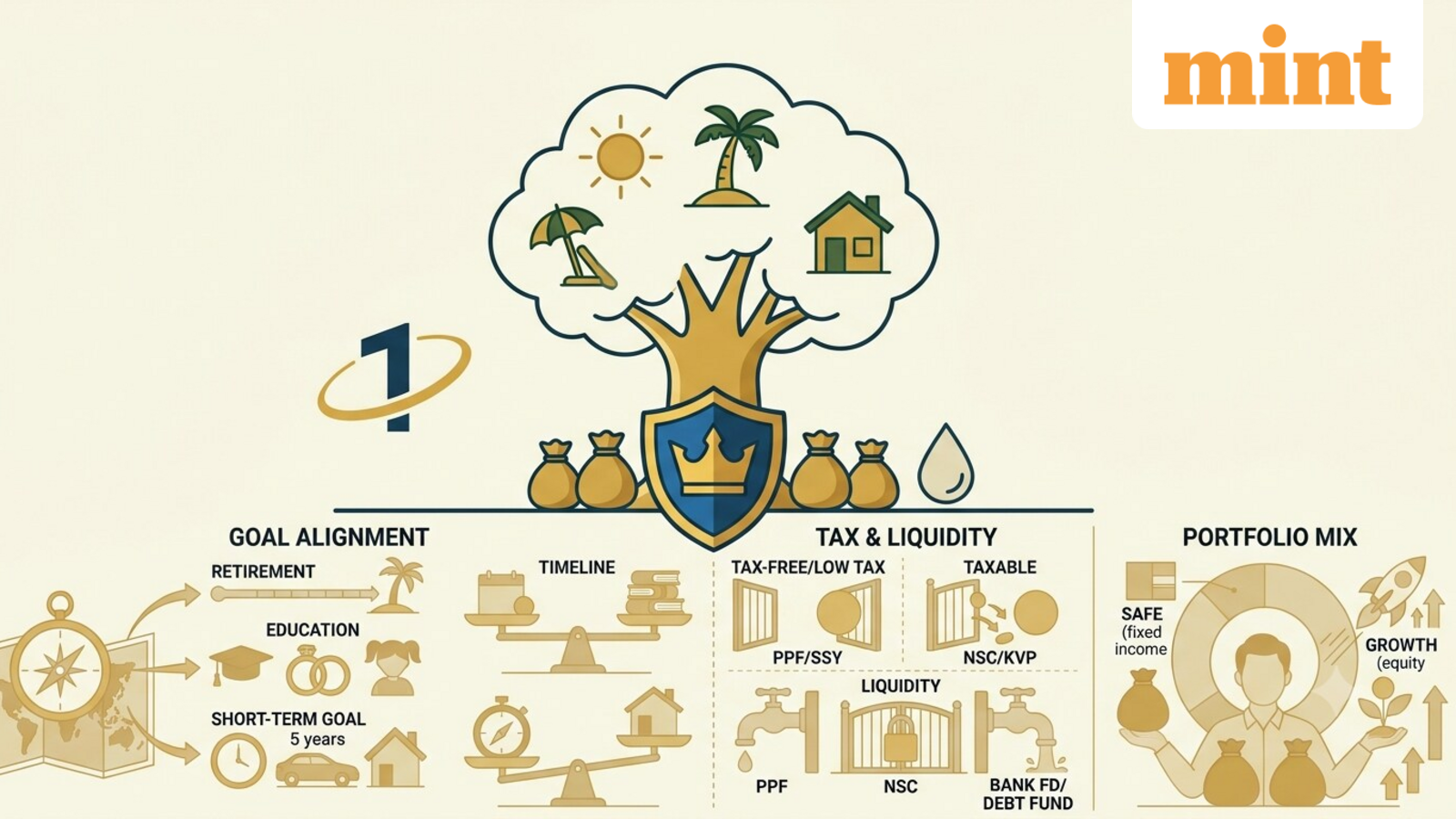
Anshi said investors should not start by comparing interest rates. They should first ask three questions. What is the money for? When will it be needed? Can it remain untouched until then?
PPF is best suited to long-term goals such as retirement. Its long tenure and tax-free returns make it suitable for investors who can remain invested for a prolonged period.
For young salaried investors, Anshi considers PPF a particularly useful starting point. “At this age, time is your biggest asset, and PPF is built to reward exactly that. Tax-free compounding over 15 years and beyond,” she said.
The lock-in can also help investors avoid withdrawing long-term savings during periods of market stress. “PPF won’t make anyone rich fast. It’ll make sure a retirement corpus exists at all,” Anshi said.
Sonam also considers PPF the default choice for most working-age investors. She said the 15-year lock-in can be a feature for someone who is decades away from retirement because it creates a stable fixed-income component that does not require frequent rebalancing decisions.
NSC can be more appropriate for investors with a defined five-year goal. It offers a government-backed fixed return and a tax deduction under section 80C, although its interest is taxable.
KVP has a narrower role. Anshi said it may suit someone who has already exhausted their 80C limit, has no further tax-planning requirement and wants a predictable lump sum over a fixed period.
SSY is different because it is specifically meant for an eligible girl child’s future. Parents saving for education or marriage may use it as a separate long-term bucket.
This means PPF and SSY can both be useful in the same household when they address different goals. PPF could fund a parent’s retirement while SSY is used for a daughter’s future.
Udupa said investors should ask what specific goal they are trying to fund before adding another scheme. If another investment is already serving the same purpose, adding one more small savings product may not provide much benefit.
Tax and liquidity matter more than headline returns
Investors should not choose among these schemes simply by looking at the advertised interest rate.
“Headline yield is the weakest basis for comparison,” said Sonam. A lower tax-free return can be more attractive than a higher taxable return, particularly for investors in higher tax brackets.
Anshi said investors should compare fixed-income products on taxation, liquidity and safety.
PPF and SSY offer tax-free returns. NSC and KVP have taxable interest. Bank FDs are also generally taxable, while debt mutual funds are market-linked and do not offer a sovereign guarantee.
Liquidity is another major differentiator.
“Treat liquidity as a hard constraint,” Anshi said. Small savings products generally have stricter withdrawal rules than bank FDs and debt funds.
PPF allows partial withdrawal only after the prescribed period. NSC and KVP are primarily intended to be held until maturity, while SSY also has restrictions on withdrawals.
For money that could be required during an emergency, these products may therefore be unsuitable.
Udupa said investors should compare small savings schemes with FDs and debt funds on post-tax return, liquidity, risk and investment horizon. “The right comparison is based on post-tax return, liquidity, risk, and tenure, not just the highest interest rate,” he said.
Bank FDs generally offer greater flexibility because they can be withdrawn before maturity, although penalties may apply. Debt funds offer greater liquidity and duration flexibility, but their returns can fluctuate with interest rates.
Do you really need more than one scheme?
For most investors, the answer is no.
Holding PPF, NSC and KVP together solely for diversification may not add much value. All three are government-backed fixed-income products, so investors should have a specific reason for adding each one.
SSY is the clearest exception because it serves a distinct goal. For an eligible parent saving specifically for a daughter, it can be a separate investment bucket rather than a substitute for the parent’s own retirement savings.
For young investors, there is also a limit to how much should go into small savings products. An emergency fund needs to remain accessible, while long-term wealth creation may require exposure to growth assets such as equities depending on the investor’s risk profile.
“PPF should not come at the cost of maintaining an emergency fund or investing for growth through equities,” Udupa said.
The bottom line
The right number of small savings schemes is not determined by how many products are available. It depends on how many distinct financial goals an investor has that require these products.
A young salaried investor building a retirement corpus may find PPF sufficient. A parent of an eligible girl child may have a separate reason to add SSY. NSC can make sense for a defined five-year requirement, while KVP may suit a narrower set of investors seeking predictable returns without a tax-saving objective.
“Match one scheme to one goal. Resist the urge to add more just because more exists,” Anshi said.
For most investors, one well-chosen small savings scheme is enough. Two may make sense when they serve genuinely different goals. Owning all four simply because they exist is unlikely to improve the portfolio.