History Shows That Adjustable-Rate Mortgages Pay Off For Homebuyers Most of the Time
Over the past half-century, homebuyers would have saved money by choosing an ARM about 70% of the time, thanks to later opportunities to refinance into a lower 30-year fixed rate.
Over the last 50-plus years, it has made financial sense for homebuyers to take out an adjustable-rate mortgage (ARM) rather than a 30-year fixed rate mortgage more often than not. That’s despite borrowers’ widespread lack of familiarity with the option.
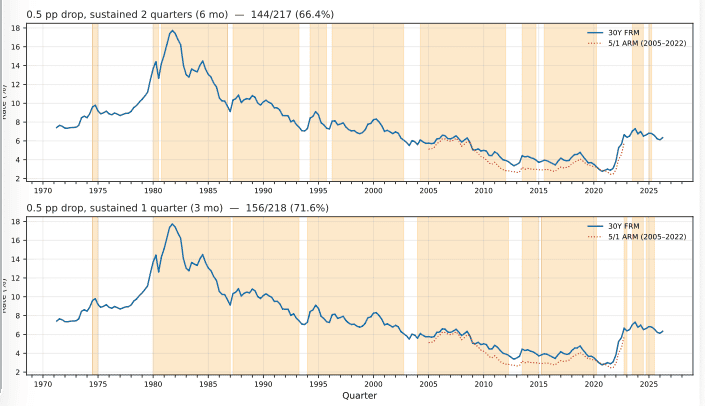
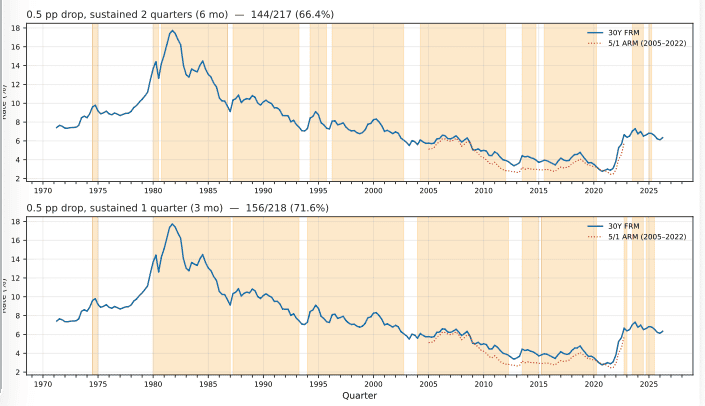
About seven in 10 U.S. homebuyers (71.6%) who take out an ARM have a chance to refinance into a 30-year fixed rate at least 0.5 percentage points lower than their original rate within five years. That means the borrower would have refinanced into a lower mortgage rate for the duration of the loan before they even reached the adjustable-rate period.
| Share of ARM borrowers with chance to lower monthly housing payment by refinancing within 5 years
Assumes the prevailing mortgage rate has dropped by 0.5 percentage points (for instance, the original mortgage rate was 6.5%, and the prevailing rate is 6%) |
||
| Number of consecutive quarters in which borrower could have refinanced | Quarters with opportunity to refinance (since 1971) | Share of ARM borrowers with opportunity to refinance (since 1971) |
| 2 | 144 out of 217 | 66.4% |
| 1 | 156 out of 218 | 71.6% |
More than half of borrowers (52.8%) who choose an ARM have a chance to lower their monthly payment even more by refinancing into a rate at least one full percentage point lower than their original rate.
| Share of ARM borrowers with chance to lower monthly housing payment by refinancing within 5 years
Assumes the prevailing mortgage rate has dropped by 1 percentage point (for instance, the original mortgage rate was 7%, and the prevailing rate is 6%) |
||
| Number of consecutive quarters in which borrower could have refinanced | Quarters with opportunity to refinance (since 1971) | Share of ARM borrowers with opportunity to refinance (since 1971) |
| 2 | 101 out of 217 | 46.5% |
| 1 | 115 out of 218 | 52.8% |
This is according to a Redfin analysis of Freddie Mac mortgage data going back through 1970; we consider it an opportunity to refinance into a lower rate when a borrower’s current rate is at least 50 basis points above the prevailing 30-year fixed mortgage rate; for instance, if they have a 6.5% rate and the prevailing rate is 6%. We also included a scenario in which borrowers have an opportunity to save even more money, by looking at what would happen if their current rate was at least 100 basis points above the prevailing mortgage rate, i.e. they have a 7% rate and the prevailing rate is 6%; this group is a subset of the former group. The opportunity must last at least one full quarter for the borrower to be counted as someone who has a chance to refinance. See the end of this report for more on methodology.
History Shows That ARMs Save Homebuyers Money Now–And Usually Later, Too
“History is on the homebuyer’s side: In the past half century, a majority of those who chose ARMs had a chance to lower their mortgage rate by at least half a point–which means their rate never increased,” said Chen Zhao, Redfin’s head of economics research. “For homebuyers who are comfortable with some uncertainty up front, ARMs are a smart way to save money now with good odds of securing an even lower fixed rate in the future.”
The main reason to opt for an ARM over a fixed-rate mortgage is that they usually come with lower interest rates for the introductory portion of the repayment period, typically the first five to seven years of the loan. Rates are lower because borrowers agree to live with the uncertainty that their mortgage rate will reset–either higher or lower–when the fixed period ends. This analysis shows the tradeoff is worth it: Much more often than not, borrowers can refinance into a lower 30-year fixed rate within the first five years, side-stepping the adjustment entirely.
Here’s an example of a homebuyer who chooses an adjustable-rate mortgage:
-
- In 2026, a buyer purchases a home for $625,000, roughly last spring’s median sale price in Denver, Sacramento, CA or Newark, NJ. They put 20% down, and take out a $500,000 mortgage.
- If they choose a 30-year fixed rate mortgage at 6.5%, their payment would be about $3,160 per month.
- Instead, they opt for a 5/1 ARM with an introductory rate of 5.75%. During the first five years of the loan, their monthly payment is $2,918, roughly $240 less than the fixed-rate payment.
- Over those five years, they save about $14,500 compared to a borrower who takes out a 30-year fixed rate mortgage.
- In 2031, the ARM’s five-year introductory period ends. Imagine that by then, prevailing mortgage rates have fallen to 5.5%.
- Rather than allowing the ARM to adjust, the homeowner refinances into a new fixed-rate mortgage at 5.5%.
- Their new monthly payment is $2,633, lower than what they paid during the ARM’s introductory period. This assumes the borrower will pay off the mortgage within 30 years of the refinance date.
- For the sake of comparison, assume that a borrower who originally took on a 30-year fixed mortgage rate also refinanced to 5.5% after five years. That borrower’s new monthly payment with a 5.5% rate is $2,658. Their monthly payment is slightly higher because the ARM borrower had a lower interest rate for 5 years, which means more of each payment went toward the principal. After refinancing, the ARM borrower pays about $9,000 less than the fixed-rate borrower over the remainder of the loan period.
- Under this scenario, the ARM borrower would make about $23,000 less in total mortgage payments than the borrower who originally chose the 30-year fixed rate mortgage.
- In 2026, a buyer purchases a home for $625,000, roughly last spring’s median sale price in Denver, Sacramento, CA or Newark, NJ. They put 20% down, and take out a $500,000 mortgage.
This analysis shows that in many cases, homebuyers who choose an ARM will have the chance to refinance into a lower rate and save money within five years. But that’s not always true. Going back to 1971, there have been a few stretches in which ARM borrowers didn’t get a chance to refinance into a lower rate within that period; in those cases, their rate resets to the prevailing one after the fixed period ends. Still, before the pandemic, most of those borrowers had an opportunity to refinance into a lower rate later in the life of their loan, and may have still come out ahead financially by opting for an ARM.
ARM Intro Rates Are Almost Always Lower Than 30-Year Fixed Rates
A recent Redfin analysis found that as of March, the typical homebuyer would save $150 per month taking out an adjustable-rate mortgage instead of a 30-year fixed rate mortgage. At that time, the average ARM rate was 5.51%, while the average fixed rate was 6.19%.
For a more recent comparison, the average 30-year fixed rate was 6.88% at the start of September, while the average ARM rate was 6.47%.
Windows to Refinance Into a Lower Rate Have Been Consistent Over the Past 50 Years
Looking back, ARM borrowers have consistently had opportunities to refinance into a lower mortgage rate since 1980, when mortgage rates started falling from a historically high point of about 18%. Rates fluctuate over time, but they typically decline after hitting peaks.
The most recent window in which it didn’t make financial sense to opt for an ARM was when mortgage rates dropped to historic lows in 2020 and 2021. At that time, buyers were able to lock in 30-year fixed mortgages with rates at or below 3%, which would have been the right call.
ARMs Aren’t As Risky As They Used To Be
It’s also important to note that ARMs aren’t nearly as risky as they once were; new rules went into effect after the financial crisis to protect borrowers. ARMs come with interest-rate caps, which limit how much the rate is allowed to increase each term and over the life of the loan. Additionally, borrowers typically have to qualify for an ARM based on a higher rate, so they have leftover room in their budget if the rate rises.
Here’s more information on ARMs and 30-year fixed rate mortgages from Rocket Mortgage.
Methodology
This is according to a Redfin analysis of Freddie Mac’s Primary Mortgage Market Survey Data going back through 1970; we consider it an opportunity refinance into a lower rate when a borrower’s current rate is at least 50 basis points above the prevailing 30-year fixed mortgage rate; for instance, if they have a 6.5% rate and the prevailing rate is 6%. We also included a scenario in which borrowers have an opportunity to save even more money, by looking at what would happen if their current rate was at least 100 basis points above the prevailing mortgage rate, i.e. they have a 7% rate and the prevailing rate is 6%; this group is a subset of the former group. The opportunity must last at least one full quarter for the borrower to be counted as someone who has a chance to refinance.
For each origination quarter, we look at the rates 9 months-5 years later. We skip the first nine months because lenders typically don’t allow borrowers to refinance until at least six months after origination. By the time nine months have passed, every borrower is past their no-refi window. We stop at five years because that matches the period of a 5/1 ARM: A borrower who took out an ARM has until the end of that fixed period to refinance into a fixed mortgage before the rate resets.
When we say it would make more financial sense to take out an ARM, we are assuming the ARM intro rate is lower than the 30-year fixed rate at origination. We do not have ARM data going all the way back to 1970, as Freddie Mac’s 5/1 ARM series starts in 2005. But over the 2005-2022 period for which that data is available, the 5/1 ARM is consistently lower than the 30-year fixed rate, so we extend that assumption to the full historical period.
The post History Shows That Adjustable-Rate Mortgages Pay Off For Homebuyers Most of the Time appeared first on Redfin Real Estate News.