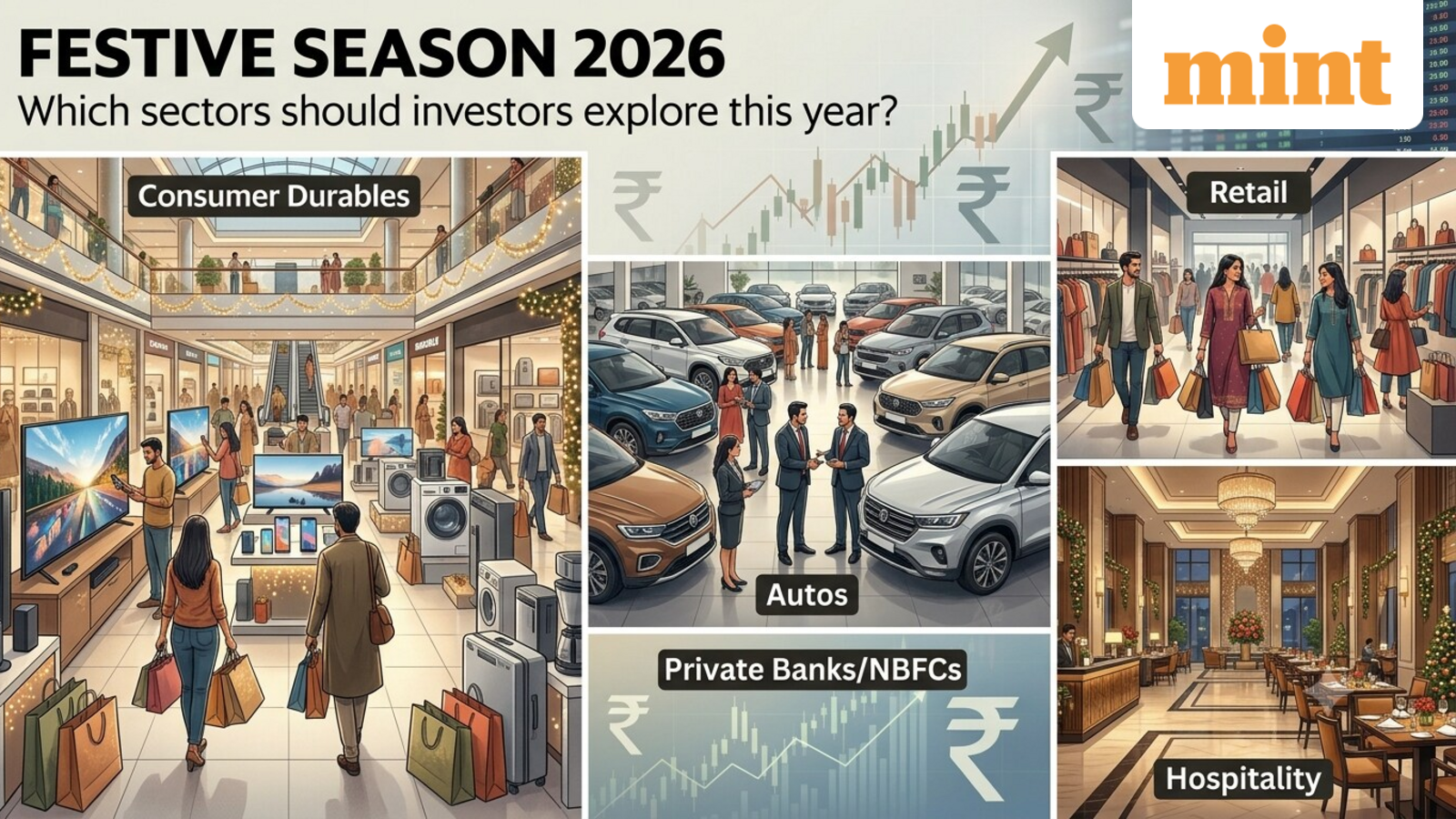
Festive season 2026 is here: Top sectors to invest your money as consumer spending picks up
As we gear up for the 2026 festive season, the expected pickup in consumer spending could open up potential opportunities for investors to explore across sectors.
The September 2026 Monthly Outlook report by Bajaj Broking Privé Research highlighted sectors based on their sensitivity to festive demand, ranging from very high to low.
Here’s what the research report says about these sectors and what the festive season could mean for the markets.
Which sectors to explore this festive season?
| Sector | Festive Sensitivity |
| Consumer Durables | Very High |
| Retail | Very High |
| Automobiles | High |
| Private Banks/NBFCs | High |
| Hospitality | Medium-High |
| FMCG | Medium |
| IT Services | Low |
*Source: Bajaj Broking Privé Research September 2026 Report
Consumer durables and retail have very high festive sensitivity, followed by automobiles and private banks or NBFCs, which are rated high.
Hospitality has medium-high sensitivity, while FMCG is rated medium. However, IT services have low festive sensitivity.
“Sectors with high sensitivity are those that tend to benefit the most from festival-driven consumer demand. As a result, their business performance and earnings can be meaningfully influenced by festive spending patterns,” Payal V. Pandya, Vice President, Prive Research, Bajaj Broking Prive, explained.
On the other hand, sectors with low sensitivity are less dependent on festival-related demand and are therefore less likely to see a significant impact from festive consumption trends, she added.
Does very high sensitivity mean higher allocation?
No.
“A very high sensitivity rating does not imply a higher allocation preference. Rather, it indicates that the sector is more exposed to changes in festive demand, Pandya noted.
She cautioned that strong festive demand could positively influence revenues and quarterly earnings, while weaker-than-expected demand could have the opposite effect.
What should investors do?
Pandya said most sectors are already well represented across the mutual fund universe, giving investors access to sector-specific, thematic and market-cap-based funds.
“If demand holds up better than expected, sectors leveraged to domestic consumption—including consumer discretionary, retail, select automobiles, private-sector financials, hospitality and travel—could benefit,” she added.
However, she said that valuations in several consumer-facing segments already reflect expectations of a demand recovery, making it important for investors to remain selective.
What does the 2026 festive season mean for the market?
“India’s upcoming festive season could provide an important boost to domestic consumption and economic activity, particularly at a time when external uncertainties remain elevated,” Pandya mentioned.
She said that with private consumption accounting for 61.5% of GDP in FY26, the festive period assumes greater significance for the broader growth outlook. Early expectations point to healthy demand, supported by resilient urban consumption, easier financial conditions, retail financing and continued premiumisation across categories.
However, Pandya cautioned that the recovery is unlikely to be uniform. India could see a two-speed consumption story, with resilient urban and premium demand on one side and a more cautious rural consumer on the other.
Disclaimer: This story is for educational purposes only. The views and recommendations made above are those of individual analysts or broking companies, and not of Mint. We advise investors to check with certified experts before making any investment decisions.
About the Author
Sheetal Goel is a Content Producer at Livemint, where she covers corporate developments, personal finance, business trends, markets, and SEBI-related updates. She focuses on simplifying complex financial concepts and presenting them in a clear, reader-friendly manner, thereby helping audiences better understand investment trends, personal finance, and market developments. Her writing focuses on making finance more accessible to everyday readers while maintaining clarity, accuracy, and relevance.
She holds a degree in Economics (Hons.) along with an MBA in Finance, which has helped her develop a strong foundation in financial analysis, market understanding, and business reporting. Before joining journalism, she worked with finance and broking firms, where she closely followed market developments, investment strategies, and evolving industry trends. This practical exposure strengthened her understanding of financial markets. She has also written content across multiple formats and platforms, including YouTube, LinkedIn, and Instagram.
Over time, she has developed expertise in covering market-linked stories, investor-focused topics, and regulatory updates in a simplified yet informative style. She also enjoys reading and listening to Hindi poetry, reflecting her appreciation for literature and creative expression beyond the world of markets and numbers.