The Two-Licence Model: How Brokers Bridge Trading and Payments
Every funded trading account on earth holds money that the owner
cannot spend today. Free that money the right way, and you do not launch a
better app. You become the rail every other app runs on.
Somewhere in a segregated account, your money is waiting. You
closed a position on Friday, filed a withdrawal, and the cash reaches your card
on Tuesday if the banking calendar behaves. Nobody in that chain is slacking.
The wait is the system doing its job.
Client money segregation is one of the better ideas in retail
finance. Under the FCA Client Assets Sourcebook in the United Kingdom and the
CySEC safeguarding rules across the EU, a broker keeps client funds in accounts
that sit apart from its own. If the firm collapses on a Monday, your balance is
still yours on Tuesday. Regulators built that protection after enough failures
buried enough clients. It should stay exactly where it is.
That same wall is why trillions sit frozen.
Add up every retail trading account balance on the planet. Every
funded account at every CFD broker, every crypto exchange balance, every margin
account waiting for a position to close. Most of it cannot be spent. It cannot
pay for lunch, cover rent, or move to another platform without a withdrawal
request, a settlement window, and a reconciliation cycle. The money exists. It
just cannot move at the speed the holder lives at.
The Card Is Not the Problem
Revolut solved the front of this problem and left the back
untouched. You can hold currencies, buy stocks, buy crypto, and spend from a
card in the same app, and since March 2026, it has done so as a fully licensed UK
bank.
What you still cannot do is take value out of a leveraged position and
put it on that card in the time it takes to reach a counter. eToro
added a card too, through its eToro Money arm,
and moves cash between your account and that card in seconds.
Try to settle a
live leveraged position into spendable money the moment you close it on Sunday,
and the wall reappears. The card is the easy part. The plumbing underneath it
is the prize.
Why the Wait Is Real
When you spend from a trading balance today, your money makes a
round trip. The broker instructs a payment out of the segregated pool. A
payment provider settles it. The funds land somewhere you can spend from.
Every
leg of that trip carries a reason for delay: bank settlement rails that close
on weekends, anti-money laundering checks, reconciliation against the omnibus
account, and the broker managing its own liquidity so that one client’s exit
does not strand another’s. None of it is optional. All of it takes time.
You cannot fix this by dissolving segregation. The protection is
the point. A firm that lets one client spend from the shared client pool while
another client’s money backs it has committed the oldest sin in the book.
Client money funds the client it belongs to and nobody else. Break that and you
are not building a superapp, you are building the next enforcement action.
The CySEC rulebook already saw this coming. Its safeguarding
circulars say that if a firm wants to credit a client’s account with immediate
effect, before the underlying funds have cleared, the firm must move an equal
amount of its own money into the client account first, and it can only do that
if it holds a licence to grant credit.
CySEC Chairman addressed the Digital Assets and the Future of Finance Summit, highlighting that cryptoassets and tokenisation are transforming financial markets, while the MiCA Regulation represents a landmark development in the global regulatory framework for financial markets pic.twitter.com/Z1yX9nr65j
— CySEC – Cyprus Securities and Exchange Commission (@CySEC_official) July 7, 2026
The regulator wrote the instant path
into the rules years ago. It just priced it in capital and permissions, which
is why almost nobody uses it.
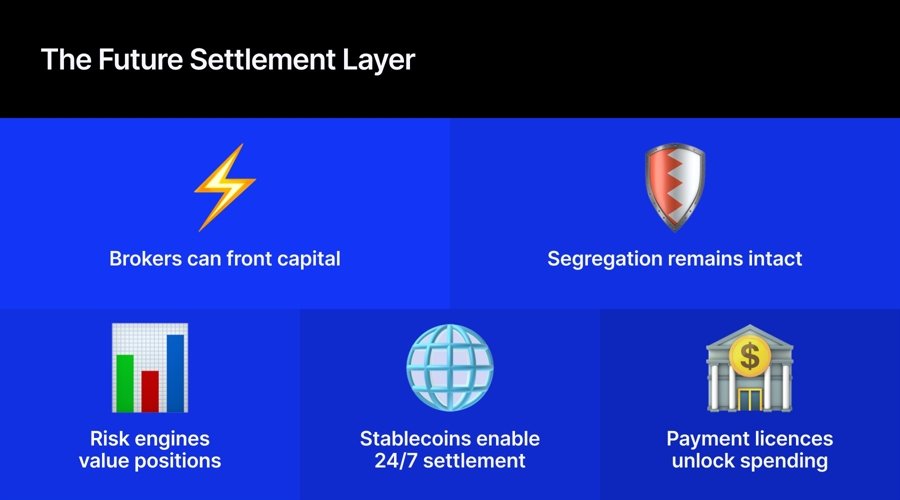
So the reward goes to whoever moves value instantly without
touching the wall. That means building a settlement layer on top of segregation
rather than through it.
The mechanics already exist in pieces. A firm that holds an
electronic money or banking permission alongside its brokerage permission
controls two legal pools of money. Client funds stay segregated inside the
investment firm. The spendable card balance sits in a separate safeguarded
account under the payments licence.
Related: CySEC Chair, “Honestly, No Matter What We Do, Scammers Will Find New Ways to Deceive Investors”
The firm settles between the two on its own
book, in real time, using its own capital as the bridge. The client sees an
instant transfer. Behind the glass, the firm has advanced its own money against
the client’s balance and squares the actual movement in the background, once
the rails catch up.
That advance is the whole game, and it is expensive. It demands
capital, because the firm carries the intraday float across thousands of
clients at once. It demands two licences working inside one company. It demands
a risk engine that knows, second by second, what each client is actually good
for.
The Winner Comes from the Trading Side
A broker already has that engine. It values open positions live
because the margin depends on it. At any moment on a Tuesday afternoon, a CFD firm
knows what your account is worth, what your exposure is, and how much it can
safely release.
It has been pricing that risk in real time for years. A bank
that bolted a trading tab onto a current account has none of this. It sees a
balance, not a live position. It cannot advance against something it cannot
value by the second.
That is why the winner will come from the trading side. The firm
that pulls this off will already live inside client money rules, already run a
live risk book, and will add a payments licence and a treasury deep enough to
front the float. It will look less like a bank that discovered trading and more
like a broker that grew up into a bank.
Stablecoins
make the picture sharper. Tokenised
settlement runs around the clock and ignores the banking calendar that causes
half the delay. A firm settling its internal bridge on tokenised rails removes
the weekend, the cutoff time, and the correspondent bank from the equation.
MiCA gave that path a rulebook in Europe, where a single currency stablecoin is
an electronic money token that only a bank or an electronic money institution
can issue. The brokers paying attention to it are not chasing a trading
product. They are eyeing the settlement layer.
None of this is a feature you ship in a sprint. It is a
licensing stack, a capital position, and a risk system that most firms will
look at and decide is someone else’s job. That reluctance is the opportunity.
The problems that sit unsolved for years are rarely the ones nobody noticed.
They are the ones everybody noticed, and nobody wanted to pay for.
The money is already there, sitting in accounts, earning the
holder nothing while it waits for a settlement window designed a decade ago.
Whoever frees it does not launch a better app. They become the rail every other
app has to run on.
So the real contest for the next ten years is not which company
adds the most icons to its home screen. It is which one will do the boring,
capital-heavy, licence-bound work underneath all of them. Who
wants the trillion badly enough to build the unglamorous part?
Every funded trading account on earth holds money that the owner
cannot spend today. Free that money the right way, and you do not launch a
better app. You become the rail every other app runs on.
Somewhere in a segregated account, your money is waiting. You
closed a position on Friday, filed a withdrawal, and the cash reaches your card
on Tuesday if the banking calendar behaves. Nobody in that chain is slacking.
The wait is the system doing its job.
Client money segregation is one of the better ideas in retail
finance. Under the FCA Client Assets Sourcebook in the United Kingdom and the
CySEC safeguarding rules across the EU, a broker keeps client funds in accounts
that sit apart from its own. If the firm collapses on a Monday, your balance is
still yours on Tuesday. Regulators built that protection after enough failures
buried enough clients. It should stay exactly where it is.
That same wall is why trillions sit frozen.
Add up every retail trading account balance on the planet. Every
funded account at every CFD broker, every crypto exchange balance, every margin
account waiting for a position to close. Most of it cannot be spent. It cannot
pay for lunch, cover rent, or move to another platform without a withdrawal
request, a settlement window, and a reconciliation cycle. The money exists. It
just cannot move at the speed the holder lives at.
The Card Is Not the Problem
Revolut solved the front of this problem and left the back
untouched. You can hold currencies, buy stocks, buy crypto, and spend from a
card in the same app, and since March 2026, it has done so as a fully licensed UK
bank.
What you still cannot do is take value out of a leveraged position and
put it on that card in the time it takes to reach a counter. eToro
added a card too, through its eToro Money arm,
and moves cash between your account and that card in seconds.
Try to settle a
live leveraged position into spendable money the moment you close it on Sunday,
and the wall reappears. The card is the easy part. The plumbing underneath it
is the prize.
Why the Wait Is Real
When you spend from a trading balance today, your money makes a
round trip. The broker instructs a payment out of the segregated pool. A
payment provider settles it. The funds land somewhere you can spend from.
Every
leg of that trip carries a reason for delay: bank settlement rails that close
on weekends, anti-money laundering checks, reconciliation against the omnibus
account, and the broker managing its own liquidity so that one client’s exit
does not strand another’s. None of it is optional. All of it takes time.
You cannot fix this by dissolving segregation. The protection is
the point. A firm that lets one client spend from the shared client pool while
another client’s money backs it has committed the oldest sin in the book.
Client money funds the client it belongs to and nobody else. Break that and you
are not building a superapp, you are building the next enforcement action.
The CySEC rulebook already saw this coming. Its safeguarding
circulars say that if a firm wants to credit a client’s account with immediate
effect, before the underlying funds have cleared, the firm must move an equal
amount of its own money into the client account first, and it can only do that
if it holds a licence to grant credit.
CySEC Chairman addressed the Digital Assets and the Future of Finance Summit, highlighting that cryptoassets and tokenisation are transforming financial markets, while the MiCA Regulation represents a landmark development in the global regulatory framework for financial markets pic.twitter.com/Z1yX9nr65j
— CySEC – Cyprus Securities and Exchange Commission (@CySEC_official) July 7, 2026
The regulator wrote the instant path
into the rules years ago. It just priced it in capital and permissions, which
is why almost nobody uses it.
So the reward goes to whoever moves value instantly without
touching the wall. That means building a settlement layer on top of segregation
rather than through it.
The mechanics already exist in pieces. A firm that holds an
electronic money or banking permission alongside its brokerage permission
controls two legal pools of money. Client funds stay segregated inside the
investment firm. The spendable card balance sits in a separate safeguarded
account under the payments licence.
Related: CySEC Chair, “Honestly, No Matter What We Do, Scammers Will Find New Ways to Deceive Investors”
The firm settles between the two on its own
book, in real time, using its own capital as the bridge. The client sees an
instant transfer. Behind the glass, the firm has advanced its own money against
the client’s balance and squares the actual movement in the background, once
the rails catch up.
That advance is the whole game, and it is expensive. It demands
capital, because the firm carries the intraday float across thousands of
clients at once. It demands two licences working inside one company. It demands
a risk engine that knows, second by second, what each client is actually good
for.
The Winner Comes from the Trading Side
A broker already has that engine. It values open positions live
because the margin depends on it. At any moment on a Tuesday afternoon, a CFD firm
knows what your account is worth, what your exposure is, and how much it can
safely release.
It has been pricing that risk in real time for years. A bank
that bolted a trading tab onto a current account has none of this. It sees a
balance, not a live position. It cannot advance against something it cannot
value by the second.
That is why the winner will come from the trading side. The firm
that pulls this off will already live inside client money rules, already run a
live risk book, and will add a payments licence and a treasury deep enough to
front the float. It will look less like a bank that discovered trading and more
like a broker that grew up into a bank.
Stablecoins
make the picture sharper. Tokenised
settlement runs around the clock and ignores the banking calendar that causes
half the delay. A firm settling its internal bridge on tokenised rails removes
the weekend, the cutoff time, and the correspondent bank from the equation.
MiCA gave that path a rulebook in Europe, where a single currency stablecoin is
an electronic money token that only a bank or an electronic money institution
can issue. The brokers paying attention to it are not chasing a trading
product. They are eyeing the settlement layer.
None of this is a feature you ship in a sprint. It is a
licensing stack, a capital position, and a risk system that most firms will
look at and decide is someone else’s job. That reluctance is the opportunity.
The problems that sit unsolved for years are rarely the ones nobody noticed.
They are the ones everybody noticed, and nobody wanted to pay for.
The money is already there, sitting in accounts, earning the
holder nothing while it waits for a settlement window designed a decade ago.
Whoever frees it does not launch a better app. They become the rail every other
app has to run on.
So the real contest for the next ten years is not which company
adds the most icons to its home screen. It is which one will do the boring,
capital-heavy, licence-bound work underneath all of them. Who
wants the trillion badly enough to build the unglamorous part?