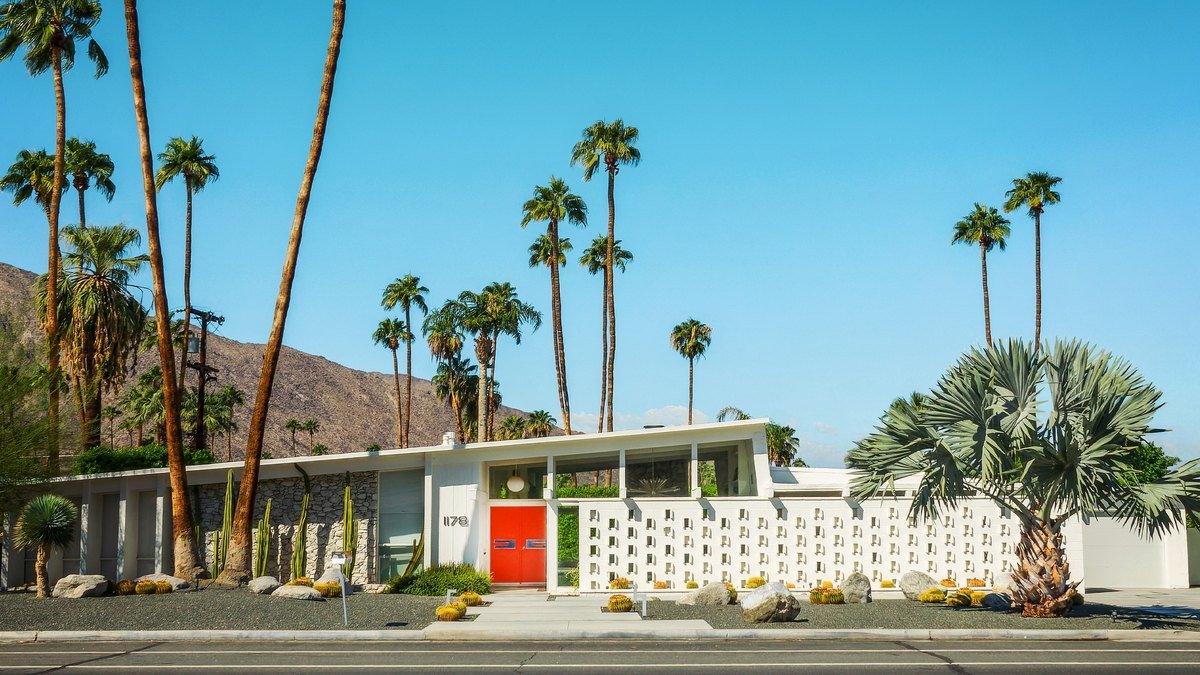
How the No-Frills Style of Midcentury Modern Homes Became High-End Gold
In architecture and home decor alike, midcentury modern design has unrivaled staying power.
Take a stroll through West Elm—or even Target—and you’re likely to stumble upon countless pieces that channel the characteristics of this impactful school of design. From low-profile seating constructed of sleek leather and stark metal to walnut sideboards boasting geometric patterns, the style has become fairly easy to spot, but difficult to define, as it continues its seemingly neverending climb in popularity.
The midcentury modern style was developed in the middle of the 20th century—from 1945 to 1969—as flourishing technology and the post-World War II housing boom sparked a philosophy that placed value on no-frills functionality and a clean aesthetic rooted in a connection to the natural world.
“Midcentury modern was about stripping away unnecessary ornament and really getting to the essence of a design gesture,” designer Jonathan Adler once told Architectural Digest.
“That clarity of vision is innately communicative and people love design that speaks to them. By stripping away the frills, the designer can communicate directly with the viewer, and communication is ultimately what good design is about,” he continued.
While midcentury modern design is highly favored for its versatility and ability to integrate with a range of styles, Adler noted another positive aspect that’s influenced its staying power.
“More than anything, I’m drawn to the vibe of optimism and the spirit of postwar possibility,” he said. “Optimism never goes out of style.”
True midcentury modern homes—particularly those that have retained their original design details—are becoming increasingly rare due to, at least in part, the soaring cost and scarcity of the distinctive wood used to build them.
Many of the wood products used extensively throughout these properties are no longer being manufactured, according to Luke Zale, general manager of Rare Woods USA, who previously told Realtor.com® that homeowners seeking to replace midcentury modern features with like-for-like products could find themselves facing a tricky challenge.
“A lot of the difficulty with these projects comes down to the fact that people aren’t just looking for ‘mahogany’ or ‘redwood,'” he said. “They’re looking for the same material that was used 50, 60, or 70 years ago, and that’s a very different proposition.”
Today, midcentury modern design can be seen in homes across the world, as well as in seminal landmarks such as the TWA Hotel at Kennedy Airport or the Guggenheim Museum. Read on to discover how a postwar housing solution grew into a highly sought-after look that’s not going away anytime soon.
What are the most distinctive features of a midcentury modern home?
Above all, midcentury modern architecture takes a utilitarian approach to design, aiming to construct spaces defined by functionality.
Built-in storage and an emphasis on clean lines helps prevent clutter, creating an overall sense of peace and calm while open-concept layouts promote connection between family members.
This popular architecture style also values a connection to nature. Expansive floor-to-ceiling windows and areas that bridge the interior to the outdoors encourage residents to use the entire property as living space, instead of just staying inside.
It’s also common for midcentury modern design to take the surrounding environment into consideration rather than working against it.
Two iconic examples of this principle are the homes department store mogul Edgar J. Kaufmann commissioned: the Kaufmann Desert House designed by Richard Neutra in Palm Springs, CA, and Frank Lloyd Wright’s Fallingwater in Mill Run, PA. Although, with its 1939 completion, the latter was technically erected too early to truly belong to the midcentury modern school of architecture.
Still, it’s considered a major influence on the movement, with its sleek stone design atop a waterfall.
Natural materials are typically contrasted against more industrial choices. For example, organic pieces such as wood, stone, or glass can be used to warm up the industrial effect of steel.
Midcentury modern homes tend to be ranch style or feature split-level layouts.
When was the first midcentury modern home designed?
The origins of some architectural movements are easy to pinpoint—such as Buckminster Fuller’s 1954 creation of the geodesic dome home or the very first Sears, Roebuck and Co. catalog house, released in 1908.
The lines blur a bit with midcentury modern homes. Many architects and designers contributed to the movement—which was not officially named until art historian Cara Greenberg’s 1984 book, “Mid-Century Modern: Furniture of the 1950s.” Similar terminology had gained popularity in the 1950s.
Along with Wright and Neutra, notable architects of the movement include Philip Johnson, John Lautner, and Rudolph Schindler. Their works through the 1940s and 1950s remain some of the most impactful architectural examples of midcentury modern design, and have stood the test of time while inspiring countless others through history.
Where are the best places to find midcentury modern homes?
If the phrase “midcentury modern” immediately conjures up visuals of colorful Palm Springs dwellings, it’s for good reason. According to Joybird, the desert destination is home to the highest number of midcentury modern builds per capita.
With that said, the style’s influence can be felt all over. These homes can be found across the country, but homebuyers in Memphis, TN, San Francisco, and Denver will also come across a higher percentage of midcentury modern residences.
Locations such as Arizona, with climates that encourage indoor-outdoor living, are also popular midcentury modern destinations.
How have midcentury modern homes changed over the years?
While the visual identity of midcentury modern design has evolved to span several design styles, the movement has maintained its core values over time.
In fact, many original builds have been well-maintained and boast price tags that have significantly soared in recent years, especially if the property has an interesting history.
For example, the Solt House—a historically significant property in Stockton, NJ, with ties to the White House—was recently listed for $2.1 million, a whopping 291% price increase from its 2023 sale.
The Solt House still holds its architectural integrity, but has been updated with modern functionality such as a new HVAC system, new kitchen appliances, and an improved roof.
The movement’s bet on unfussy—yet still striking—design has certainly paid off. The look of midcentury modern design is as desired as ever, with investments proving their ability to retain—and in many cases, appreciate—value over time.
Why do people buy midcentury modern homes?
With a design style that’s become timeless, midcentury modern homes are an excellent choice for homebuyers looking for original charm that will age well.
Plenty of A-listers opt for midcentury modern dwellings. But, of course, this architecture isn’t just reserved for the likes of Dakota Johnson and Jon Hamm. Originally intended for America’s middle class, these homes can still be obtained by anyone drawn to the style’s open floor plans, massive windows, and gorgeous sleek lines.
Get real estate news in your inbox