Carriage horse ban could unlock prime Far West Side sites
Central Park’s iconic carriage horse industry may soon be put out to pasture as the City Council nears a final vote on legislation that appears poised to pass. When those hardworking steeds aren’t pulling visitors through the park, they spend their downtime in Manhattan’s few remaining stables, which sit on prime lots across the Far West Side.
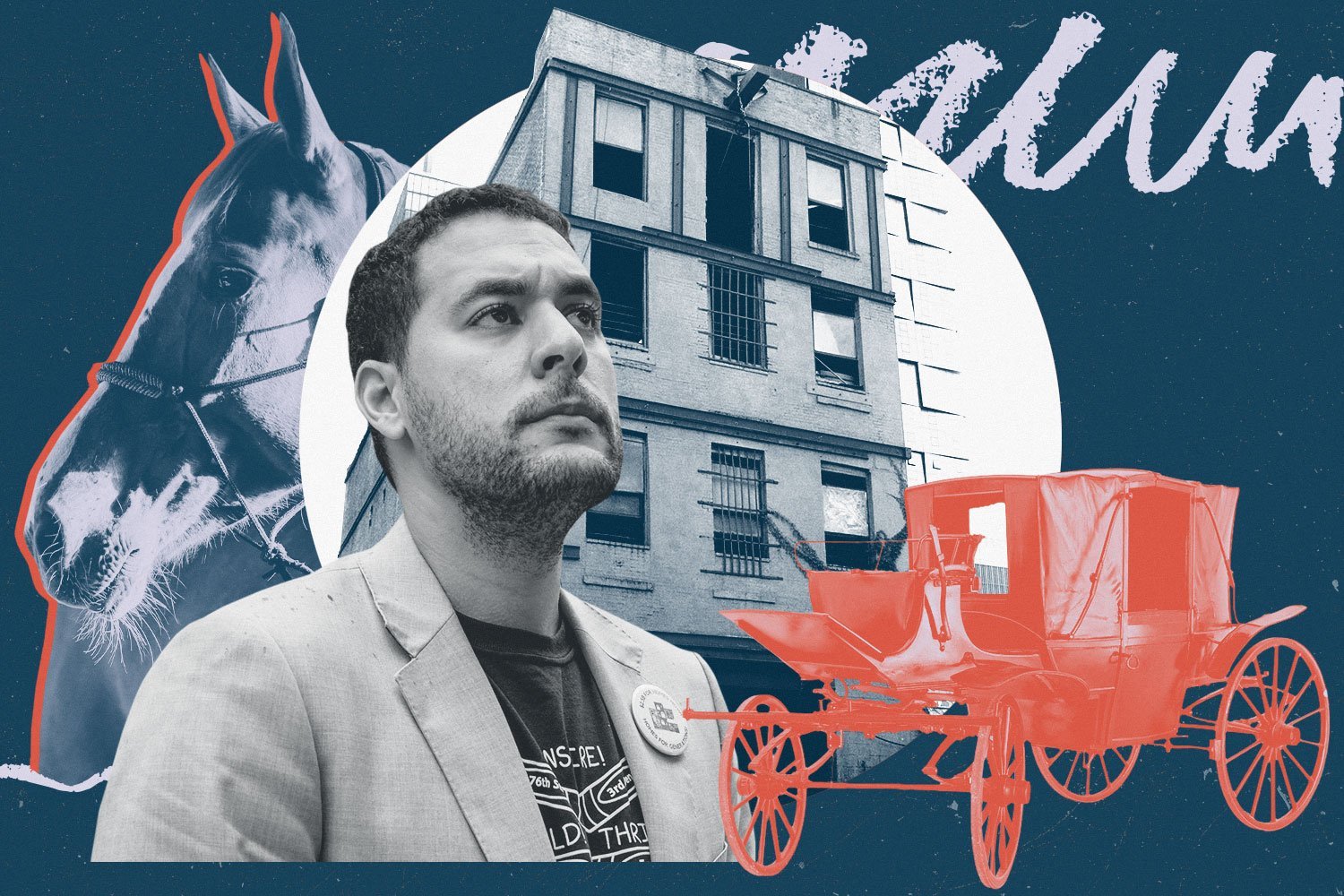
Two stables sit a stone’s throw from the high-rises of Hudson Yards on West 37th and 38th Streets, while a third remains on 52nd Street. The West Side Livery Stable on 38th Street, connected with Central Park Carriages on 37th Street, sits on an otherwise empty lot, housing horses. The aging four-story stable buildings, outfitted with ramps for the horses, resemble tenement buildings once common throughout the city.
The stables stick out among the sleek residential towers and the luxury mall that Related Companies built atop the rail yard in the past decade, and the sunset of the carriage horse industry could open up lucrative development opportunities. But stable owners are determined to stay put after decades of holding out. Some carriage owners and drivers allege that the push to end the industry is motivated by more than animal rights, pointing to the real estate background of one advocacy group’s founder and president, former Edison Properties CEO Steve Nislick.
‘Miscarriage of justice’
The bill, dubbed Romanch’s Law and named for an 18-year-old tourist who died in a horse carriage accident in June, has more than enough votes to pass. The policy introduced by Council member Chris Marte has garnered support from high-profile figures including Speaker Julie Menin, Mayor Zohran Mamdani and at least 28 co-sponsors.
It’s the latest in a long saga of legislation introduced over the years aiming to end the Central Park carriage horse industry, whose approximately 300 drivers and owners are unionized under the city’s powerful Transport Workers Union that also represents MTA staff.
Animal rights nonprofit New Yorkers for Clean, Livable and Safe Streets, or NYCLASS, founded in 2008 by Nislick, has thrown its support behind the bill and made banning carriage horses its key advocacy issue.
NYCLASS didn’t immediately respond to a request for comment.
The land that the stables sit on has been a natural target for developers interested in cobbling together an assemblage to accommodate another high-rise more suited to the new scale of the surrounding neighborhood.
“The real estate that the carriages hold is extraordinarily valuable, and the amount of effort to obtain that real estate knows no bounds,” carriage driver Dave Cook said during testimony at a 10-hour Council hearing on the bill in July. “You look to the left and there’s our stables, 38th Street, but you continue to gaze to the left and there is the hood ornament of Hudson Yards, the Vessel, two blocks south of there. There is no more precise definition of what is going on with the carriages.”
The land between the two Hudson Yards stables is owned by Mack Real Estate Group, which obtained the lot at 545 West 37th Street this year from Chetrit Group in a $94 million title transfer after the embattled former owner defaulted on an $85 million loan from Mack’s credit arm.
Chetrit paid $26.5 million for the site in 2012 and had planned a 131-room, 373,000-square-foot hotel on the site, but construction never moved forward. During the 2014 demolition of four low-rise commercial buildings to make way for the development, the stables required the developer to install costly steel bracing to prevent their potential collapse.
A Mack spokesperson declined to comment on its plans for the site, or whether it has made any offers to the neighboring stables’ owners. Nearby construction could disrupt the stables’ day-to-day operations. And if the Council phases out the carriage business, owners would need to find new uses for their properties, or consider selling.
Cook also noted how many buildings surrounding West Side Livery Stable are boarded up and ready for demolition.
Carriage owner, driver and stable manager Connor McHugh, one of 15 co-owners of Clinton Park Stables on 52nd Street, alleged that real estate market forces are pushing to ban the industry so developers can purchase the land. He considers the bill a “miscarriage of justice” for the carriage drivers and stable owners.
“We bought our land because we wanted it and we needed it, and we didn’t buy it to sell it. That is rubbing a lot of people the wrong way nowadays, especially since the whole rezoning took place. Our mission is not to give up our land, ever! ” he said during his testimony. “The day you sell your land is the day you are finished.”
Cornelius Byrne, who owns Central Park Carriages on 37th Street, also testified before the Council. He declined to comment or confirm any plans to sell.
“There’s livelihoods involved here for these people, and there’s the lives of the horses, too,” he said. “Let’s keep them alive, because you’re going to ruin both if you pass this legislation.”
After Romanch’s Law
Passing the bill would kick off a two-year process to wind down the industry, starting with an immediate halt to issuing new carriage medallions and horse driver licenses, and ending with a full ban starting on June 1, 2028. The legislation also includes a requirement that the city’s Department of Consumer and Worker Protection help drivers and industry workers transition to new fields during that period.
“That doesn’t mean the stables or those buildings have to change, there’s a number of things you can do with them, but I think that’s a longer land use discussion,” Marte said.
The family that formerly ran Chateau Stables at 607 West 48th Street sold the building for $4.6 million in 2022, four years after owner Gloria McGill put it on the market upon retiring. The transaction offers a potential preview of what could happen to remaining stable owners willing to entertain offers as legislation puts pressure on their business model. Anita McGill, who ran the stable with her parents, cited high operating costs when the property was sold in 2018. This month, she came out in support of the bill, penning an opinion piece in City & State. She now operates Chateau Farms in East Earl, Pennsylvania, which provides ponies for parties and events.
If the Hudson Yards stable owners decide to take a page from the McGills’ playbook, they would likely be in for a sizable payday. Or they could opt to keep control of the buildings and find a way to convert them for new purposes after the carriage horse industry phases out.
“Make a museum out of it, or tourist attraction, I think there’s a lot of different ideas,” Marte said. “A lot of the owners of the stables are still publicly against the legislation, and I think they’re not willing to give in or discuss what future plans are as long as the legislation is still pending.”
The exact market value of the properties will only be clear if they are put on the market, according to Bob Knakal, a commercial broker who is the exclusive agent for four parcels in the same two-block radius that the stables occupy.
“If the horse-drawn carriages are no longer allowed in New York, then that is probably no longer the highest and best use of those buildings,” he said. “The market in Hudson Yards has been so robust that the highest and best use could be for residential, could be for an office, could be for a hotel.”
Read more

Mack takes Hudson Yards site from Chetrit in $94M title transfer

Former Edison Properties boss pushed real estate agenda with mayor

Whoa, Nelly! West Side horse stables could fetch up to $70M