Luxury homes up 9-fold, flats below Rs 1.5 cr fall from 85% to 47% in 4 yrs | Personal Finance
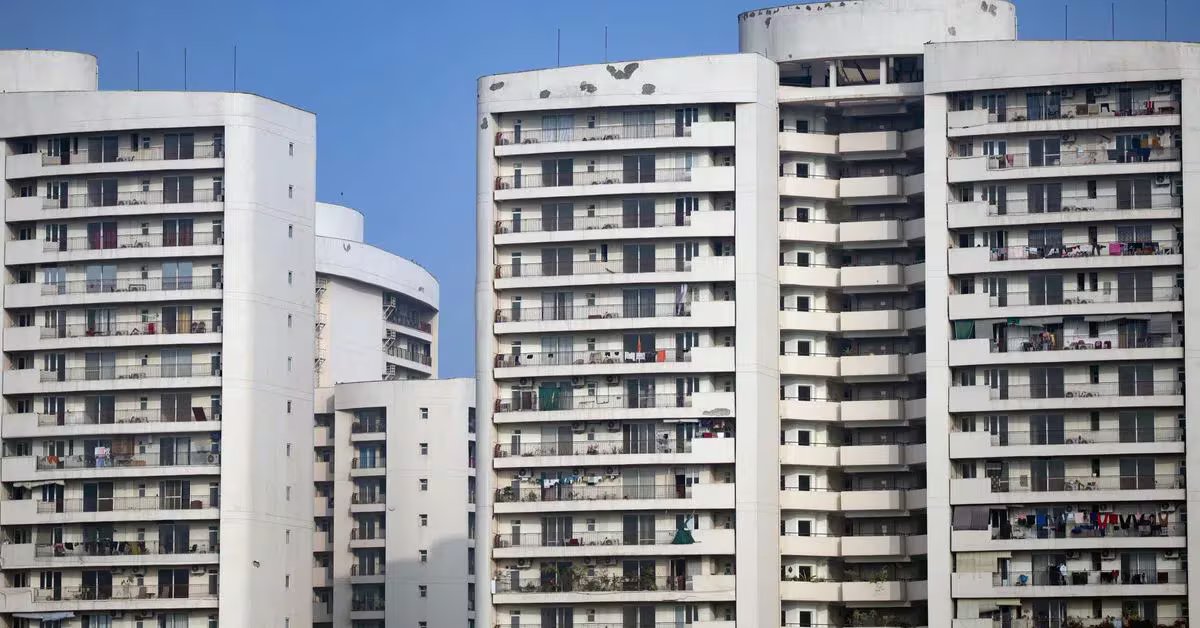
India’s residential real estate market is undergoing a structural shift towards premium and luxury housing, even as overall housing sales moderate across several major cities, according to CareEdge Ratings.
Homes priced below Rs 1.5 crore accounted for 85% of new launches across the top seven cities in Q1 2022. Their share fell to 57% in Q1 2025 and further to just 47% in Q1 2026. At the same time, the Rs 1.5-4 crore segment expanded from 14% of launches in Q1 2022 to 44% in Q1 2026, while homes priced above Rs 4 crore increased their share from just 1% to 9%.
The trend comes alongside a significant strengthening of developers’ balance sheets, with the debt-to-collections ratio of leading residential developers falling to a record low of 0.68 times in FY26 from 1.80 times in FY20.
“This shift reflects developers’ increasing focus on mid-premium and luxury housing, driven by customer preferences and rising land acquisition, construction and compliance costs that have impacted the viability of affordable housing projects. At the same time, sustained demand from affluent domestic buyers and NRIs, coupled with a preference for larger homes with premium amenities, has encouraged developers to allocate a greater share of new supply toward the luxury/ultra-luxury segments,” said Rajashree Murkute, Senior Director, CareEdge Ratings.
Since 2022, India’s residential real estate market has witnessed a structural shift in demand toward premium and luxury housing, widening the divide from the affordable segment. Housing sales across the top seven cities declined by a low single-digit percentage in Q1 2026 compared with Q1 2025. However, demand trends varied significantly across segments. While the premium and luxury segments remained resilient, supported by affluent homebuyers and relatively lower sensitivity to inflation, demand in the affordable and middle-income segments softened amid inflationary pressures, elevated property prices and affordability constraints.
Developer balance sheets strengthen
The debt-to-collections ratio has declined sharply from 1.80 times in FY20 to 0.68 times in FY26, reflecting sustained deleveraging across leading market players.
The chart above shows the debt-to-collections ratio for the top 13 residential developers falling steadily from 1.80 times in FY20 to 1.93 times in FY21, before declining to 1.01 times in FY22, 0.79 times in FY23, 0.81 times in FY24, 0.70 times in FY25 and 0.68 times in FY26.
CareEdge said the improvement has been driven by healthy collections, fundraising-led deleveraging and greater financial discipline. Collections from sizeable launches crossed Rs 90,000 crore in FY26, while bookings exceeded Rs 1.5 lakh crore. With debt remaining broadly range-bound, the improvement in collections has strengthened the financial cushion available to leading developers.
Housing demand increasingly diverges by city
Chennai: Housing sales rose 9%, the strongest growth among the top cities.
Housing sales in Q1 2026 fell 11% year-on-year in both Pune and Delhi-NCR, while Mumbai Metropolitan Region (MMR) recorded a 7% decline. In contrast, Chennai registered the strongest growth at 9%, followed by Bengaluru at 5% and Hyderabad at 1%. Kolkata and Ahmedabad recorded growth of 5% and 2%, respectively.
The weakness in Pune, Delhi-NCR and MMR reflects affordability pressures following sustained price appreciation, normalisation after a strong multi-year housing upcycle and cautious buyer sentiment amid geopolitical and financial-market uncertainty.
Southern markets have proved more resilient, supported by steady end-user demand, employment-linked housing requirements and new project activity. Kolkata and Ahmedabad have also benefited from comparatively affordable pricing and stable local demand.
City-wise housing sales: Q1 2026 YoY
-
Chennai: Housing sales rose 9%, the strongest growth among the top cities. -
Bengaluru: Sales increased 5%, supported by steady end-user demand. -
Kolkata: Housing sales grew 5%. -
Ahmedabad: Sales increased 2%, helped by comparatively affordable pricing. -
Hyderabad: Sales edged up 1%. -
Mumbai (MMR): Sales declined 7%, reflecting affordability pressures after sustained price appreciation. -
Delhi-NCR: Sales fell 11%, among the steepest declines. -
Pune: Sales also dropped 11%, the sharpest decline alongside Delhi-NC