62% of Financially Improving Households Have a Savings Cushi…
As today’s consumer confidence reading from The Conference Board shows, metrics can be complicated. They may be holding in a narrow range, but household finances are moving in a less stable direction.
The August 2026 PYMNTS Consumer Expectations Index (PCEI) finds that the overall index slipped 0.8 points to 54.8, still within the 53-to-57 band it has occupied for 11 straight months. Underneath that relative stability, however, more households report losing financial ground than gaining it. Nineteen percent say their financial lifestyle got worse over the past 12 months, compared with 7.1% who say it improved.

We’d love to be your preferred source for news.
Please add us to your preferred sources list so our news, data and interviews show up in your feed. Thanks!
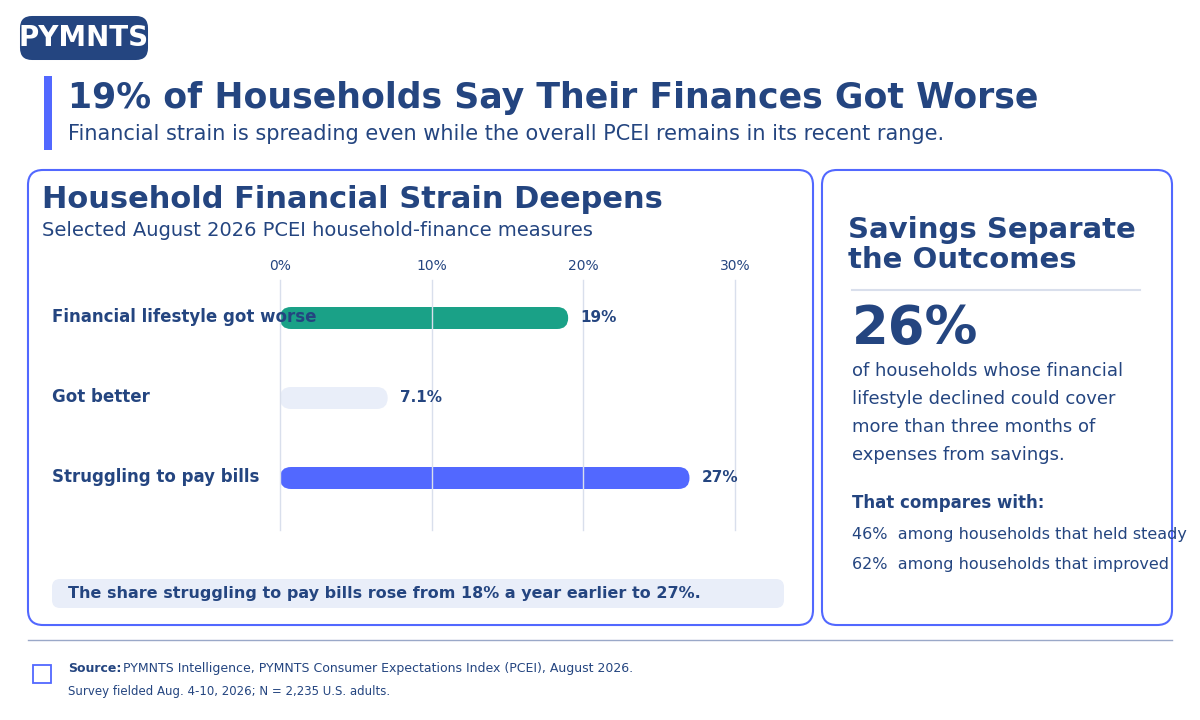
- Financial deterioration is outpacing improvement. Households were 2.7 times as likely to say their financial lifestyle worsened as improved over the past year. The imbalance matters because the headline index can remain relatively steady even while more families move into financial difficulty.
- More households are struggling to pay bills. The share of households living paycheck to paycheck and struggling to pay bills rose to 27% from 18% a year earlier. Meanwhile, the share not living paycheck to paycheck fell to 33% from 38%. Only 5.2% of households that were struggling a year ago had moved completely out of paycheck-to-paycheck living by August.
- Savings are a dividing line when finances deteriorate. Among households whose financial lifestyle declined, 26% had enough savings to cover more than three months of expenses if income stopped. That compares with 46% of households whose financial lifestyle held steady and 62% of those whose finances improved. The report also finds that 66% of households that fell into difficulty had drained their savings or had none in the prior 90 days.
The pressure is not explained by prices alone. Among households whose bills became harder to pay, 71% of those whose financial lifestyle worsened and 76% of those whose lifestyle stayed the same cited essentials rising faster than income. Income loss and unexpected expenses were more distinguishing: 33% of households whose financial lifestyle declined said household income fell, versus 21% of those that held steady, while 36% cited a large, unexpected expense, compared with 23% of households that stayed stable.
The August results point to a gap between how consumers view the economy and how securely they are managing their own finances. Labor-market confidence improved, particularly among consumers under the most financial pressure, but stronger job security did not prevent household finances, debt manageability and buying conditions from weakening during the month.
At PYMNTS Intelligence, we work with businesses to uncover insights that fuel intelligent, data-driven discussions on changing customer expectations, a more connected economy and the strategic shifts necessary to achieve outcomes. With rigorous research methodologies and unwavering commitment to objective quality, we offer trusted data to grow your business. As our partner, you’ll have access to our diverse team of PhDs, researchers, data analysts, number crunchers, subject matter veterans and editorial experts.