Mapped: Where Mortgage Holders Are Seriously Underwater
The share of seriously underwater homes is up half a percentage point from last year, and in states such as Minnesota, South Dakota, Iowa, Michigan, and the District of Columbia, it’s risen dramatically.
That’s according to the latest report from real estate analytics firm ATTOM, which found that 3.2% of mortgages were considered underwater in the second quarter of this year, up from 2.7% last year.
Underwater mortgages are mortgages in which a homeowner’s debt on the home exceeds a home’s market value by 25% or more. Having an underwater mortgage creates negative home equity and often makes it impossible to refinance or sell without losing money. An underwater mortgage effectively hobbles a homeowner’s mobility.
And while 3.2% of the housing market may not seem like a concerningly high number, that equates to between 1 million and 2 million homes. This has a knock-on effect on the housing market, limiting inventory.
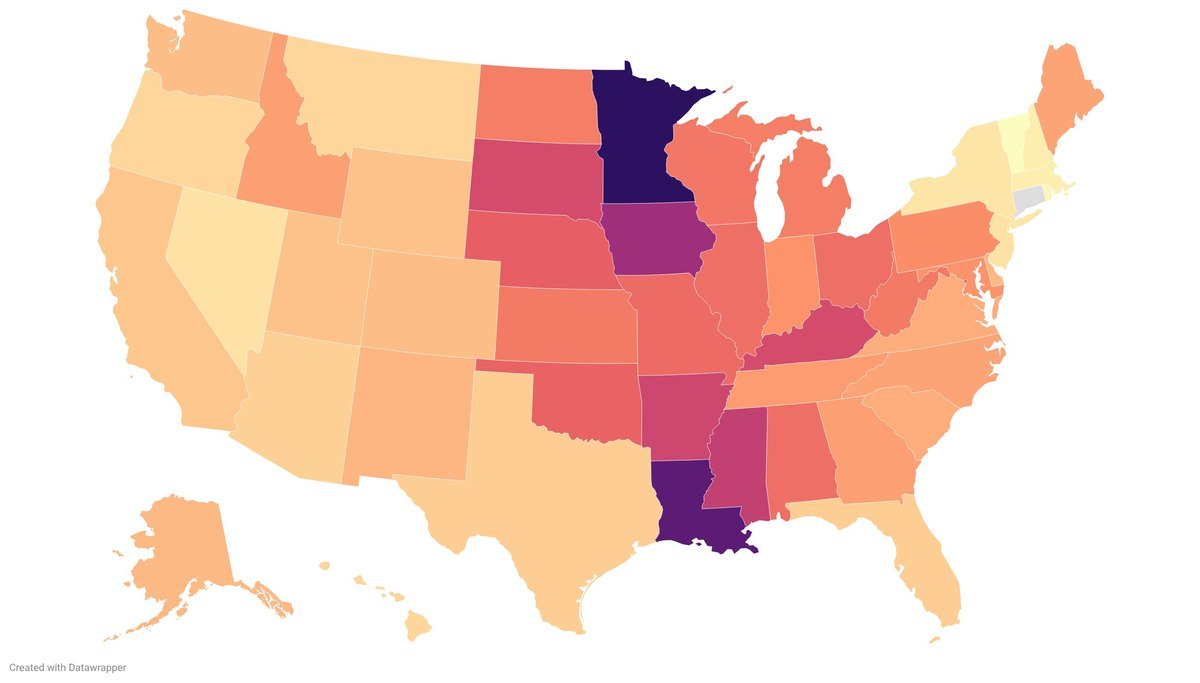
According to ATTOM’s report, the states that saw the biggest annual increase in underwater mortgage rates were Minnesota (12.1% of homes seriously underwater, up from 2.6% a year ago), South Dakota (to 5.7% from 3.1%), Iowa (to 7.8% from 5.9%), Michigan (to 4% from 2.5%), and the District of Columbia (to 5% from 3.7%).
Meanwhile, these states saw the biggest decreases: Louisiana (down to 10.3% from 11.9%), Kentucky (to 5.7% from 7%), North Dakota (to 4% from 5%), Oklahoma (to 4.7% from 5.6%), and New York (to 1.5% from 2%).
Overall, Minnesota (12.1%), Louisiana (10.3 %), Iowa (7.8%), Mississippi (6.4%), and Arkansas (6%) had the highest share of underwater mortgages this past quarter.
“Underwater mortgages have typically been concentrated in the climate-exposed Gulf and coastal states, and those actually improved this cycle,” says mortgage researcher Mujahid Merchant. “Across the country, the common characteristic of states with large underwater concentrations is a prevalence of low-equity-at-origination mortgages that originated in 2022 or later, reflecting both a late-cycle purchase and down-payment compression.”
As interest rates crept back up after the historic lows at the beginning of the COVID-19 pandemic, homeowners offset increasing rates by taking advantage of FHA loans, which allow buyers to put as little as 3.5% down.
“For coastal markets that saw steep appreciation, this created little issue; subsequent rapid price growth offset the low initial equity,” Merchant continues. But that hasn’t been the case for Midwestern states, which have seen much lower appreciation.
Minneapolis exploded in popularity in fall 2022, climbing 92 spots to rank among the Realtor.com hottest metros in October 2022, followed closely behind by Milwaukee.
“Recent buyers there typically purchased near the peak with little down, then saw flat to slightly lower prices, creating significant underwater risk,” Merchant explains. “And because the buying spike is recent, that underwater cohort is large as a share of total mortgages.”
Cameron Walker, a real estate expert and manager at Clever Real Estate, says states with rising underwater mortgages share several characteristics.
“In the last couple of years, price growth in the Upper Midwest has been very slow, while price growth in the coastal and Southern states has been rapid. Homebuyers who purchased in 2022, 2023, or 2024 will see little to no price appreciation when a high loan balance depletes their equity.”
In the past year, average home prices in Minneapolis increased by less than 1%, while in 2021, they rose by nearly 14%.
When it comes to Minneapolis, in particular, Walker says that the city has “a soft local market” compared to cities of comparable size. It’s also seen a meaningful share of FHA loans in recent years.
“A buyer who put down 5% in a market that has since flattened has almost no cushion, and few local market price dips would put that buyer underwater. This combination of thin down payments and a slower local market is much more significant than current mortgage rates.”
South Dakota, Iowa, and Michigan have similar market conditions, says Walker.
“These markets did not have the price run-ups like the coastal metros, which leaves less home equity, and therefore less absorption for the potential market softening.”
Walker advises underwater homeowners not to panic.
“It only becomes a concern when you need to sell, or refinance, or take money out of your house,” he says. “The best option usually is to stay in the house and pay down the loan. Best case, you stay in your home and recoup money later. If a move is probable, it would be a good idea to contact local agents to find out what your home is worth now.”